Paradox is for the recruiter who has become an unpaid air-traffic controller. The gate is a calendar. The planes are candidates, hiring managers, panel interviews, reminders, reschedules, background checks, and the person who replies “any time Tuesday” without saying which time zone. Olivia, Paradox’s conversational AI assistant, takes that traffic and turns it into a chat. A candidate can find a role, answer qualifying questions, pick an interview slot, receive an offer, and complete onboarding from a phone. The proposition is plain: let software handle the queue so people can handle the judgment.
That makes Paradox most interesting for employers where recruiting is closer to operations than courtship. Think restaurants opening dozens of stores, health systems filling shifts, retailers staffing a holiday season, manufacturers with multiple sites, or a franchise network whose managers should be serving customers rather than wrestling an applicant tracking system. A three-person design studio will struggle to justify it. A company with thousands of openings, many locations, and candidates who live on their phones can see the point before the demo ends.
Scale note: These are Paradox’s reported figures. The company said it served nearly 1,000 clients in February 2025 and handled interactions in more than 30 languages during 2024.
Who should put Olivia to work?
Buyers should begin with a bottleneck, not with the initials A and I. If qualified applicants wait two days for a reply, managers spend evenings coordinating calendars, or candidates abandon a fifteen-page application, Paradox has a concrete job. It is particularly suited to repeatable hiring flows with clear minimum qualifications. “Are you at least 18?” “Can you work Saturday?” “Do you hold the required license?” Those questions translate neatly into a conversation and a routing rule.
It also fits enterprises that want to keep an existing HR system. Paradox lists connections to Workday, SAP SuccessFactors, calendars, assessment vendors, payroll systems, and video platforms. Its assistant can sit on top of that machinery as the candidate-facing layer. Since Workday completed its acquisition of Paradox in October 2025, the official name to watch is the Workday Paradox Candidate Experience Agent. The older name, Olivia, remains the one candidates are likely to recognize.
The journey, minus the login maze
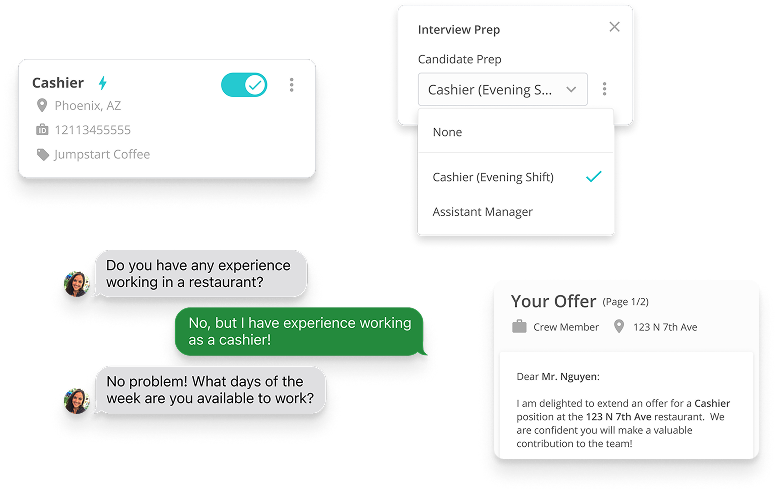
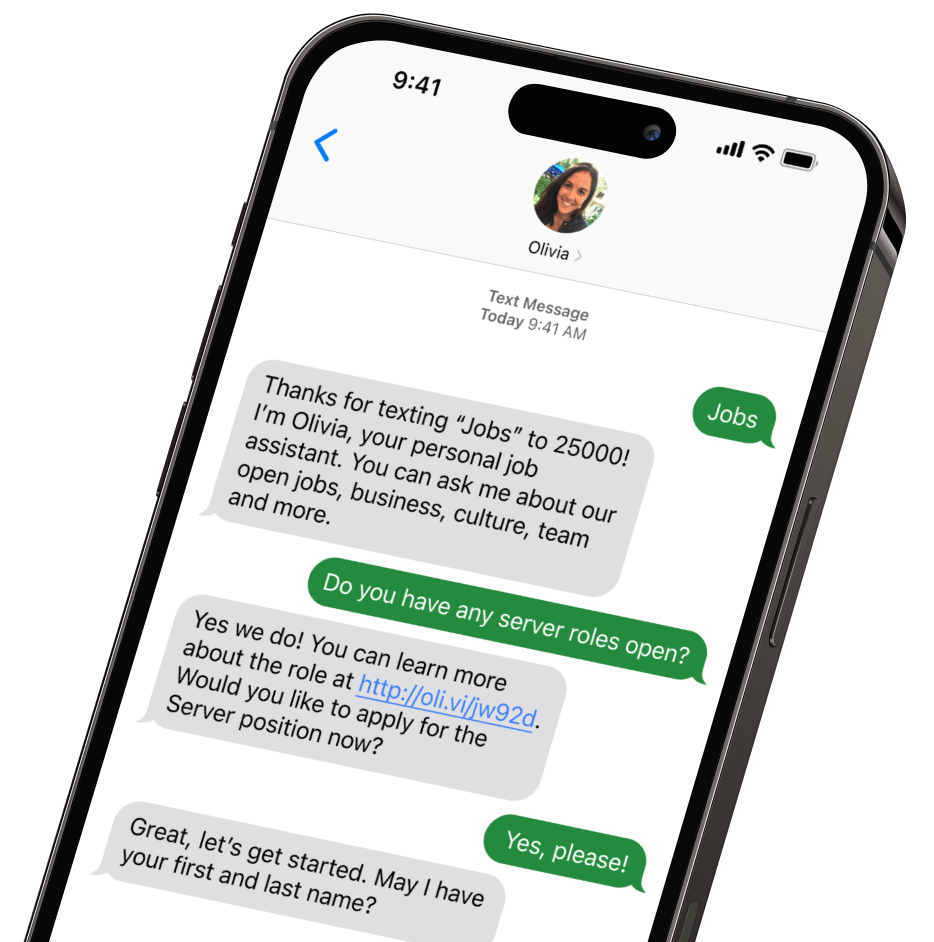
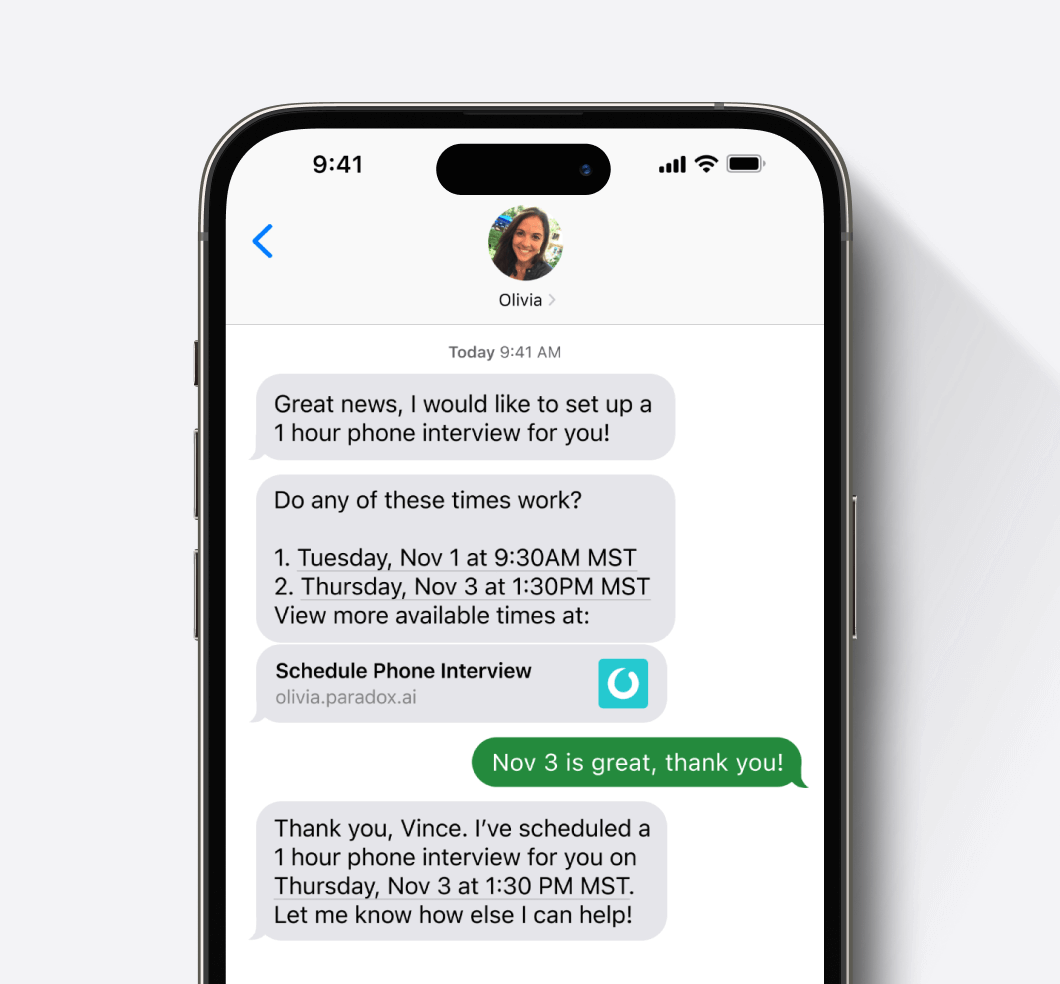
A candidate might see a QR code in a shop window, text a keyword, and begin the application in SMS. Olivia asks what kind of work they want and where, shows matching jobs, gathers basic information, and checks required qualifications. A qualified person receives available times from connected calendars. The confirmation and reminders arrive in the same thread. Depending on the employer’s setup, Paradox can then collect a recorded video response, send an offer, gather forms, and ask for feedback.
Recruiters get another side of the exchange. Olivia can coordinate one-to-one, panel, sequential, multi-location, virtual, or in-person interviews. It handles cancellations and reminders, then writes status changes back to the connected system. Paradox says conversational scheduling is trusted for more than 30 million interviews annually on its current product page. Its mobile apps are restricted to clients, while candidates mainly meet the product through web chat, text, WhatsApp, Facebook messaging, or an employer’s career site.
What it does well
Speed is the obvious advantage, but continuity may be the better one. Candidates do not have to wonder whether an application fell into a silent database. The assistant responds at midnight, remembers where the exchange stopped, and offers a next action. For recruiters, the repetitive work disappears without requiring candidates to learn another piece of software. Paradox’s key design decision is treating conversation as the interface, not adding a chat widget to a form and calling the job finished.
“It has been very time-saving and cuts down on back-and-forth communication between job candidates and recruiters.”A mid-market reviewer on G2, September 2023
The product is broad enough to become the hiring system itself. Conversational ATS covers job and candidate management, offers, pre-boarding, and onboarding. CRM tools rediscover previous applicants and build campaigns. Events manage registration and reminders. Surveys collect reactions from candidates and hiring managers in the moment. The 2025 Immersive Job Preview adds AI-assisted scripts, storyboards, videos, and interactive Q&A so applicants can see the less photogenic truth of a role before accepting it.
| Need | Paradox move | What to test in a pilot |
|---|---|---|
| Too many abandoned applications | Conversational apply by chat or SMS | Completion rate by source, role, language, and device |
| Calendar ping-pong | Automated scheduling, rescheduling, and reminders | Time to schedule, no-shows, exceptions requiring a human |
| Applicants choose the wrong role | Job matching and Immersive Job Preview | Thirty-day turnover and applicant-to-interview quality |
| Managers ignore the ATS | Mobile-first prompts and simple workflows | Manager response time and status accuracy |
Where the bubbles burst
Automation is a multiplier, including for mistakes. If a requisition is stale, a manager’s calendar is wrong, or a location has quietly stopped hiring, Olivia can confidently schedule a candidate into nonsense. Job seekers on Reddit describe arriving for interviews only to hear that the employer was not hiring, or receiving repeated prompts after a human interview had already happened. Those stories do not prove the software failed by itself. They show that a conversational front end cannot repair neglected data and loose handoffs.
The conversation can also misunderstand. One 2026 G2 reviewer said Paradox was useful for scheduling and paperwork but “not very intuitive in conversations,” citing an answer placed in the wrong application field. Another reviewer liked the time savings but warned that recruiters could rely on the technology too heavily and lose the personal touch. This is the core buying tension: efficiency improves when the path is standardized, while unusual candidates and unusual answers are exactly where a rigid path needs an escape hatch.
Candidates need a small field guide of their own. An Olivia message may be a legitimate part of an employer’s process, but the employer should still be identifiable and the role should match one you applied for. Paradox warns that its own recruiters will never request credit-card or bank-account details during recruitment. If a question is ambiguous, ask for clarification instead of guessing what a screening rule wants. Save the confirmation, check whether the meeting is phone, video, or in person, and use the employer’s published careers page when anything feels off. The assistant may arrange the interview; the hiring company remains responsible for it.
Green flags
- Thousands of similar openings or many locations
- Clear screening rules and reliable calendars
- Large drop-off between click, apply, and interview
- An existing ATS that needs a friendlier front door
Red flags
- Low hiring volume or highly bespoke searches
- Requisitions and manager availability are often stale
- No owner for conversation design and exceptions
- A team hoping automation will replace candidate care
Price the plumbing, not the faucet
Paradox does not publish official plans. Sales begins with a demo and a custom quote. Capterra currently displays a $1,000-per-month basic starting figure, while its reviewers rate the perceived cost at the expensive end. Treat that number as a rough entry marker only. The real bill will follow hiring volume, locations, modules, languages, integrations, implementation, and support. A global rollout of a conversational ATS is not meaningfully comparable to adding standalone scheduling for one recruiting team.
The buying case should count more than recruiter hours. Measure application completion, time from qualified screen to booked interview, no-show rate, manager response time, advertising cost per completed application, and early attrition. Establish the baseline before implementation. Then run a limited pilot across roles with enough volume to create a trustworthy sample. A vendor case study is useful for possibility; your own funnel is useful for a purchase order.
Contract question worth asking: Who owns the conversation copy, what happens when the assistant is uncertain, how quickly can your team pause a broken workflow, and how are SMS, implementation, integration, and renewal costs separated?
The verdict
Paradox is good at the boring work that quietly ruins hiring: waiting, chasing, copying, reminding, and rescheduling. Its interface makes sense for people applying between shifts on a phone, and its range makes sense for enterprises tired of stitching together a chatbot, scheduler, event tool, video tool, and ATS. Workday’s ownership gives it a larger platform and a clearer enterprise home, though buyers outside Workday should verify the future of every integration they need.
The product is less convincing as a cure for recruiting culture. It cannot make a dormant opening real, persuade a distracted manager to show up, or turn a confusing policy into a kind answer. The employers who benefit will treat Olivia like an extremely fast coordinator with carefully defined authority, regular quality checks, and a visible route to a person. Give her clean calendars and honest jobs, and the text bubble earns its place. Give her organizational clutter, and she will deliver that clutter at machine speed.