The applicant is looking at a drawing of a metal retainer. There are dimensions, cross-sections, tolerances, and a question about the width of a rib. Nobody has asked for an elegantly arranged account of the applicant’s career. The little drawing, published as an example by HRMC, makes a wonderfully impolite suggestion: perhaps the person who can read the blueprint should get a chance before the person who can decorate a resume.
- What it does: Acclaim combines early screening, assessments, communication, and interview scheduling.
- Who it suits: employers with repeated hiring needs and job criteria they can define.
- The distinguishing move: a resume is optional; a relevant demonstration of ability can come first.
HRMC, short for Human Resource Management Center, sells recruiting software and the expertise to configure it. Its flagship, Acclaim, is a cloud platform for bringing candidates from initial interest through evaluation and into the next hiring step. The company calls it automated talent acquisition. The blueprint supplies the less abstract description: ask people something that has a bearing on the job.
The first loss happens before the interview
There is an awkward possibility in recruiting: the employer can lose a capable person without ever rejecting them. A candidate has to find the posting, prepare the right document, answer questions already answered in that document, complete an assessment somewhere else, and wait for another message. Each transition requires another small act of faith. HRMC’s argument begins with those transitions.
On its website, an unnamed call-center talent executive describes losing too many candidates during a multi-step application process. The executive credits Acclaim’s single session with allowing more promising applicants to advance. This is a vendor-published testimonial, but it identifies a concrete problem: the process itself can consume the interest that brought someone there.

Founder Ron Selewach arrived at that problem through corporate HR. A graduate of Cornell’s School of Industrial and Labor Relations, he founded HRMC in 1984 after working in human resources for Fortune 100 companies. His stated ambition was to reduce redundant recruiting tasks, improve evaluation and candidate experience, and make HR contribute more visibly to business results.
That origin helps explain the product’s temperament. HRMC has plenty to say about artificial intelligence. Yet the practical obsession is older and less glamorous: organize the work so recruiters can spend their time on useful conversations. A calendar appointment, in this worldview, can be as consequential as an algorithm.
- 01See the jobWelcome + realistic preview
- 02Show the skillsQuestions + work samples
- 03Get a next stepEvaluation + self-scheduling
Illustration of HRMC’s published candidate journey. The exact steps depend on the employer.
A drawing is harder to bluff
The journey HRMC describes starts by giving something to the applicant. An executive can introduce the organization; an employee can describe the actual job. Then come basic questions about experience, qualifications, skills, and preferences. Candidates who proceed can encounter work samples designed around the role. Qualifying applicants may choose a final-interview appointment before leaving the session.
The retainer drawing belongs to that middle stage. It is evidence of a particular kind of product thinking. “Manufacturing experience” is a claim broad enough to accommodate considerable imagination. Interpreting a dimension is a task. The employer still has to choose a sensible task and decide how to score it, but the conversation now has an object both sides can examine.
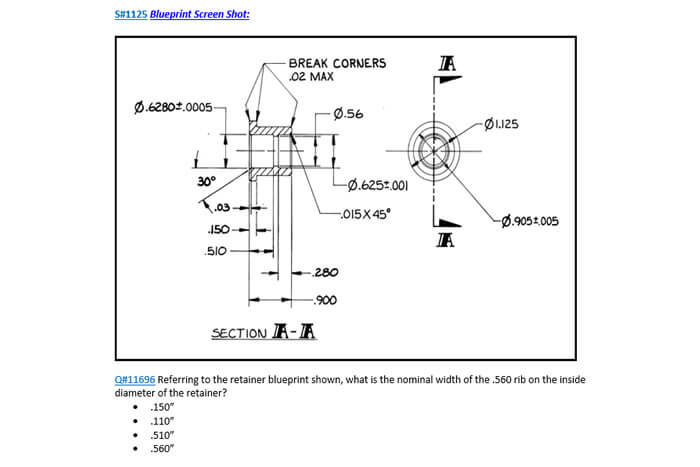
HRMC says Acclaim uses job samples and mini-simulations to examine practical ability and responses to workplace situations. Employers define the success criteria, with HRMC helping develop relevant materials. The platform can combine information across internal or third-party assessments and rank applicants against those criteria.
This also clarifies what HRMC means by AI. Its published employer description emphasizes adaptive branching and algorithms that evaluate a candidate’s interaction. A modern reader might picture an open-ended chatbot. The documented proposition is more specific: a configurable interview and evaluation process whose questions and decisions follow the employer’s requirements.
The factory-floor theory of hiring
Manufacturing is an especially revealing market for Acclaim. HRMC’s manufacturing page compares the platform to a five-axis machining center: configure the process, run it consistently, and let people attend to the work that needs their judgment. The metaphor is cheerfully industrial. It also exposes the appeal to employers hiring repeatedly for defined roles.
The company describes customers in snack foods and beverages, pharmaceuticals, financial services, grocery retail, and call centers. These are employers for whom recruiting can involve many applicants, repeated openings, or multiple locations. An hourly applicant without a current resume is therefore a central design consideration.
For an unnamed major pharmaceutical company. A company-reported example of processing capacity, rather than a count of people hired.
HRMC also reports use at more than 250 locations of a large snack-food manufacturer, and more than 65 million candidates processed through Acclaim cumulatively. Those figures describe the scale of the company’s claimed work. They do not tell us how many people became employees, or how well every new hire performed. The distinction matters when evaluating a recruiting product.
The speed claim needs the same care. HRMC says candidates can often move from welcome to scheduling an invited final interview in under 30 minutes. That is a shortened preliminary process. A final conversation, an offer, and any subsequent checks still have their own place in hiring. The valuable achievement is getting a useful next step into the same encounter.
The software brings company
Acclaim can operate as a standalone platform or as an integration hub for tools an employer already uses. HRMC describes joining job postings, candidate interactions, assessments, and their data in one place. This puts the company between several familiar purchases: an applicant tracking system, an assessment service, a scheduling tool, and the work required to make them cooperate.
Its market position is therefore broader than a database of applications. Buyers can compare it with recruiting platforms such as Greenhouse, Lever, or iCIMS, or with a collection of separate services. Acclaim’s particular pitch is a joined-up, resume-optional encounter with evaluation built into it. The sensible comparison is the resulting workflow, including the applicant’s experience of it.
Configuration also requires people. HRMC lists HR professionals, recruiters, industrial and organizational psychologists, data analysts, interview developers, and job analysts among its client-support functions. The software automates a process; these disciplines help decide what that process ought to contain. That is a meaningful part of the offer for a buyer who needs more than another place to store candidates.
Speed has a price, and a condition
Software Advice and Capterra list Acclaim’s starting price at $500 per month. Treat that as a directory figure when building a shortlist. A useful purchasing discussion must cover the actual hiring scope, configuration, assessment work, integrations, and support. The monthly starting point alone is a poor way to compare a tailored workflow with a simpler application tracker.
“Candidate experience can be a bit clunky.”
Jon T., regional HR manager, G2 review, December 2017. The review was incentivized.
The same reviewer described a functional system, responsive staff, and help making changes, alongside growing pains after adoption. This is a dated, individual account. Still, it makes a useful point about HRMC’s central promise: connecting the stages does not automatically make every stage pleasant. The candidate journey deserves testing in its finished, configured form.
Acclaim’s approach makes most sense when hiring repeats and employers can identify work-related evidence worth collecting. For an occasional, highly bespoke appointment, the configuration effort may be difficult to justify. And if an employer cannot define success in the job, a fast ranking merely carries that uncertainty forward. Those are practical deductions from the product’s design, rather than claims about a particular customer failure.
Borrow the sequence
Recruiters can borrow several ideas without buying the platform. Describe the job before demanding a long account of the applicant. Remove duplicate questions. Where a resume is unnecessary at the first step, defer it. Choose a short task tied to actual work. Give candidates a clear next action and enough information to decide whether they want it.
These are also themes in HRMC’s advice on applicant drop-outs: set expectations, keep communication moving, support mobile applications, and provide information while requesting it. The exchange is reciprocal. An employer assessing someone is also being assessed by them, sometimes on nothing more sophisticated than whether the process respects an evening of their time.
The retainer drawing offers a fitting last word. It does not make a grand speech about potential. It asks a small, answerable question about a real kind of work. HRMC’s most interesting contribution is giving that question a place near the beginning, while the applicant is still there to answer it.