At Bendix, the trouble began after the form was finished. Someone still had to download a PDF, split it, rename the pieces and upload them into UKG PeopleDoc. A completed task had quietly given birth to several more. This is how office work acquires the reproductive habits of a rabbit.
- Rival connects HR work: recruiting, employee journeys, learning and performance.
- It can sit beside existing systems: the pitch allows a company to keep its ATS or HCM platform.
- The evidence is in the handoffs: customer accounts describe less document handling and fewer administrative steps.
- ROSI adds AI inside the process: matching candidates, answering questions and drafting workflows.
The manufacturer’s integration with Rival reduced that document handling to a single click. Rival’s published case study reports more than 450 administrative hours saved annually. Astrid Hintze, a regional project lead at Bendix, puts the division of labour neatly: “I’m in HR, not IT.” Rival handled the configuration; her team supplied the process.
There is a useful question hiding in this modest story. When a company buys software, does it buy a better place to store work, or a better way to move it? Rival’s answer increasingly favours the movement. The completed form, stranded between two perfectly respectable systems, is its kind of problem.
administrative hours saved
A company-published customer result, not a forecast for every buyer.Software has a handoff problem
Imagine the ordinary arrival of a new colleague. Recruiting knows the offer was accepted. HR needs the paperwork. IT needs to prepare access. The manager needs to know when the person is actually ready. Each department may have a useful application. The employee experiences the entire sequence, including the gaps.
This imagined arrival explains Rival’s positioning. It sells cloud software for talent acquisition and employee administration, with modules that can operate independently or together. Its current proposition is an orchestration layer: tasks, documents and decisions move across the tools an employer already owns. A manager should be able to see the next step without conducting a small investigation.
That makes the market position more interesting than the usual promise to put everything in one place. Enterprise buyers have already put a great deal in several places. Rival is prepared to work with that arrangement. Its expertise lies in recruiting, employee workflows and the configuration needed to connect them.
acceptedRecruiting
completedHR
preparedIT
readyManager
Rival’s opportunity lives in the arrows between the boxes.
A welcome mat becomes a control room
Rival has an older wardrobe than its name suggests. The company began as SilkRoad Technology in 2003, with Andrew “Flip” Filipowski and Brian Platz as co-founders. Recruiting, onboarding, learning and performance were part of its business long before conversational AI became a buying category.
The financial history supplies some perspective. A $40 million equity round announced in November 2010 was led by Intel Capital and Tenaya Capital. In 2021, HighBar Partners acquired SilkRoad and announced additional growth equity alongside Foundation Capital and Two Sigma Ventures. The company’s recent products rest on an established software business.
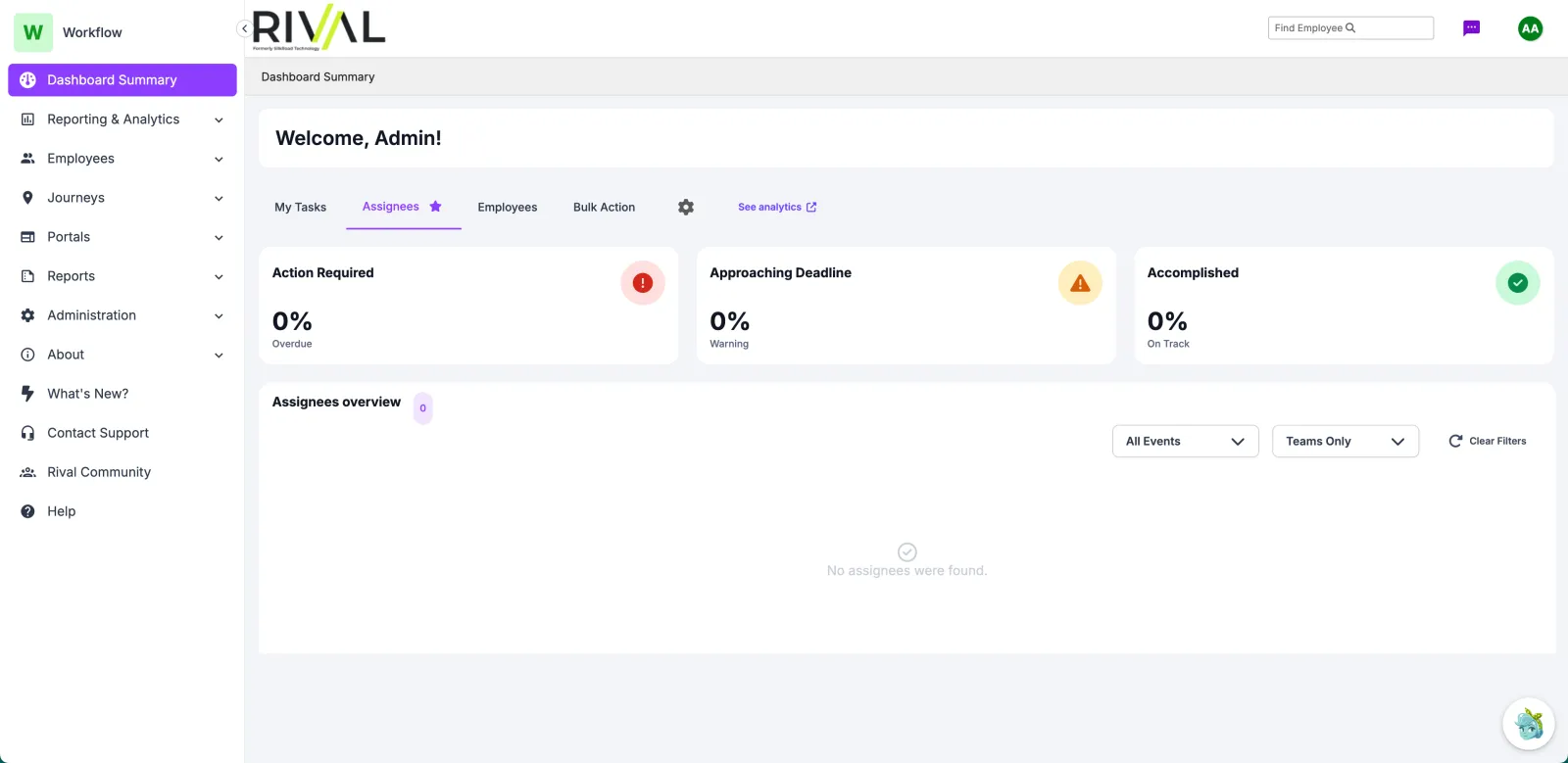
In August 2022, SilkRoad added Entelo’s candidate search and recruitment marketing technology. The Rival rebrand followed in November 2023, alongside a new version of Recruit and the appointment of Greg DiTullio as CEO. In October 2024, Rival introduced Workflow as the latest generation of its RedCarpet technology. An onboarding product now had a wider remit: the employee lifecycle, including departures.
Entelo adds sourcing and recruitment marketing.
RedCarpet’s next generation becomes Workflow.
ROSI arrives inside the product.
The trajectory is revealing. Finding the employee and getting the employee started had become adjacent problems. Keeping the sequence coherent offered a reason to sell more than a recruiting database or a digital welcome pack. Rival’s product history follows that administrative logic.
Four products, one awkward interval
Recruit combines applicant tracking, candidate relationship management, sourcing, outreach and analytics. Rival advertises access to more than 750 million candidate profiles. Buyers can choose the full recruiting platform or an outbound sourcing layer for an existing ATS. The second option matters: the customer can seek candidates without making a system replacement the first order of business.
Workflow handles employee journeys, forms, approvals and coordination across departments. Learn assigns and tracks training, supports role- and region-based journeys, and accepts learning content formats such as SCORM and AICC. Go1 and Syntrio content can sit in its course catalog. Perform covers goals, check-ins, feedback, reviews and succession planning.
These tools serve different people. Recruiters need a useful shortlist. Administrators need a completed process. Learning teams need evidence of completion. Managers need a record of goals and conversations. Rival’s commercial wager is that those needs become more valuable when the transitions between them are handled deliberately.
The alternatives depend on the problem. A buyer might consider a broad HCM suite such as Workday or SAP SuccessFactors, a recruiting specialist, or a dedicated learning platform. Rival’s distinction is its modular approach and willingness to connect to incumbent systems. A replacement strategy and an integration strategy involve different budgets, different disruption and different internal negotiations.
A visitor badge makes the point
Cleveland Clinic offers another view of the same coordination problem. Its case study describes approximately 38,000 non-employees onboarded each year, including contractors, researchers, students and volunteers. Background checks, health requirements, training and access have to line up. The people involved do not all belong on the employee payroll, but they still need a reliable route into the institution.
The case reports that updating a badge went from 15-20 steps to 3-5. It also reports a 30x return on investment over 12 months. These are published customer claims. Their practical lesson is the sequence: access depends on clearance, and clearance depends on work completed by several parties. Automating that sequence has consequences beyond a tidier HR inbox.
ROSI gets a job description
ROSI stands for Rival OS Intelligence. Its initial Workflow release in June 2025 described a knowledge agent that could retrieve employee information, documents and event status through Rival’s APIs, respecting the user’s permissions. The public launch followed in July. That is a concrete starting point for AI: help a person find the state of the work already underway.
In June 2026, Skills Match added ranked candidate matches, adjustable priorities for skills and score breakdowns. In July, Journey Builder introduced a different shortcut. Describe a process in ordinary language, upload a spreadsheet, or combine the two; the system drafts tasks, sequencing, dependencies and suggested assignees. The resulting journey remains editable before publication.
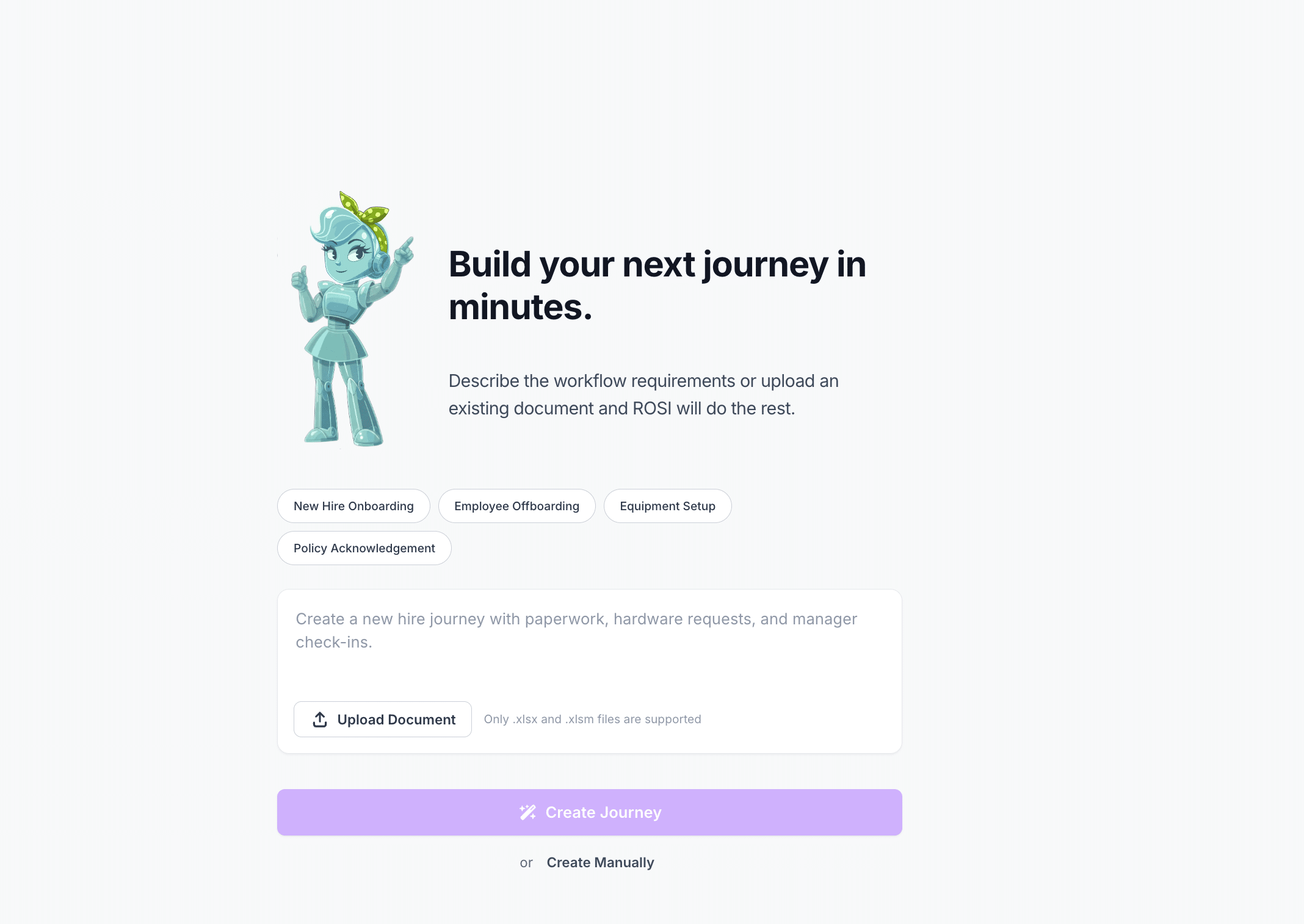
The attraction is easy to understand. A blank configuration screen requires the administrator to remember everything at once. A draft gives that person something to inspect. The useful test is whether it captures the real dependencies, exceptions and responsibilities. A beautifully worded task can still be assigned to the wrong person.
A workflow is a promise about who does the next thing.
Editorial observation
Put a price on the little transfers
Rival sells B2B SaaS subscriptions through negotiated agreements. Products have specified license parameters; professional services can be part of the purchase. The sensible buying exercise begins with the current process: how often it happens, how many minutes it consumes, and what happens when a step is missed.
Estimate the annual handling time in one repeated task.
Transfers × minutes ÷ 60. This is current effort, not promised savings or a Rival price quote.The lesson a reader can copy is pleasingly unglamorous. Follow one form from completion to final storage. Record every transfer. Name an owner for each step. Decide which system needs the result. Then ask an automation vendor to demonstrate that exact sequence, including the exception that currently requires a human to intervene.
That approach needs repeatable work, usable data and agreement on responsibility. If the process changes every time, or no department accepts ownership, a generated journey cannot supply the missing decision. Integration also has to move the right information to the right destination. Those are conditions for the business case, not details to postpone until after the purchase.

Rival’s most persuasive idea fits inside that original document transfer. The work was complete; the organisation was still busy moving the evidence. Make the movement easier, and people can get on with the next useful thing. It is a modest ambition with a surprisingly large addressable inbox.
Take a closer look
Explore Rival’s website, its product updates and blog, and the newsroom.