The least glamorous person in an HR department may be the one who knows which spreadsheet is secretly keeping the company legal. A new hire appears in payroll, then reappears in a benefits portal, a document folder, an onboarding checklist and perhaps a carrier file. A termination takes the same tour in reverse. Every stop is an opportunity for a mistyped date, a stale deduction or a form that nobody signed. Insynctive, a small software company in Walnut Creek, California, has built its business around this administrative relay race.
Its product is a configurable layer for human resources, benefits and document automation. It can generate and route offer letters, collect e-signatures, manage I-9 and tax forms, guide benefits enrollment, store employee records, reconcile carrier bills, run a help desk and push data between systems. The important part is what it does not insist on doing: replacing the payroll platform already bolted to the floor.
The actual product
A traffic controller, not another airport
Insynctive describes four connected lines: document automation, an HR information and compliance layer, benefits administration, and the Insynctive Hub for integrations and third-party services. In daily use, those categories blur. A hire entered in ADP Workforce Now can trigger a branded onboarding portal, populate an offer, route federal and state forms, assign tasks to IT and a manager, then return completed data to payroll. One event travels; employees and administrators do less retyping.
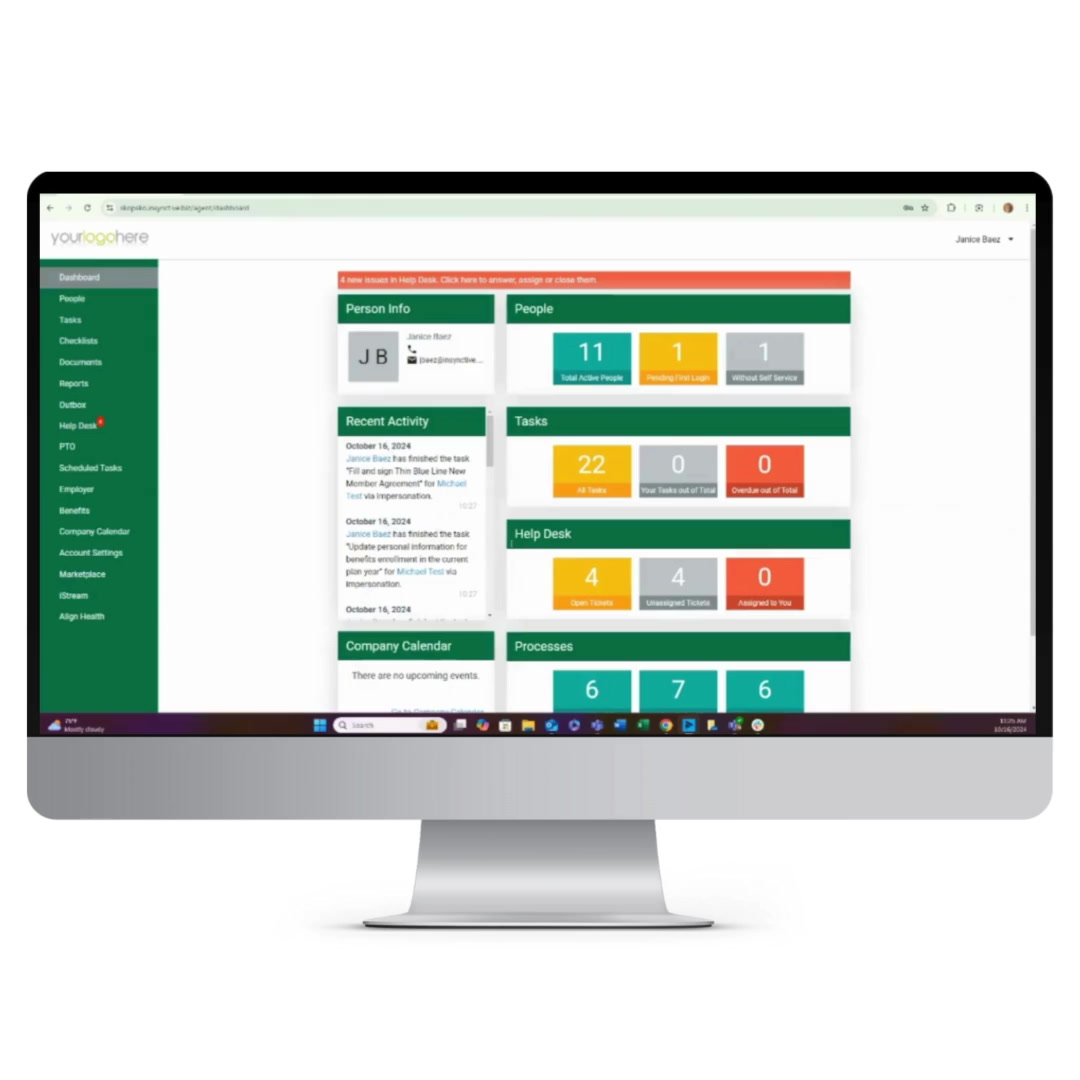
That makes the company easier to understand as connective tissue than as a monolithic HCM suite. Its best-known integration is with ADP Workforce Now, available through ADP Marketplace. The sync is bi-directional: changes can move both ways instead of arriving as a weekly CSV that someone must babysit. Carrier connections use APIs where available and the benefits industry’s EDI 834 files where necessary. Insynctive also pairs the software with hands-on implementation and continuing configuration support.
The company’s sharpest feature may be configurability. Workflows can vary by role, employment type, location and employer group. That matters when a California hire needs different notices from a Texas contractor, or when a broker administers dozens of clients with different eligibility rules. Templates provide a starting point, but the sales promise is that the software bends around an organization’s existing procedure.
Who pays and why
Two customers hiding inside one company
Insynctive sells directly to mid-market employers, with current product pages generally aimed at organizations from 50 to 5,000 employees. It also sells through service providers: benefits brokers, third-party administrators, professional employer organizations and HR outsourcers. The second audience is the more interesting wedge.
A broker can run a white-label version under its own logo and domain. Insynctive says one administrator login can oversee more than 100 employer groups while keeping each client’s plans, workflow rules, feeds and enrollment windows separate. To the employer and employee, the portal belongs to the broker. Behind the scenes, Insynctive supplies the machinery. The broker deepens its client relationship and gains a recurring software story without financing a software company from scratch.
The smartest part of the pitch is not “replace your old stack.” It is “stop making your old stack lonely.”
The pricing is refreshingly visible. Smart HR Workflows is listed at $4 per employee per month, plus an $8 setup fee per employee. Comprehensive Benefits Administration is $4.50 monthly plus $9 setup. The combined suite is $8.50 monthly plus $17 setup. Public pages show contract terms and note that final rates can depend on configuration. For a 250-person company, the combined subscription pencils to $25,500 a year before setup. That is real money, but small beside a payroll migration or another full-time administrator.
The financial case rests on avoided labor, mistakes and disruption. Insynctive says its paperless onboarding removes an average of 11 paper forms and can save three to five administrative hours per hire. Those are the company’s own operating claims, so buyers should test them against a real month of work. The cleanest pilot metric is not “engagement.” Count duplicate entries, corrections, unresolved tickets, late signatures and hours spent reconciling benefits deductions before and after.
The founder’s scar tissue
What failed first was the handoff
CEO and co-founder Gary Goldstein arrived with unusually relevant mileage. He founded benefits technology company BISNet in the 1990s and later sold it. Public biographies date his work on Insynctive to 2013; company directories typically use 2016 as the current corporation’s founding or launch year. Early Insynctive participated in the StartX ecosystem, and its ADP integration was publicly promoted by 2017.
The problem Goldstein chose was not that HR lacked databases. It had too many of them. Payroll systems were durable but rigid. Benefits tools and service providers sat outside them. Forms moved through email. The first thing to fail was the handoff: the same event expressed differently in several places. That observation changed the product logic. Instead of persuading every customer to abandon a sunk investment, Insynctive became the adaptable layer around it.
That decision also explains the company’s culture and its constraint. Insynctive talks like a consultancy wearing a SaaS jacket: discover the process, configure the platform, manage data, keep adjusting. Customers quoted on its site praise responsiveness and compliance knowledge as much as features. This is useful when workflows are genuinely odd. It is harder to scale than a self-serve product with three buttons and no phone number.
What another founder can copy
- Sell compatibility as the feature. Preserve the customer’s expensive system of record and make its missing workflows your market.
- Turn service partners into distribution. Give brokers a product they can brand, sell and use across their whole book.
- Price the smallest painful unit. Per-employee pricing maps neatly to the administrative load and grows with the customer.
- Make one event travel. Start with a hire, termination or life event and eliminate every re-entry point around it.
Where it wins
The middle is messy enough to be a market
Insynctive competes with benefits platforms such as Employee Navigator, Ease, PlanSource and Selerix, and with broader suites including Rippling, Gusto, Paycor, Paycom and UKG. Those are not interchangeable alternatives. Some offer larger carrier networks. Some want to own payroll. Some deliver a polished, standardized employee experience. Insynctive’s lane is the employer or service provider whose process is too particular for a small-business template and too entrenched for a wholesale replacement.
Its white-label model creates another distinction. Many employer-first products can give a broker an agency view; Insynctive makes the service provider the visible product owner. Its public materials position the console for brokers, TPAs and PEOs managing many groups, not merely one employer with outside advisers. That gives a small company leverage: every broker relationship can carry multiple employers.
Good conditions
ADP Workforce Now is staying. Benefits and documents live in separate tools. Rules vary by location or client. A broker wants its own brand. HR can name the manual steps it wants removed.
Bad conditions
The company has fewer than 50 people and simple benefits. It wants a new global payroll core. It needs the market’s broadest carrier network. Nobody owns ongoing workflow configuration.
This is also where the model would not work. A 20-person company using one modern payroll tool may never recover the setup effort. A multinational seeking payroll replacement will need a broader suite. A buyer that changes every process weekly can turn configurability into an expensive hobby. And white-glove support only remains white-glove if a small team can serve growing accounts without becoming a custom-development shop.
Insynctive’s funding history is reported unevenly across private-company databases, but the supplied company record totals $5.46 million and identifies a $1.5 million convertible note in January 2016 as the latest included round. Other databases show earlier seed and note financings and a later convertible-note entry. No audited revenue or current valuation is public. LinkedIn places the company in the 11-to-50 band; the supplied record counts nine employees. The useful conclusion is scale, not precision: this is a compact, privately held company pursuing enterprise complexity.
Its latest public push makes the thesis more explicit. Through spring and summer 2026, Insynctive expanded detailed guides on onboarding, document automation, reporting, integrations and white-label benefits administration. The resource library says it now contains 39 guides across 12 categories. The move is practical content marketing: explain the compliance threshold, show the broken handoff, then place the configurable layer nearby.
Enterprise software usually promises transformation and invoices the migration. Insynctive offers the less cinematic proposition that the old system can stay, provided the traffic around it gets better signals. For HR leaders buried in forms, and for brokers trying to turn service into a scalable product, that may be the more credible kind of modernity.