At Bevi, the company that makes water dispensers for offices, job applications went into a generic “Jobs” inbox. Feedback travelled by email or by conversations in passing. Offer letters wandered around as PDFs. The business was growing; its memory was scattered among the people doing the hiring.
“Our hiring process was a disaster,” recalled Lauren Della Morte, its People Operations Manager, in a Workable customer account. The revealing detail is the missing record. When an interview ended, the next person could not reliably see what had happened. Hiring depended on somebody remembering to tell somebody else.
- One place to hire. Workable connects sourcing, applications, interviews, feedback and offers.
- A longer relationship. Onboarding and HR tools follow the candidate into employment.
- AI with a running cost. Agent screening, sourcing and chat consume different quantities of credits.
- A useful test. Can your managers run a real vacancy and leave a record the next person can use?
01The inbox was the first thing to go
Bevi was already close to choosing between two other platforms when a conversation at a Talent Hackers event introduced Workable. What changed the decision was a familiar shape: a visual pipeline, like a sales funnel, showing where candidates stood. Managers could recognize the process before learning the software.
Workable supplied interview scorecards, careers pages and job-board distribution. Bevi trained its managers with a recorded webinar offered at three different times. The account says adoption took a few weeks and that the company doubled in size over the following year. That is a customer-reported result, not proof that software caused the growth. It does show what the customer valued: a hiring process people could actually follow.
A hiring system earns its keep when the next person no longer has to ask what happened.An editorial observation
This is the territory of an applicant tracking system, or ATS. Workable stores candidates against jobs, tracks their progress and keeps communication and evaluation together. The unglamorous benefit is continuity. Nobody wins a business award for retrieving last Tuesday’s interview notes. They may, however, avoid interviewing the same person twice for the same unanswered question.
02A common nuisance, exported from Athens
Nikos Moraitakis and Spyros Magiatis founded Workable in Athens in 2012. Its early focus was smaller businesses, which needed to recruit without necessarily having a dedicated HR department. The company’s opportunity was practical: make the machinery of hiring available to teams that could not maintain a collection of specialist systems.
The founders did not have to invent the demand for employees. They had to make the process of finding them manageable. Openfund backed the early company. A $1.5 million financing followed in 2014; Balderton led a $27 million round in 2015. In November 2018, Zouk Capital led $50 million in growth financing, with participation from 83North, Balderton, Notion, TriplePoint and Endeavor Catalyst.
That 2018 announcement explicitly identified the problem as a stack of separate sourcing, evaluation and workflow tools ill suited to smaller employers. The company was selling a connected operation. The same logic still explains its position better than the fashionable vocabulary surrounding recruiting software.
Workable’s reported totals, checked September 2026. These are cumulative scale claims, not active subscription counts.
03The offer letter was only a comma
Recruiting software traditionally has a satisfying finish line: “Hired.” For the employer, that is where another collection of chores begins. Someone needs documents signed, an employee record created and an onboarding checklist completed. An accepted offer has an impressive ability to generate fresh paperwork.
Workable’s 2023 roadmap recorded the release of onboarding portals, employee profiles, document management, an org chart and time-off management. Its HR product extended the relationship beyond the hiring pipeline. Today the offer includes time tracking and payroll preparation and integrations. Payroll preparation should not be confused with running every country’s payroll inside Workable.
- 01Find & attract
- 02Evaluate & hire
- 03Onboard
- 04Manage & listen
Recruiting → employee record → ongoing HR. A connected workflow, rather than a performance claim.
In July 2026 it added Employee Surveys to Performance & Engagement, alongside performance reviews. The product now reaches from an applicant’s first contact to an employee’s feedback about working there. The commercial logic is straightforward: each additional useful task gives customers another reason to keep the platform open after recruitment slows.
That breadth shapes the comparison with ATS alternatives such as Greenhouse, Lever, Ashby, JazzHR and Teamtailor. Workable’s case rests on the combination of recruiting, sourcing and ongoing HR. Buyers should examine the connections they will use. An existing employee system with carefully established processes may make the recruiting package more relevant than the full bundle.
04Now the shortlist has a meter
Workable Agent, announced in general availability in June 2026, moves into the work before the interview. It helps define the role, finds candidates, sends outreach, gathers missing information and evaluates candidates against the agreed criteria. The point of placing it inside the ATS is that it can operate on the hiring pipeline the team already uses.
Workable says scores come with written reasoning and that users can pause or override the agent. Those controls matter because a crisp number can conceal a muddled specification. A hiring manager who has not decided which skills are essential has given the software a disagreement to process. Faster screening does not settle that disagreement.
The base business is subscription software, priced by employee band, plan and package. On September 30, 2026, the public page displayed Standard at $299 a month, or $3,588 a year, for the 1-20 employee band. Package choices, term and add-ons affect the bill. Agent usage adds a second calculation: screening costs one credit, sourcing two and candidate chat ten. The 5,000-credit bundle costs $600.
A shortlist has several costs
Illustrative usage at $0.12 per credit. Enter action counts to compare consumption; this is not a purchase quote.
500 × 1 + 50 × 2 + 20 × 10 = 800 credits. Subscription, other actions and unused credits are excluded. Credits expire after one year; the minimum listed bundle is $600.
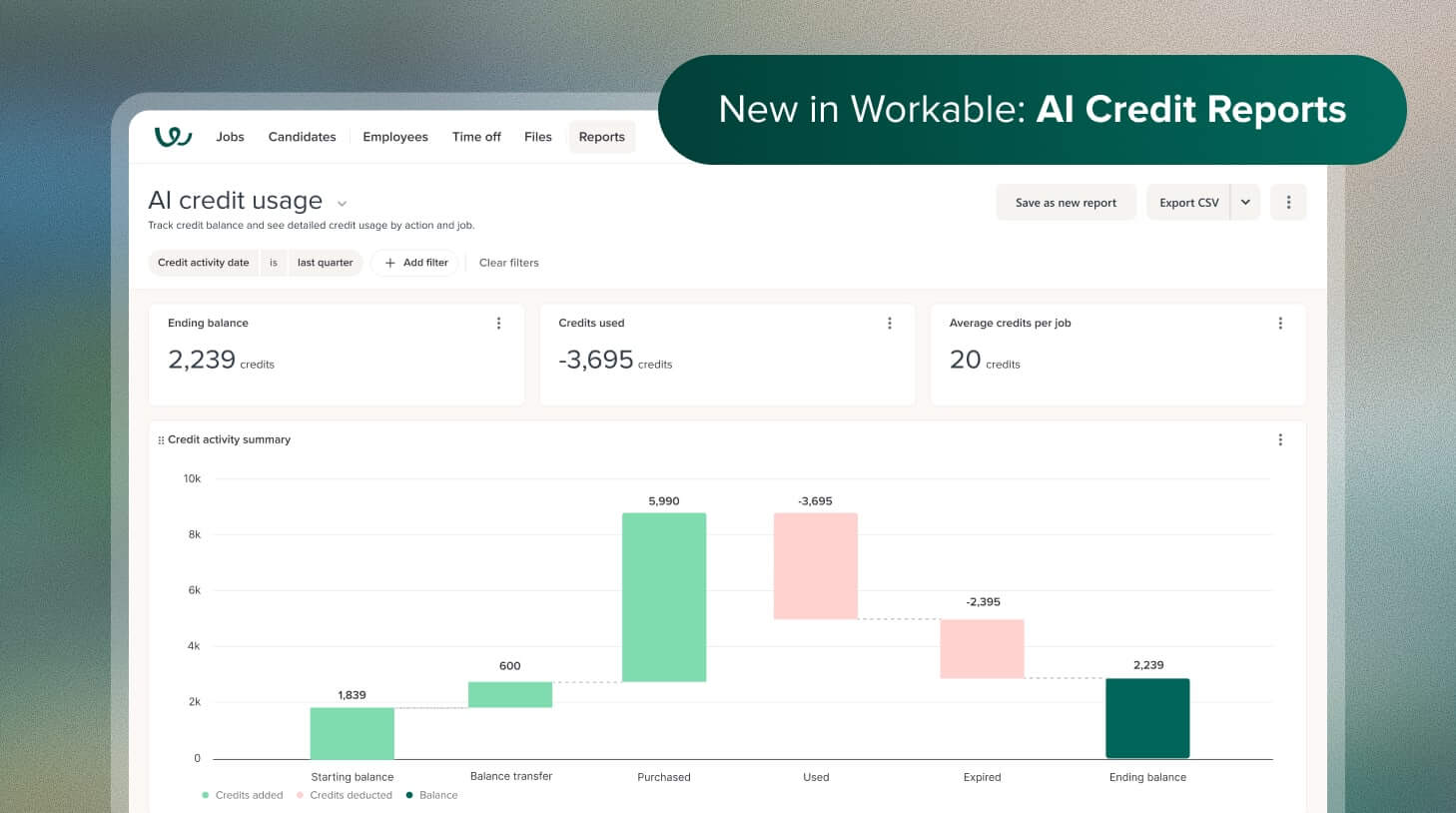
September brought a useful companion: an AI credits report. Administrators can inspect purchases, consumption and expirations, then see usage by action and job. A running meter is easier to manage when someone can read it. This release makes the cost conversation more concrete than a promise to save hours.
05The pool won the argument
Workable has its own experience with the limits of process design. In a historical account of its company retreats, Moraitakis described a small product-planning meeting growing into a gathering for colleagues across international offices. As the team expanded, the event became a way for people to know the person behind an email.
One retreat involved building and racing rafts. Employees later said they preferred the spare time spent talking by the pool. The 2019 gathering consequently gave more priority to free time. It is a pleasing detail from a company selling organizational software: sometimes the better arrangement contains fewer organized activities.

06Try one vacancy before buying a philosophy
There is a method here that readers can copy without buying anything. Agree on a role’s essential criteria before applications arrive. Put feedback in a shared record. Give each handoff an owner. Keep the interview assessment separate from an interviewer’s vague enthusiasm. Those practices make a hiring pipeline useful; software makes them easier to repeat.
For a prospective customer, Workable’s 15-day trial offers a sensible testing ground. Run one real vacancy, invite the actual hiring managers and check whether the next person can find the previous person’s assessment. For HR, test employee data and approval settings before inviting the whole company. Workable’s rollout guidance explicitly asks administrators to confirm configuration first.
The fit weakens when those assumptions fail. A manager who keeps decisions in private messages leaves the shared record incomplete. An agent given poor criteria may screen consistently against the wrong requirements. An organization with little recurring hiring should weigh a subscription against its modest workload. These are purchasing judgments, not claims that one product must suit every employer.
Workable’s useful proposition is a legible process: what happened, who acts next and what that action costs. For a growing company, those are unusually consequential questions to be answering with “I think someone emailed it.”
Open the product, watch the process
Website · Current pricing · News & recruiting articles · Customer stories
Product demo · Video walkthrough · YouTube videos & conversations