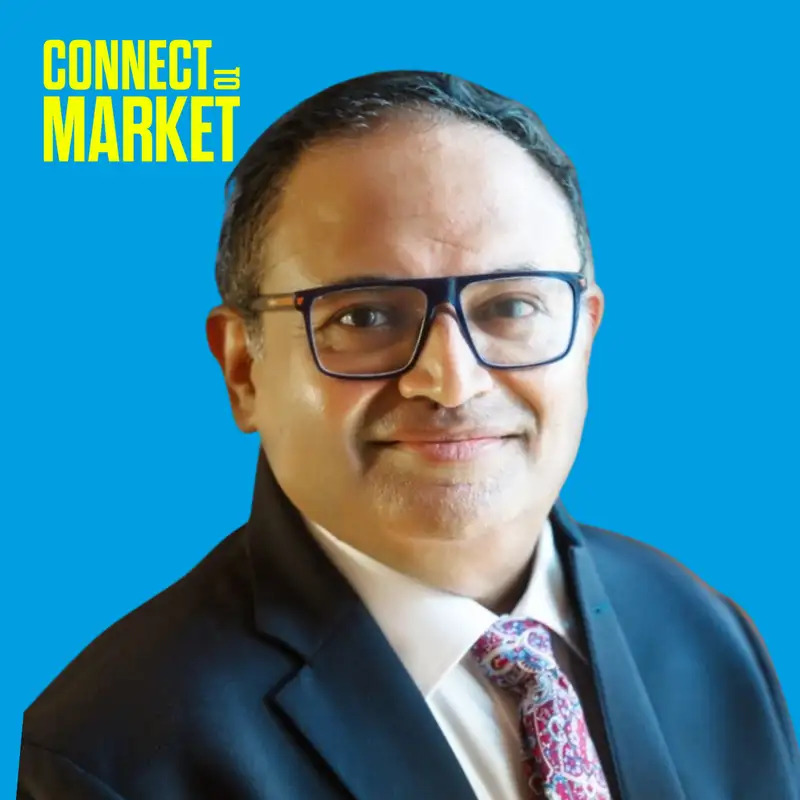
Andy Dé has spent a large part of his career standing between complicated technology and an impatient question. The technology changes its costume. First enterprise software, then visual analytics, then automated analytics, now artificial intelligence. The question is stubborn: what useful thing happens next? In an industry fond of grand forecasts, this makes him an unusually practical character. He can speak fluently about large language models, machine vision and AI agents, yet he keeps dragging the conversation back to workflows, decisions and return on investment. Somewhere, a demo is longing to become a habit. Dé wants to know who will use it on Monday morning.
Today he is the first chief marketing officer of Dallas-area Lightbeam Health Solutions, where he leads global marketing and go-to-market work. The title is tidy. His route to it is not. He began with a bachelor’s degree in mechanical engineering in Mumbai, added a master’s in materials science and engineering at the University of Florida, then collected business degrees in Tel Aviv and Ontario. Strategy programs at Harvard, MIT and Kellogg followed. His education crossed four countries and several intellectual neighborhoods. The connecting street is systems thinking.
A mechanical engineer asks how parts interact under pressure. A materials scientist asks how something behaves in the real world. A marketer, at least in Dé’s version of the job, asks how a product survives contact with a customer. His career has made those questions roommates. They may quarrel over vocabulary, but they agree about evidence.
“The industry’s challenge is not whether AI can be deployed. It’s whether it can deliver ROI.”Andy Dé, 2026
A career built in translation
Before the C-suite titles, Dé worked across strategy, portfolio management, product and commercialization at i2 Technologies, SAP Health Sciences and GE Healthcare. At SAP, his public portfolio credits him with helping enable $400 million in life-sciences revenue over three years and $200 million in incremental revenue from an acquisition. At GE Healthcare, he led the global launch of Centricity Cardio Enterprise and reports $70 million in incremental revenue in the first year. The recurring assignment was neither pure product nor pure promotion. It was to make a complex system legible to a market.
Tableau gave that instinct a larger canvas. As managing director and global general manager, then senior global industry director for healthcare and life sciences, Dé worked on innovation, positioning, partners and commercialization. His portfolio records 545% growth for the vertical in less than four years, alongside 57% annual recurring revenue growth. In a 2016 interview, he described the core problem as creating a “360-degree version of the truth” from data trapped across departments. That phrase could double as a job description for his own career: connect the fragments, reveal the pattern, help somebody decide.
At Alteryx, Dé moved from visual analytics to analytics automation. He wrote about self-service tools and the old imbalance in data work, where specialists spent most of their time preparing information and too little using it. He reports that the healthcare and life-sciences business grew 176% in 18 months, with a fiftyfold increase in sales pipeline. The exact technology had changed. His appetite for removing the gap between information and action had not.
Then came the three CMO appointments: MedeAnalytics, Verato and Lightbeam. At MedeAnalytics he says a rebuilt marketing function helped produce more than 1,300% pipeline growth and a tenfold increase in customer references. He joined Verato in March 2024, bringing his translation work to identity data management. By 2025 he was at Lightbeam, focused on population health management, value-based care and a rapidly expanding vocabulary of AI.
After the dashboard, a verb
Dé’s current argument begins with a useful distinction. Generative AI usually answers a query. Agentic AI can advance a task. An answer may be clever; a task completed safely can be valuable. In his telling, the important shift is grammatical. Technology has spent years generating nouns: insights, summaries, predictions, recommendations. The next test is a verb: schedule, route, monitor, alert, close, follow up.
He does not present that progression as a licence to remove people. His public five-stage model moves from prescriptive guidance through copilots and monitored automation toward more autonomous systems. In consequential settings, he argues for governed automation, with people retaining oversight. The useful near-term target is not a machine left entirely alone. It is a repetitive process handled more consistently while a qualified person remains accountable.
This is where his engineer’s suspicion of loose claims becomes useful. AI is not one thing. Dé treats it as a portfolio that can include machine learning, deep learning, natural-language systems, robotics, computer vision, generative models and agents. The sensible choice depends on the problem. A new label does not invalidate an older method that already works. The executive’s task is to resist fashion long enough to select the right instrument.
That view also makes room for caution without paralysis. Dé speaks plainly about hallucinations, bias, security, copyright, governance and workforce effects. He has noted the temptation to pour resources into a fashionable model before defining the use case or the return. His answer is not abstinence. It is portfolio discipline: rank opportunities, decide what to build or buy, create oversight and calculate the value after deployment. The phrase “art of the possible” appears often in his talks. He appears equally interested in the accounting of the actual.
Begin with the customer challenge. Match the technology to the workflow. Keep accountability visible. Measure what changed. A dazzling demo may survive all four tests, but it does not receive diplomatic immunity.
Marketing without the fog machine
His marketing philosophy shares the same bones. On the Connect to Market podcast in December 2025, Dé described meaningful connection as a product of listening. Understand the customer’s challenge, lead with value and earn the position of trusted adviser. He discussed using AI for personalization, but drew a line between relevance and intrusion. More data does not automatically produce more trust. Often it merely produces a more precisely targeted annoyance.
The public testimonials around his work suggest a high-energy, hands-on leader. A former Cleveland Clinic and Texas Health CIO calls him a mentor and sounding board. A GE Healthcare leadership citation praises his inclusiveness, clear expectations and willingness to work alongside the team. Another colleague reaches for the phrase “contagious enthusiasm.” It is not hard to imagine that enthusiasm meeting a spreadsheet and asking for its assumptions.
Dé also keeps writing. His Health Sciences Strategy work has found readers in 47 countries, and his bylines have appeared across trade publications and executive forums. He was a HIMSS Social Media Ambassador in 2018 and 2019, joined the Forbes Communications Council in 2022 and was recognized by the Swiss Institute of Economic Excellence for AI thought leadership in 2025. In June 2026, he added credentials in responsible AI leadership, AI business solutions architecture and agentic AI for enterprise. The accumulation is consistent with a trait he discusses openly: continuous learning.
By July 2026, that learning had turned into another pair of public provocations. One article argued that AI is creating openings for responsible leaders; another asked whether companies were ready for the “agentic AI enterprise.” The emphasis had widened from selecting models to preparing organizations. Tools need owners. Owners need judgment. Teams need enough fluency to question an output before acting on it. For Dé, adoption is change management with a technical vocabulary, not a software switch someone flips after lunch.
There is also purpose in his vocabulary. Dé speaks about ikigai, often translated as a reason for being, as a “true north” for a working life. In public conversations, he connects technology with a larger aim: improving quality of life. The sentiment gives his preoccupation with ROI a needed dimension. Value can be financial, operational and human. Measurement is not the enemy of meaning. It is one way to check whether meaning escaped the slide deck.
“Technology should not merely optimize systems. It should improve the quality of life.”Andy Dé
The proof after the promise
The most interesting fact about Dé may be that his career keeps collapsing the distance between disciplines. Engineering meets marketing. Analytics meets narrative. Purpose meets a performance metric. He has changed companies and titles, but the work retains a recognizable shape: take a complicated platform, assemble the market around it and make the promised result visible.
That makes him well suited to this particular AI moment. Every week supplies a new model, a new claim and a new acronym wearing expensive shoes. Dé’s framework asks each one to sit down and answer ordinary business questions. Which problem? Which workflow? Which accountable person? Which measurable outcome? It is not the language of prophecy. It is the language of operating.
For a chief marketing officer, that may be the quiet advantage of starting as an engineer. Dé knows a bridge is not complete when the rendering looks persuasive. It is complete when the load arrives.
Keep reading and listening