A project can look splendid in a sales meeting and rather less splendid in the accounts. The proposal promises a capable team. The schedule assumes that team is available. The invoice assumes somebody recorded the hours correctly. Each assumption belongs to a different department. Somewhere between the handshake and the payment, a profitable idea can become an expensive misunderstanding.
That is the territory Unanet occupies. It sells the software behind the work: enterprise resource planning, or ERP, for delivery and money; customer relationship management, or CRM, for relationships and pursuits; and a growing collection of AI tools connecting those activities. Its particular interest is companies that sell projects. They need to know what they can win, what they can staff, and what they can afford.
- Government contractors, architects, engineers, and construction firms are the main customers.
- The central problem is disconnected pursuit, project, staffing, and financial information.
- Its case rests on industry-specific workflows and usable data, with AI layered into the work.
- The buying decision includes implementation, training, integrations, and product scope.
01 / The hour is the unit of truth
For a project business, time is inventory with an unusually short shelf life. An engineer’s unused Tuesday cannot be stored for December. An overcommitted project manager cannot be duplicated by changing a cell in a spreadsheet. A good system has to make those constraints visible while there is still time to do something about them.
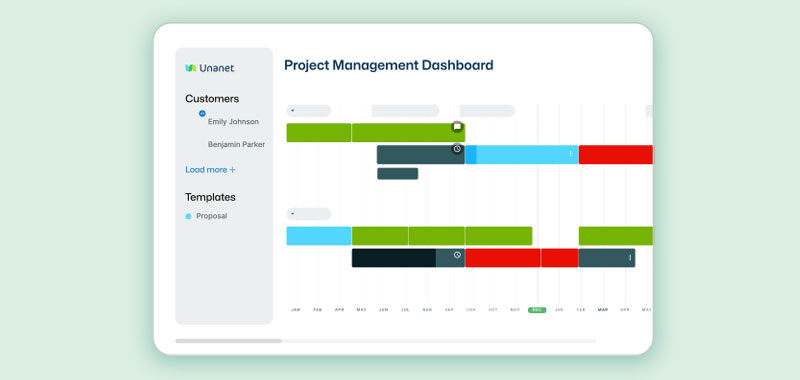
Unanet GovCon ERP connects project and contract management with financials, timekeeping, billing, resource planning, and reporting. Government contractors can use it to track project costs and subcontractors and prepare the records needed for audits. The expertise is in the connections between those jobs: a labor entry belongs to a person, a project, a cost structure, and ultimately a bill.
AE ERP addresses architects and engineers, combining project operations with accounting and resource management. The related AEC CRM handles relationships, opportunities, and proposals. Construction sits slightly differently in the portfolio: Unanet offers CRM, and its Xpedeon partnership connects that to construction-specific ERP. The North American agreement followed their UK collaboration. Buyers should examine which product performs which job.
02 / An engineering firm changes its shopping list
Above Group initially planned to buy a new ERP. Its information was scattered, departments repeated data entry, and billing approvals required lengthy email exchanges. Learning how tightly Unanet’s ERP and CRM connected changed the plan: it implemented both.
In Unanet’s case study, the design and engineering firm reported a 44% win rate, ten hours a week saved for its senior marketing coordinator, and billing approval time cut by half. These are customer-reported results, rather than a controlled comparison. The operational change is more instructive than the headline figures: past project information became useful to the people deciding what to pursue next.
“We have achieved target market precision.”
Ashley Hartman · Above Group · Unanet case study
The lesson a reader can copy is to examine the handoff before buying the tool. Who owns the opportunity? Who translates it into a staffing plan? Who checks whether the estimate matched the actual work? A company can automate every department and still leave those questions unanswered.
↖ Actual results inform the next pursuit
03 / What failed first was access
At government services firm AGEISS, the old ERP made data hard to retrieve and project managers reluctant to use it. Operations executive Brian Bartholomew described requests for custom reports carrying charges of $5,000 or $10,000. That was the price of particular changes to its previous system, not Unanet’s subscription price.
AGEISS evaluated three ERP options, prepared its accounts, and used an outside implementer. In its published customer account, tracking and forecasting unearned or unbilled project revenue fell from eight hours a month to less than two minutes. Month-end billing time fell 30%. The company also reported that project managers began using the system willingly.
Reported by AGEISS after moving to Unanet GovCon ERP. A customer result, not a universal forecast.
Adoption belongs in the economics of software. A report may contain excellent information and still arrive too late. A feature may be technically available and practically avoided. The useful demonstration is a person doing an ordinary job with the system, without a specialist standing beside them to translate.
04 / A timesheet grows ambitions
The small beginning is unusually apt. In a 2004 account of the product’s development, founder Fran Craig described conceiving a web-based timesheet in 1997 in response to consulting customers’ needs. Customers funded a prototype; the team rewrote it in server-side Java in early 1998 and turned the consulting company into a software products business. A task that seems administrative was the entrance to a larger problem: seeing what a dispersed workforce was doing.

The portfolio expanded in stages. Unanet released its ERP offering in 2015. JMI Equity invested in 2019, the year Craig Halliday became CEO and Clearview Software joined the business. Cosential brought AEC CRM in 2020. Onex invested in 2022. Those developments explain today’s breadth better than treating the company as a newly arrived AI startup.
Its institutional backing is also a reason to read old descriptions carefully. A company’s founding identity and its current ownership are different questions. The present-day operating culture is easier to observe: Unanet offers remote and hybrid working and announced employee-survey-based remote workplace recognition in September 2026.
05 / AI gets a job description
The recent acquisitions move Unanet toward the work before a contract is signed. GovPro AI joined in November 2024, adding proposal-writing technology. Contraqer followed in February 2025 with opportunity intelligence and procurement tools. GrowthStudio, introduced in 2026, connects market signals, qualification, capture, and proposal work around a shared pursuit record.
Unanet says ProposalAI can produce first drafts up to 70% faster. That is a vendor claim about drafting, not evidence that contracts are won 70% faster. The distinction matters. A team still has to decide whether to bid, substantiate its claims, check requirements, and approve the response. A fast draft of an unwise pursuit is an efficient way to waste money.
Champ Agents, powered by Wyatt, addresses another job: asking questions of business data and carrying out repeatable workflows. Unanet expanded availability to GovCon ERP and AEC CRM in July 2026, following AE ERP. Its stated approach is permission-aware, with analysis and actions connected to the systems customers already use.

Security belongs to this product story. Unanet reported FedRAMP Moderate Equivalency for GovCon ERP in January 2026, and later for GrowthStudio and ProposalAI. Its published scope guidance limits the boundary to products identified on a customer’s order form. Customers retain their own data classification, access-control, CMMC, and contract responsibilities. A security designation has a boundary; a sales adjective usually does not.
06 / The invoice for getting organized
Unanet sells subscriptions and related professional services. Its cloud agreement covers the software and services named on the order form. GovCon pricing information describes packages and volume- or user-based pricing depending on the offering. A useful comparison therefore covers the selected modules, deployment, migration, integration, training, and support.
Unanet Go offers preconfigured tools and processes; custom implementations allow more tailoring. Unanet Connect links outside applications through more than 100 pre-built connectors. The practical attraction is preserving useful systems while reducing manual handoffs. Each integration still deserves an owner and an agreed definition of the information being exchanged.
Deltek is a direct alternative in these markets, with Costpoint for government contractors and Vantagepoint for architecture and engineering. The choice turns on workflow fit, reporting, deployment, and the cost of changing systems. A smaller firm with straightforward bookkeeping and few handoffs may have less to gain from a substantial ERP implementation.
Unanet says more than 4,200 firms use its products and reported double-digit revenue growth in 2025. Its appeal is easy to understand under the right conditions: project complexity, repeated reconciliation, constrained staffing, and consequential compliance requirements. It depends on people maintaining reliable records and using the system. The worthwhile question at the end of the demo is wonderfully unglamorous: can the team trace a promising opportunity all the way to collected cash?