Mario Schlosser wanted to get some work done. The news was available. So was Game of Thrones. His attention, inconveniently, appeared to have its own business plan. In 2012, while researching ideas for a new company, he began writing down when he started a task and when he stopped. A stretch of actual work would become visible. So would the escape route to the television.
The habit survived the founding of Oscar Health, his years as its CEO, and his move back toward technology. By January 2026, he described a table containing 56,000 rows. Dates, start times, end times, activities, companions: a life with a surprisingly comprehensive index. Most people have a vague suspicion about where Tuesday went. Schlosser has records.
There is something wonderfully awkward about a founder admitting that the original enemy was distraction. The spreadsheet began as a way to stay with a task, rather than a theory of how everyone else should work. That modest origin matters. It gives the numbers a human scale: one person trying to finish reading before surrendering to a much more entertaining plot.
Years of start times, stop times, and a question: where did the day go?
A helmet before a job title
Schlosser was born in Hochheim am Main, Germany, and began programming early. As a school student, he built a camera-equipped data helmet and took fourth prize at the 1997 Jugend forscht national final. The project belongs to an earlier, more physical chapter of computing: an idea had to become an object, something that could be assembled and shown.
It also offered an early audience. A science competition puts a private obsession in a room with other people who have private obsessions of their own. For a future founder, that is useful preparation. Someone has to understand the contraption. Someone has to care enough to ask another question.
He went on to earn a computer science degree with highest distinction from the University of Hannover and an MBA from Harvard Business School. Stanford appears in his biography as a visiting research appointment. The distinction is worth keeping straight: his American academic journey included both doing research and studying business, two different ways of asking whether an idea can survive contact with other people.
A floor in Palo Alto, a problem on the internet
In 2002, Schlosser was visiting Stanford’s computer science department. Near the end of his stay, his housing lease ran out and he slept on the floor of a house rented by graduate-student friends. One of them was Sep Kamvar. Their complaint was ordinary for the period: downloading a song from a file-sharing network could deliver a fake file instead.
The irritation concealed a research question. In a network of strangers, with no central authority keeping score, how could one computer know which other computers deserved trust? Schlosser, Kamvar, and Héctor Garcia-Molina developed EigenTrust. The paper was presented in 2003; in 2019, it received the Seoul Test of Time Award.
The award arrived sixteen years after the paper. That interval offers a different clock from the one that governs a product launch or a quarterly meeting. Research can continue to matter long after its authors have moved into other jobs. By the time this work was recognized, Schlosser had already become a founder and chief executive. The older problem was still following him.
Its subject was reputation. Local experiences could contribute to a broader assessment of participants, helping a network identify bad actors. The mathematics had a social problem inside it: whose judgment should count, and how much? Trust was something to be computed from interactions. The Palo Alto floor is a useful corrective to the polished biography. An enduring piece of research started with temporary accommodation and a nuisance.
- 01Record an interaction
Local experience - 02Weight trusted opinions
Reputation travels - 03Combine and repeat
A network-wide trust score
The virtual farm was a real business
At Harvard, Schlosser connected with Daniel Kafie. Alongside Joshua Kushner, they built Vostu, initially a social network aimed at Latin America. W magazine’s April 2008 account caught the company in that early incarnation, describing a newly launched network whose members were largely students and young adults in Argentina and Mexico. The familiar games business came later.
That early photograph of Schlosser and Kafie has the slightly formal air of a company introducing itself to the world. The suits are real. So is the uncertainty that sits outside the frame. A launch photograph records the confidence required to begin; it says very little about which version of the business will eventually work.
Vostu moved into social games, including Mini Fazenda, MegaCity, and Café Mania. By October 2011, Schlosser reported roughly 25 million monthly active users. He led analytics and game design, studying how players behaved and feeding those observations into changes. A farm or café on a screen could become a laboratory for decisions. Customers were playing; the designers were learning.
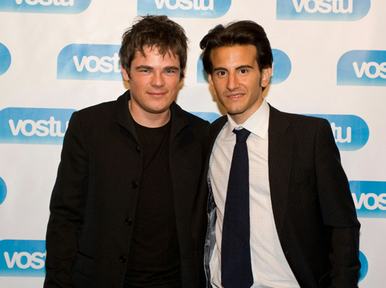
Before the virtual farms: Schlosser, left, with Daniel Kafie. Published in 2008. Photograph via W magazine.
A model needs room for people
His work also took him through McKinsey and Bridgewater Associates, where he developed analytical trading models. The settings changed, but the attraction of a complicated system remained. A market, a network, and a game all give an analytical mind plenty to occupy itself with. They also contain people, who have a habit of making the diagram untidy.
In later conversations about company building, Schlosser has described breaking difficult problems into their constituent parts. He calls the approach radical decomposition and connects it to his experience at Bridgewater. The appeal is practical. A problem that appears impossible as a whole may become a list of smaller questions that can be investigated separately.
He has been equally explicit about candor inside a business. Speaking with Florian Otto in New York in January 2020, he described communicating performance to employees even when the news was difficult. “You must have a path to profitability and sustainable growth,” he said. That is a fairly unromantic sentence for a founder. It also gives everyone in the room something concrete to discuss. A mission can recruit people; honest arithmetic has to accompany it.
“You must have a path to profitability and sustainable growth.”Mario Schlosser · 2020
The founder changes chairs
Schlosser co-founded Oscar in 2012 with Kushner and Kevin Nazemi. He served as CEO through April 2023, then became president of technology as Mark Bertolini took the chief executive role. Schlosser remained on the board. For a person whose biography starts with building things, the return to a technology brief had a recognizable shape.
A founder’s title can make a career appear more static than it is. The same company may demand different work at different stages, and the person who began it has to decide where to contribute next. Schlosser’s sequence is unusually easy to see: founding chief executive, technology leader, then advisor.
The next change took effect on June 1, 2026, when he became co-founder and advisor to Oscar’s CEO, continuing as a director. His new brief includes advancing the company’s artificial intelligence agenda. These are distinct roles with distinct responsibilities. The continuity lies in his involvement with the company; the change lies in how he spends his working day. For someone who records that day, the difference should be measurable.
2012Co-founder
& CEO
2023President of
Technology
2026Advisor to
the CEO
The owl gets a fellow player
Duolingo announced Schlosser’s appointment as an independent director in June 2024; its subsequent proxy statements date his board service from July. The connection makes sense through the games chapter of his life. Learning software has to persuade people to return, keep trying, and accept a little difficulty. Game designers have spent a great deal of time worrying about precisely those things.
Schlosser described himself as a power user and spoke about his interest in language and gaming. “I love the Duolingo product and the potential for technology in education,” he said. There is a pleasing economy to joining a board as someone who also uses the product. The decisions eventually arrive back on your own screen.
The board connection brings him into the orbit of another founder with a computer science background, Duolingo co-founder Luis von Ahn. Their public biographies meet at the intersection of software and everyday behavior. For Schlosser, the move also joins two interests he has explicitly named: language and gaming.
The appointment also places his career in a wider frame. Oscar is the company most closely associated with his name, but his experience crosses research, finance, games, and consumer software. The repeated question is how people interact with a system. Sometimes the interaction produces a trust score. Sometimes it is a lesson completed. Sometimes it is simply the decision to come back tomorrow.
The spreadsheet learns to talk back
In January 2026, Schlosser gave his old time logs a new use. He described using an AI coding agent to query and classify entries, turning a long personal archive into something he could interrogate. One retrospective calculation identified 470 hours of IPO-related activity. The record had preserved work that memory alone would struggle to reconstruct.
Then, in June, he published a World Cup model built in the probabilistic language Church. Users could ask questions in natural language and explore possible outcomes. His examples included a “heartbreak index” for teams likely to reach the final and lose. Even recreational mathematics, apparently, should allow for disappointment.
The two projects make a fitting pair. One examines a life already lived; the other explores events that might happen. Both begin with a model and invite a question. They also preserve something of the student with the helmet and the researcher on the floor: the pleasure of making a thing work well enough that someone else can try it.
The calendar remains the more intimate invention. After all the companies, titles, and algorithms, its original question is still disarmingly small: what did I actually do? Schlosser has spent years leaving himself an answer. There may be a grander account of ambition, but this one has timestamps.
Keep following the questions
Writing, conversations, and places to find him.
- Personal website
- X / @mariots
- Oscar Health
- His EigenTrust origin story
- The 2019 Test of Time Award
- A conversation about Vostu · Jugend forscht, 2011
- Vostu’s early days · W magazine, 2008
- Time, problem solving, and leadership · Moneywise, 2026
- Claude Code for Self-Coaching · January 2026
- Simulating the World Cup in Church · June 2026
- Watch: a conversation with Harry Stebbings · 20VC
- Duolingo board appointment · June 2024
- Oscar advisory appointment · June 2026