At nineteen, Masayoshi Son gave himself a timetable. His twenties were for establishing himself. His thirties were for building resources. His forties were for taking on challenges; his fifties, for achieving his vision. In his sixties he would hand the business to the next generation. It was a young person’s plan, with the reassuring neatness that comes from having experienced almost none of it.
By 2026, the timetable required an amendment. Son wanted to keep working into his seventies. Artificial intelligence had furnished a fresh assignment. After decades spent buying, building and backing technology companies, he wanted a place in the development of artificial superintelligence. Retirement had run into a scheduling conflict with the future.
There is a familiar version of Son’s story told through enormous numbers: the Alibaba investment, the Vision Fund, the losses, the next enormous number. A smaller continuity runs through the deals. Before he became an investor with the means to rearrange industries, he was a student trying to invent something. The investor and the inventor have been sharing an office ever since. They do not always agree about the budget.
The teenager who wanted an appointment
Son was born in Tosu, in Japan’s Saga Prefecture, on August 11, 1957, into a family of Korean ancestry. He grew up using the Japanese surname Yasumoto. His later public identity as Son sits within a childhood shaped by the discrimination experienced by Korean residents in Japan. The distance he travelled was social as well as geographical.
As a teenager, he became fascinated by Den Fujita, the entrepreneur behind McDonald’s Japan. Son repeatedly tried to secure an appointment. Eventually, he went to Tokyo and obtained an audience. Fujita’s advice pointed toward computers and an education in the United States. A visit to the person selling hamburgers helped steer him toward an industry that barely figured in most teenagers’ career plans.
At sixteen he went to California. He eventually studied economics at the University of California, Berkeley, graduating in 1980. Alongside his studies, he worked with collaborators on an electronic translator and sold the technology to Sharp. The degree and the device make an illuminating pair: one concerned how resources move; the other made a machine do something useful.
Published accounts disagree about the precise proceeds from his early ventures. The more durable fact is the activity itself. He was already moving between an idea, technical collaborators and a corporate buyer. Fujita later served on SoftBank’s board. An appointment that had been difficult to obtain became a relationship lasting well beyond the original advice.
A bank with software on the shelves
In 1981, Son founded the company that became SoftBank. The name referred to a bank of software. Its original business distributed packaged programs for personal computers. Publishing followed in 1982. Before the investment portfolio, there were products to get into shops and readers to reach.
An early account describes Son climbing onto apple boxes to announce his ambitions to his two employees. The audience soon departed. It is a splendidly economical founding scene: a platform, a speech and an immediate staffing problem. The ambition survived the reception.
The software business placed Son near people making and using computers. Publishing placed him near their attention. As the internet developed, SoftBank invested in Yahoo in the United States in 1995 and launched Yahoo Japan in 1996. These moves joined an existing habit of distribution to a new way of reaching customers.
Then came Alibaba in 2000. The relationship with Jack Ma became one of the defining financial facts of Son’s career. It also offered a model of ownership he would later describe explicitly: take a meaningful stake, leave room for the entrepreneur and grow alongside the business. A founder need not surrender the company name to make an investor very happy.
In 2016, SoftBank announced plans to monetize at least $7.9 billion of its Alibaba holding. That announcement gives the famous investment a useful scale without turning the story into a fairy tale about one cheque. Over years, relationships, additional transactions and decisions about when to sell mattered too. Owning a successful business creates another job: deciding what to do with the proceeds.
distribution
investment
acquisition
investment completed
Selected milestones, rather than a complete company history.
Buying the road to the customer
Son also became an operator of the systems that carried technology into everyday life. Yahoo BB launched in 2001. In 2006, SoftBank agreed to acquire Vodafone Japan at an equity value of ¥1.75 trillion. The target already had more than fifteen million subscribers. This was a different kind of undertaking from writing a startup an investment cheque.
A mobile network comes with customers who expect their phones to work, infrastructure that needs investment and competitors who are already answering calls. The acquisition put SoftBank inside that daily obligation. The company’s stated aim was to connect its existing internet and fixed-line businesses with mobile communications. The customer could leave the desk and stay within reach.
The acquisition of Arm in 2016 moved Son to another layer of computing. SoftBank paid approximately £24 billion for the British chip designer. Networks carry information; chip designs help determine how machines process it. Arm returned to public markets on Nasdaq in 2023. Through all these changes, Son kept moving around the machinery behind the screen.
The cheque grew. So did the consequences.
The first Vision Fund changed the scale of Son’s investing. Its first major close in May 2017 brought in more than $93 billion of committed capital. Participants included Saudi Arabia’s Public Investment Fund, Mubadala, Apple, Foxconn, Qualcomm and Sharp, alongside SoftBank. The translator’s old corporate buyer had reappeared in a rather different funding conversation.
Capital on that scale can give a young company time to hire, expand and challenge an incumbent. It can also complicate the distinction between a business customers need and a business investors are willing to keep financing. Rapid growth supplies impressive charts. Eventually someone asks what it costs to produce each upward slope.
WeWork forced that question into view. Its planned public offering unravelled in 2019. SoftBank announced a valuation loss connected to its investment and committed further funding to the company. The promise of growth had become an obligation to manage the consequences.
“My judgment was not right in many ways.”
Masayoshi Son, November 2019, translated remarks
The admission belongs beside Alibaba in any account of Son. His willingness to back founders has helped finance valuable companies. It has also left SoftBank exposed when confidence in a founder outran the business underneath. A long investment horizon does not answer a question about governance. It merely allows more time for the consequences to arrive.
A notebook beside the bed
By 2023, Son was talking again about invention. He described roughly 630 ideas produced over eight months and a habit of waking, writing in a notebook, photographing the page and sending it to his team. His colleagues had acquired a founder whose imagination did not observe office hours.
“Sure, most of them will turn out to be duds,” he wrote. The sentence offers a welcome pinprick in the balloon of corporate ambition. Ideas are cheap enough to discard. Once an idea has been furnished with billions of dollars, the tidying up becomes more involved.
He had passed more daily management responsibilities, including earnings calls, to his team. Generative AI gave him something to explore directly. The technology appealed to his old interest in machines that could cross a boundary in human capability. A student’s translator had become a much broader question about what computers might be able to do.
A future with a financing schedule
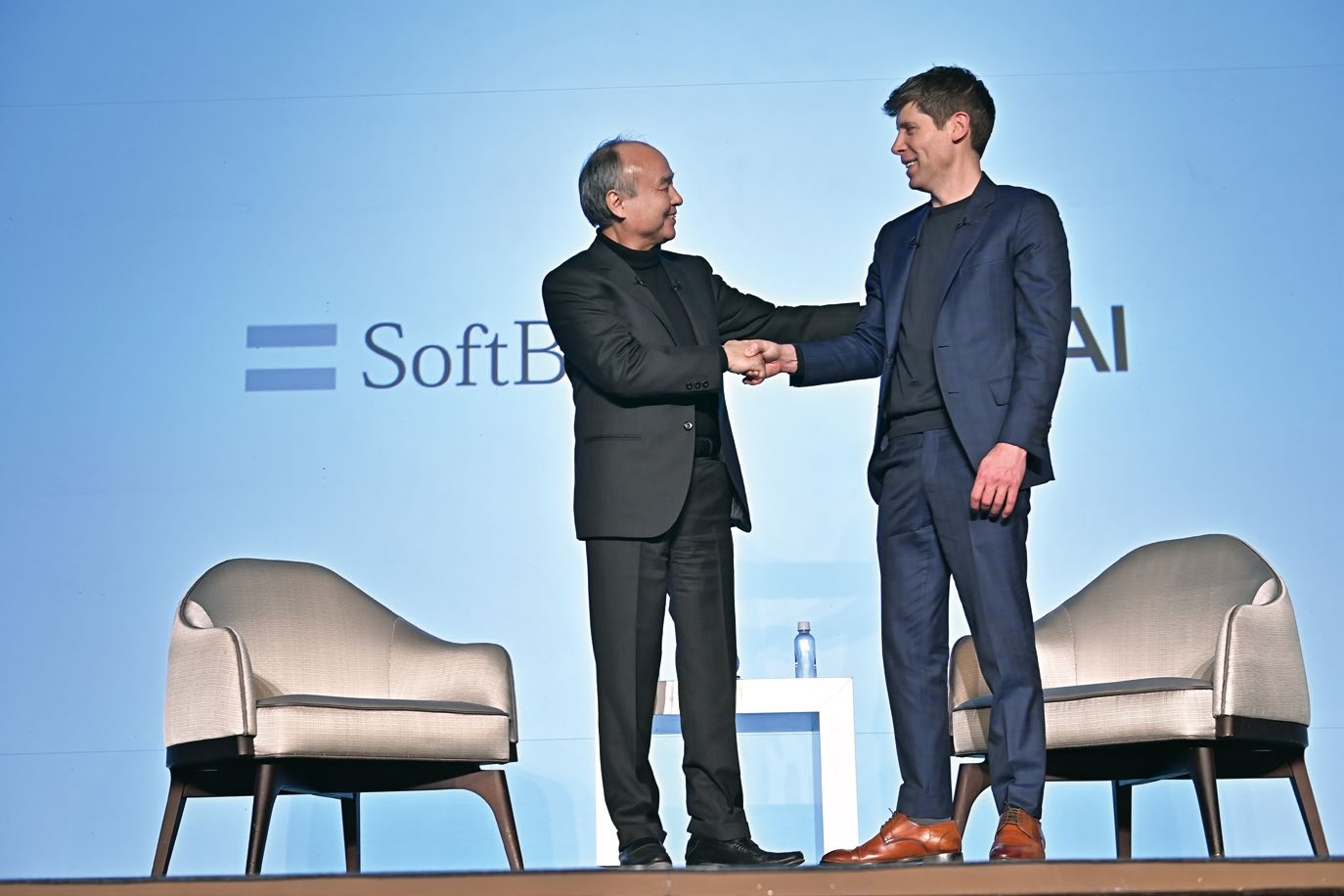
In January 2025, Son was named chairman in the announcement of Stargate, the AI infrastructure venture led by SoftBank and OpenAI. Its announced intention was to invest $500 billion over four years in American infrastructure for OpenAI. SoftBank would take financial responsibility; OpenAI would take operational responsibility. Oracle and MGX were also initial equity funders.
Those were announced ambitions, with construction and financing still to do. The distinction matters. A proposed investment programme describes what its organizers intend to build. A completed investment records money already put to work. Son’s career contains plenty of both, and the figures should keep their labels.
SoftBank Group’s cumulative investment in OpenAI
Approximately 13% ownership · October 1, 2026
On October 1, 2026, SoftBank completed the final $10 billion tranche of a further $30 billion OpenAI investment. Its cumulative investment reached $64.6 billion, representing approximately 13% ownership. The final tranche was funded with proceeds from senior notes. A future imagined in expansive terms had arrived with a very specific financing schedule.
The money belongs to a corporate investment story. Calling it Son’s personal spending would erase the shareholders, lenders and fund structures involved. His influence is central; the obligations extend beyond him. That has been true through the telecom acquisitions, the Vision Funds and the latest AI commitments.
The horizon moves again
Son has long wanted SoftBank to endure for three hundred years. His proposed solution has involved a group of businesses able to change as technologies change, rather than a single operation preserved indefinitely. For a founder who has repeatedly replaced the central business of his company, adaptability is a practical concern.
The retirement revision fits that history. The next opportunity has again altered his sense of where the work ends. He can point to decades in which computing moved from a packaged program to an internet service, a mobile device and now an AI system. He has reasons to expect another change. The cost and rewards of financing it remain open questions.
The Masason Foundation, established in 2016, puts some of that interest in the future into younger hands. It supports talented young people through funding, research opportunities and introductions to others with similar ambitions. In June 2025, it selected thirty-two new members aged nine to twenty-four. Son’s own visit to Fujita came at sixteen.
At nineteen, he divided the future into decades. Nearly half a century later, he has decided the plan needs more room. The inventor wants another page in the notebook. The investors still need the numbers to add up.
Follow the conversation
Son’s own words, company announcements and a conversation worth watching.