In a short alumni update from Shanghai, Alex Clavel remembered two people who rarely appear in the story of a multibillion-dollar investment fund: his language teachers. He named Lin Laoshi and Chou Laoshi, who had taught him during his first two years at Princeton. By then, he was a Morgan Stanley managing director, living in China with his wife and three children. The message was brief. The gratitude had survived the journey.
There is something pleasing about a financier remembering the people who taught him how to ask a question. Careers tend to acquire a more polished origin story as they advance. The early influences become grander; every youthful decision begins to look suspiciously strategic. Clavel’s note offers a smaller, more credible beginning. Someone taught him a language. Years later, in a city where that language mattered, he was still thankful.
Today, Clavel leads SoftBank’s Vision Funds. His work involves deciding where capital should go, how portfolio companies should be supported, and when investors should get their money back. The sums can make the person disappear. Yet the student in that Shanghai update is a useful companion to the executive: attentive to what an earlier education had made possible, and willing to acknowledge who had helped.
A career with several time zones
Clavel graduated from Princeton in 1995, with a degree in East Asian Studies. His subsequent banking career took him through New York, Hong Kong, Shanghai and Tokyo. He spent 19 years at Morgan Stanley, concentrating on mergers and acquisitions in technology, media and telecommunications. He speaks Mandarin Chinese and French, and describes his Japanese as conversational.
The itinerary matters because his present job is international in practice. A company’s route to growth, or to a public listing, depends partly on the market in which it operates. A career spent moving among financial centers provides a concrete introduction to those differences. It also supplies an antidote to the convenient belief that every promising business should follow the same route.
He joined SoftBank in Tokyo in 2015, then worked in Silicon Valley before moving to New York in 2018. In June 2022, he was appointed CEO of SoftBank Group International, succeeding Michel Combes. His remit included an assortment of holdings: Arm, T-Mobile, SoFi, Fortress and Boston Dynamics. Chips, communications, finance, robots. Few job descriptions give the reader quite so much ground to cover.
Masayoshi Son backed the appointment, pointing to Clavel’s international experience and history inside the organization. By 2023, Clavel was identified as co-CEO of SoftBank Investment Advisers. The transition to sole leadership of that business was announced in November 2024 and took effect on January 1, 2025. He continued as sole CEO of SoftBank Global Advisers.
- 1995Princeton graduate
- 2015Joins SoftBank in Tokyo
- 2022Leads Group International
- 2025Sole CEO of SBIA
SBIA = SoftBank Investment Advisers. Sole-CEO transition effective January 1, 2025.
The surprise a banker learns to allow
Clavel has offered a dry description of the culture he came from: “You didn't want to surprise your boss, even on the upside.” It is a fine little piece of office anthropology. A good result, apparently, could still have the bad manners to arrive unexpectedly.
His account of SoftBank emphasizes a different relationship with uncertainty. He describes allowing for outcomes that cannot be known six months ahead, then returning to the decisions to learn from what happened. That is a more demanding habit than merely declaring oneself comfortable with risk. It requires a second look, after the excitement of the original decision has passed.
There is an obvious tension in running funds this way. An investor needs enough conviction to commit money and enough flexibility to revise a judgment. Neither quality is particularly useful without the other. A person who changes direction at every new piece of information can become impossible to follow; a person who never changes can become expensive to follow.
“Staying open-minded and nimble is crucial to the work we do.”
Alex Clavel
When defense became the job
Clavel’s rise coincided with a period when restraint had become essential. In the 2023 management message he shared with Greg Moon and Navneet Govil, the Vision Funds described sharply reducing new capital deployment during fiscal 2022. Portfolio management concentrated on conserving cash, improving resilience and helping companies operate more efficiently.
The statement gives the ambitious language around investing a practical counterweight. Supporting a company can mean pressing it to spend less. Preserving the chance of a future success may require a thoroughly unglamorous conversation about how long the existing cash will last.
At March 31, 2023, the reported cumulative investment loss for Vision Fund 2 was $18.3 billion, before third-party interests, taxes and expenses. The figure belongs to a particular fund and reporting date. It explains the seriousness of the defensive posture without turning every subsequent outcome into a personal score for its CEO.
That distinction is useful throughout Clavel’s story. He leads an investment organization whose results span teams, decisions and market cycles. Taking the job means accepting responsibility for that history. It does not mean having personally made every investment in it.
The exit deserves its own chapter
In an October 2024 conversation at SoftBank’s Mumbai office, Clavel explained why India’s public markets had become more encouraging for investors. Earlier enthusiasm for local businesses had come with a question about liquidity: would the domestic market be deep enough to provide exits? His answer was that capital markets had developed, with greater domestic liquidity reducing dependence on listings elsewhere.
It was a revealing subject for someone whose organization is closely associated with writing large checks. The exit is the less photogenic half of investing. A founder can celebrate a funding round immediately. An investor’s return may require years of waiting, a sale, a listing, and a judgment about when to let go.
SoftBank’s fiscal 2024 results supplied examples. Ola Electric, FirstCry and Swiggy listed in India. Vision Fund 1 also fully exited DoorDash, recording a $7.3 billion investment gain. In a June 2025 interview, Clavel described the DoorDash investment’s return as almost 12 times the money invested.
Investment gain on Vision Fund 1’s fully exited DoorDash position, reported for fiscal 2024. Before third-party interests, taxes and expenses.
These are fund outcomes, and they illuminate the work rather than settle any grand argument about it. A portfolio needs ways to turn ownership into cash. Even a compelling story about the future eventually has to make an appointment with the present.
An AI thesis with a power bill
The recent investment story is increasingly organized around artificial intelligence. In fiscal 2024, the funds made 27 new investments in AI companies. They included OpenAI, Databricks, Perplexity, Glean and AlphaSense. The names cover different parts of the business, from models to software used inside companies.
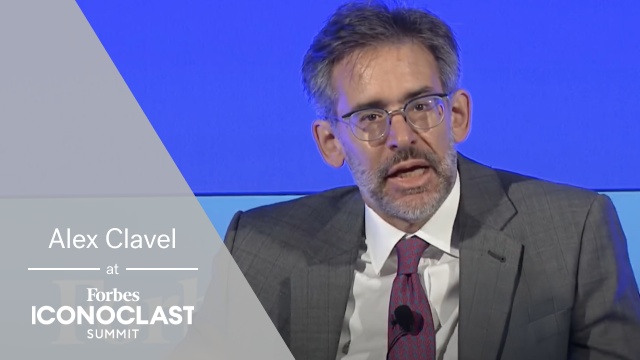
At the June 2026 Forbes Iconoclast Summit in New York, Clavel described four themes: AI models, AI chips, physical AI and AI infrastructure. He shared the stage with Dambisa Moyo, Oscar Fahlgren and Mary Callahan Erdoes. The categories offer a useful way of following the dependencies behind the familiar interface on a screen.
Models need computing capacity. Computing needs chips and infrastructure. Physical AI brings intelligence into robots and autonomous systems. Viewed this way, the investment thesis extends into the equipment and facilities that make the software possible. The future, however weightless it looks in a demonstration, has a power bill.
Investment themes discussed at Forbes Iconoclast, June 2026. Categories, not allocations.
His July 2026 message reported $45.9 billion in Vision Funds investment gains for fiscal 2025, before third-party interests, taxes and expenses, and more than $37 billion of investment activity. Vision Fund 2’s cumulative gain had moved into positive territory. The message also emphasized exits, discipline and exposure across the AI stack. Those qualifications matter alongside the large figures: an investment gain and a cash distribution describe different things.
A smaller room in New York
There is another version of Clavel’s work, with much smaller numbers. In 2018, Prep for Prep welcomed him as a trustee. Its introduction noted that he had judged the organization’s Institute for Entrepreneurship Business Plan Competition that summer. It also recorded his return to New York with his family after working in Asia and Palo Alto.
Clavel had attended Trinity School before Princeton. At Trinity, he had encountered Prep for Prep students firsthand. A June 2026 account of an alumni event described him discussing risk-taking and mentorship alongside Thomas Alston and the organization’s CEO, Diahann J. Billings. He encouraged experienced alumni to pass career knowledge to people coming up behind them.
The parallel with his professional life is modest but clear. Both conversations concern people attempting something before the result is guaranteed. A student presenting a business plan has a different set of resources from a venture-backed founder. Each can benefit from someone who listens carefully and offers an informed response.
The Shanghai note belongs here, too. Clavel once named the teachers whose help he continued to value. His encouragement to mentors gives that gratitude a practical continuation. Useful experience becomes more useful when somebody else can borrow it.
Imagine it. Then make the decisions.
In a May 2026 reflection, Clavel described Sōzō AI, a San Francisco gathering of more than 100 portfolio founders and CEOs from Europe, India, Latin America and the United States. He explained the name through the Japanese ideas of imagining and creating. The two words make an apt pair for an investment organization. A future has to be imagined before anyone can fund it; creating it requires considerably more than the imagination.
That gap is where Clavel’s career now sits. The banking years, the international moves, the defensive periods and the exits all enter the same job. His public remarks leave room for changing course. His responsibilities require him to choose one.
Back in Shanghai, he could identify two people who had made part of his working life possible. The next generation of founders will have its own account of who helped, who listened, and who made the useful introduction. Clavel is now on the other side of that conversation, with decisions to make and people waiting for an answer.