On the back of Altimeter’s early business cards, Brad Gerstner put a compound interest table. It was a curious use of valuable stationery. Most founders devote that little rectangle to a title, a telephone number, perhaps a logo that has endured seventeen meetings. Gerstner gave some of it to arithmetic. The message survived without a sales pitch: money has a different life when it gets time to grow.
That detail makes a useful starting point for a career that now stretches from Silicon Valley investment meetings to a campaign for children’s investment accounts. Gerstner founded Altimeter in 2008. He has backed technology businesses in both private and public markets, challenged Mark Zuckerberg in an open letter, and taken his views into the public conversation with fellow investor Bill Gurley. Underneath the various jobs is a question about who gets to own a piece of what comes next.
A business card. A company’s first funding rounds. A child’s first account. Time keeps turning up in Gerstner’s work.
Indiana, with the risks left in
Gerstner was born in Goshen, Indiana, in 1971 and grew up in nearby Syracuse. His childhood account includes summers around the lake and a much less comfortable education in business. His father ran an auto-parts company. After an acquirer broke commitments to its workers, Gerstner recalls, his father gathered people to start a competitor. The attempt ended in bankruptcy. For a child watching, entrepreneurship included obligations to neighbours and consequences that came home.
Years later, discussing those formative years with Katie Koch, Gerstner placed them against the economic pressures of the late 1970s and early 1980s: high inflation, punishing interest rates, and competition in the car industry. His memory of business was tied to the conditions around it. A capable person could work hard and still encounter a world that refused to cooperate. That is a rather less decorative origin story than the customary lemonade stand.
A Lilly Scholarship helped him attend Wabash College, where he studied economics and political science and spent time at Oxford. He graduated in 1993, completed law school at Indiana University in 1996, practiced securities law, and served as Indiana’s deputy secretary of state. The sequence offered several respectable futures. Gerstner eventually chose a different one, earning his MBA at Harvard Business School in 2000.
Legal training gave him a way to analyse problems; the emerging internet gave him a different set of problems to pursue. His subsequent work with General Catalyst and online travel businesses moved him closer to the people building companies. Before becoming a recognisable technology investor, he had spent time on the operating side of the table. A founder asking for capital could speak to someone who had also needed it.
A fund without a fence
Altimeter began with roughly $3 million during the financial crisis, a small pool for a firm proposing to invest across private and public technology companies. The distinction mattered. A promising business could be privately held on Monday and publicly traded later in its life without becoming an entirely different business. Gerstner wanted an investing organisation that could travel with it.
He had worked at PAR Capital before establishing his own firm. His approach combined the relationships of venture investing with the research and price discipline of public markets. The company entering a funding round and the company reporting to shareholders belonged in the same conversation. Altimeter’s own description of its work emphasises being a long-term partner as businesses enter the public markets.
There is practical sense in that arrangement. An IPO supplies liquidity and a daily price. It does not finish the product, settle every competitive question, or excuse a company from earning its customers’ next payment. An investor who understands the business before the listing may have useful knowledge afterward. The arrangement also asks for fresh judgement: familiarity can become an expensive substitute for thinking.
Altimeter’s investment remit crosses these stages. A listing changes how shares trade; it leaves plenty of work ahead.
Snowflake provided a visible demonstration. Altimeter led its $79 million Series C in 2015. At the cloud-data company’s 2020 IPO, the firm’s stake was valued at about $4.4 billion. The investment helped bring Gerstner onto the 2022 Forbes Midas List, at number 95. The figures describe the value of a firm’s holding at a particular moment, rather than a personal bank balance.
Grab supplies the necessary complication. In 2021, Gerstner’s Altimeter Growth agreed to take the Southeast Asian business public in a transaction with an expected equity valuation of nearly $40 billion. Altimeter committed $750 million to the accompanying private investment. By December 20, shortly after the Nasdaq debut, Grab had lost half its market capitalisation. A plan for patient ownership still has to contend with the price paid at the beginning. The market has never accepted conviction as payment.
The shareholder writes back
On October 24, 2022, Gerstner addressed Zuckerberg and Meta’s board publicly. His letter, titled “Time to Get Fit,” made three concrete proposals: cut employee-related expenses by at least 20 percent, reduce annual capital expenditure by at least $5 billion, and limit yearly metaverse investment to $5 billion. The specificity gave the argument something more substantial than a displeased shareholder’s sigh.
He continued to support founder-led businesses and Meta’s prospects, particularly in artificial intelligence. “We believe the future lies in AI,” he wrote. For Gerstner, belief in the company’s future came with an argument about allocating its present resources. The letter illustrates a version of partnership in which staying invested can include saying something the recipient might prefer to hear privately.
In March 2023, Zuckerberg outlined Meta’s Year of Efficiency, including flatter management, lower-priority projects being cancelled, and plans to reduce the team by around 10,000 people. Those decisions were Meta’s to make. The episode brought Gerstner’s view of focus into public view, while also exposing the distance between an investor’s proposed savings and the people whose jobs become part of that calculation.
“The art of doing less better”
Brad Gerstner, on essentialism
His interest in essentialism provides another way into the argument. He has described it as a philosophy for life as well as business: identify the central purpose and resist accumulating activities that pull you away from it. An investment firm can express that through concentrated positions. A large company faces a messier task, because every project arrives with someone who believes it deserves to stay.
A twelve-year-old’s inconvenient question
In 2020, Gerstner took his sons, Lincoln and Jack, to a peaceful protest in Palo Alto. Lincoln, then twelve, asked what his father intended to do. It was the sort of question that makes adult explanations suddenly feel very well rehearsed. Gerstner looked at the place where he had influence: corporate boards.
He co-founded The Board Challenge with Guy Primus and Sukhinder Singh Cassidy. The initiative asked companies to commit to adding a Black or Latinx director within twelve months. It translated a family conversation into a request a board could actually act on. The target was representation in rooms where consequential business decisions were made.
The episode belongs beside the investment career because access is also about who enters the room. Capital and connections can widen somebody’s choices; board appointments distribute another kind of power. Gerstner’s response used the professional world he already knew. It also gave his sons something more concrete to observe than an adult announcing that the matter was complicated.
An account before a first payslip
Invest America extended the ownership question to children. Gerstner introduced the proposal in 2020; in 2022, he and his sons worked on early application designs. The foundation followed in 2023. Working with Matt Lira, he helped build a coalition around the idea of a funded investment account at birth. The campaign connected an investor’s understanding of a long horizon to the much slower work of public policy.
The enacted federal pilot provides a $1,000 contribution for eligible U.S. citizens born between January 1, 2025, and December 31, 2028, with valid Social Security numbers. The accounts are called Trump Accounts. The eligibility boundaries matter: a universal aspiration and a specific enacted pilot have different dimensions. Gerstner’s campaign helped bring the idea into the 2025 tax legislation.
Federal pilot contribution for eligible U.S. citizen children born in 2025-2028.
An opening contribution, rather than a promised future return.An account at the beginning of life gives compounding a long runway. It also offers a family a reason to talk about what ownership means. A child can learn that a company’s growth has shareholders attached to it, and that market prices can fall as well as rise. The educational possibility sits alongside the money. Whether families engage with that possibility is a question the opening deposit alone cannot answer.
There is an appealing continuity with the business card. The little table invited someone to imagine the consequences of letting money work over time. The children’s account proposal tries to arrange the starting conditions. Gerstner has moved from explaining the arithmetic to helping create a structure in which more people might encounter it.
The conversation keeps going
With Bill Gurley, Gerstner co-hosts BG2, a podcast about technology, markets, investing, and capitalism. Its conversations let the public hear how investors frame questions while the answers are still unsettled. In December 2024, Microsoft CEO Satya Nadella joined them to discuss subjects including AI agents, Microsoft’s investment in OpenAI, and the economics of model scaling.
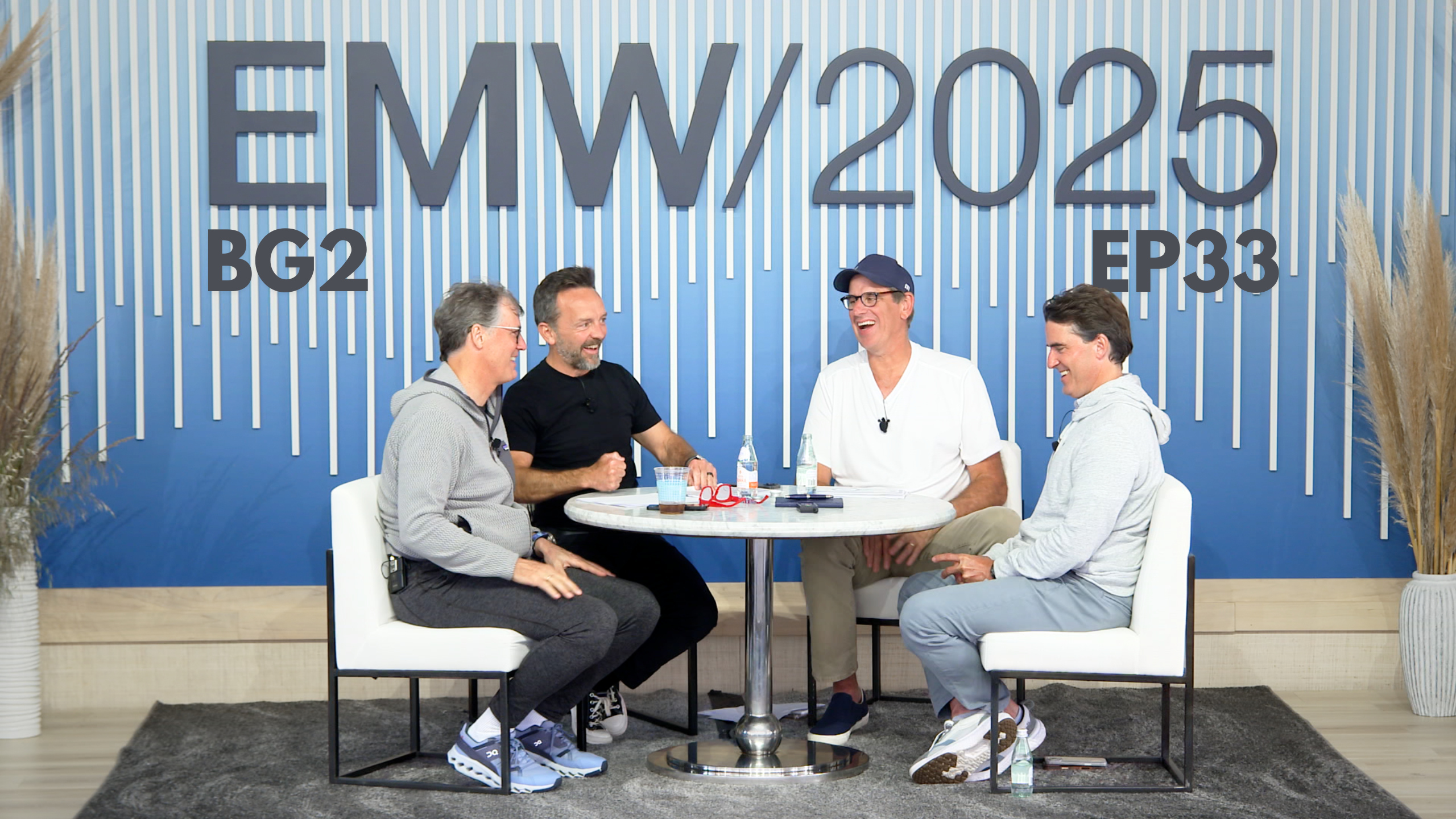
At Coatue’s East Meets West gathering in June 2025, the two hosts sat down with Philippe and Thomas Laffont to discuss AI, crypto, IPOs, and investing across public and private markets. The setting suits Gerstner’s career: people from different corners of investing working through questions that refuse to stay in one corner.
He remained in that conversation in September 2026, joining CNBC’s Halftime Report to discuss the backlash against AI and what it meant for the sector. Alongside the market commentary runs the work on children’s ownership. One calendar contains quarterly results, another contains childhood. The difference in scale is part of what makes the combination interesting.
The business card is still a useful place to leave him. A name on one side, a table on the other. The name tells you who is making the introduction. The table asks you to consider what a beginning might become, given enough time.