AI Rudder Built a Business on the Calls Nobody Wants to Make
A Singapore startup taught machines to phone millions of people a day - in their own language and accent - to chase payments, verify orders and answer questions. Boring work. Very profitable work.
Somewhere in Jakarta, a phone rings. A voice - warm, unhurried, speaking Bahasa Indonesia with the right local lilt - reminds the person on the other end that a loan installment is due on Friday. The call is polite. It answers a follow-up question about the amount. It never gets tired, never gets snippy at the fortieth caller of the hour, and it is not, technically, a person. It is AI Rudder.
The company, founded in Singapore in 2019, sells something deeply unglamorous: automated phone calls and chats for businesses that have to make a lot of them. Not the calls you want - the ones you have to. Payment reminders. Delivery confirmations. Identity checks. Customer surveys. The digital equivalent of the seat in the call center that everyone hopes they won't be assigned to.
That focus turns out to be the whole point. While much of the AI industry chases assistants that write sonnets and summarize meetings, AI Rudder went after the tedious, high-volume, revenue-adjacent conversation - and found buyers who pay for it every month.
01 / What it doesThe call center, minus the call center
At its core, AI Rudder is a voice-AI platform. A bank, lender, insurer or e-commerce firm plugs in a list of customers and a goal - remind these people about payments, verify these orders, survey these buyers - and the platform makes the calls. The bots use automatic speech recognition to understand what a customer says, natural-language processing to figure out what they mean, and text-to-speech to reply in a voice that does not sound like a 2005 IVR menu.
The system routes, reschedules and escalates on its own. If a call needs a human, it hands off. If a customer asks to be called back tomorrow, it calls back tomorrow. Everything is logged, transcribed and turned into the kind of dashboard a operations manager can actually read.
"Machine learning advancements are enabling Voice AI to be increasingly human-like."Kun Wu, Co-Founder
02 / The customersWho is actually buying this
The client roster tells you where the money is: digital lenders, banks, insurers, e-commerce platforms and logistics firms, heavily concentrated in Southeast Asia and increasingly in Latin America. These are businesses that live or die by two numbers - how fast they can reach a customer, and how much it costs to do it. A fintech in Manila with millions of small loans cannot staff a human for every reminder. A logistics firm confirming thousands of deliveries a day cannot either.
AI Rudder grew from roughly 200 enterprise clients in 2022 to more than 500 today, spanning banking, insurance, e-commerce, telecom and consumer finance. The logos on its site read like a directory of Southeast Asian finance and commerce - regional banks, buy-now-pay-later players, digital lenders, insurers and marketplaces. The use cases stack up inside each account: a lender might start with payment reminders, then add KYC verification, then customer surveys, then telemarketing for a new product.
That land-and-expand pattern is the quiet engine of the business. Winning a new bank is hard and slow; adding a second use case to a bank that already trusts the platform is neither. Each new campaign - a delivery confirmation flow here, a policy-renewal reminder there - raises call volume, and call volume is what the meter runs on. A single large client can graduate from a pilot on one workflow to millions of automated interactions a month across a dozen.
03 / The problemWhy a phone call is still hard
The obvious problem is cost. Human call centers are expensive, hard to scale on short notice, and inconsistent - the fortieth call of a shift rarely sounds like the first. Automated voice fixes the cost and the consistency at once: the bot's fortieth call is identical to its first.
The less obvious problem is language. Southeast Asia is not one market; it is Bahasa Indonesia, Tagalog, Thai, Vietnamese, Tamil, Hindi and a dozen regional accents that global voice assistants routinely mangle. A reminder call only works if the person on the line understands it and trusts it. AI Rudder built its product around accents and dialects that bigger platforms tend to skip - which is exactly why local enterprises pick it.
The bots speak Bahasa, Tagalog, Hindi, Tamil, Thai and Vietnamese - the languages most global voice assistants quietly ignore.
There is a third problem, quieter than the other two: trust and consent. In regulated industries, an automated call about someone's loan or insurance policy is not just a technical act - it is a compliance one. Who was called, what was said, whether the customer agreed to be contacted, and whether the transcript can be produced later all matter to a regulator. A voice bot that cannot document itself is a liability, not a tool. AI Rudder's answer is to log and transcribe everything and to carry the certifications that let a compliance officer sign off.
04 / The differenceAccents as a moat
Plenty of companies build voice AI. AI Rudder's edge is less about a single breakthrough model and more about a stack of unglamorous choices: deep coverage of regional languages, a focus on regulated enterprise use cases, and the compliance paperwork to match. The platform carries SOC 2, ISO 27001, GDPR, PDPA, IMDA and CSA certifications - the boring credentials that decide whether a bank's procurement team will even take the meeting.
Against rivals like WIZ.AI, Cognigy, PolyAI, Yellow.ai and Gupshup, AI Rudder's pitch is regional depth plus enterprise-grade trust. The founding team is split across Singapore, Silicon Valley and a Shanghai R&D center - close enough to the markets it serves to know how a reminder call should actually sound.
The expertise shows up in the parts customers never see. Getting a bot to sound natural in ten languages is a speech and machine-learning problem; getting it to stay on course when a customer goes off-script is a conversation-design problem; keeping thousands of simultaneous calls flowing without a busy tone is an infrastructure problem, handled on cloud systems built to burst. The company describes its team as having more than a decade of collective AI experience, and its no-code layer, BotLab, is the attempt to package all of that into something a bank's operations staff can run without calling an engineer.
05 / The productsFrom scripted bot to VoiceGPT
The lineup has grown from a single voice product into a small suite:
AI Voice Agent
Human-sounding inbound and outbound calls for collections, reminders, verification and surveys.
VoiceGPT
Two-way conversations where the bot understands and responds instead of reading a fixed script.
BotLab
A console for building, training and deploying voice and chat agents - no engineer required.
AI Chat Agent
Context-aware chat across messaging channels, including WhatsApp Business.
Omnichannel
Voice, chat, email and social stitched into one continuous customer conversation.
AICC
An AI contact center with automation, analytics and real-time assistance for human agents.
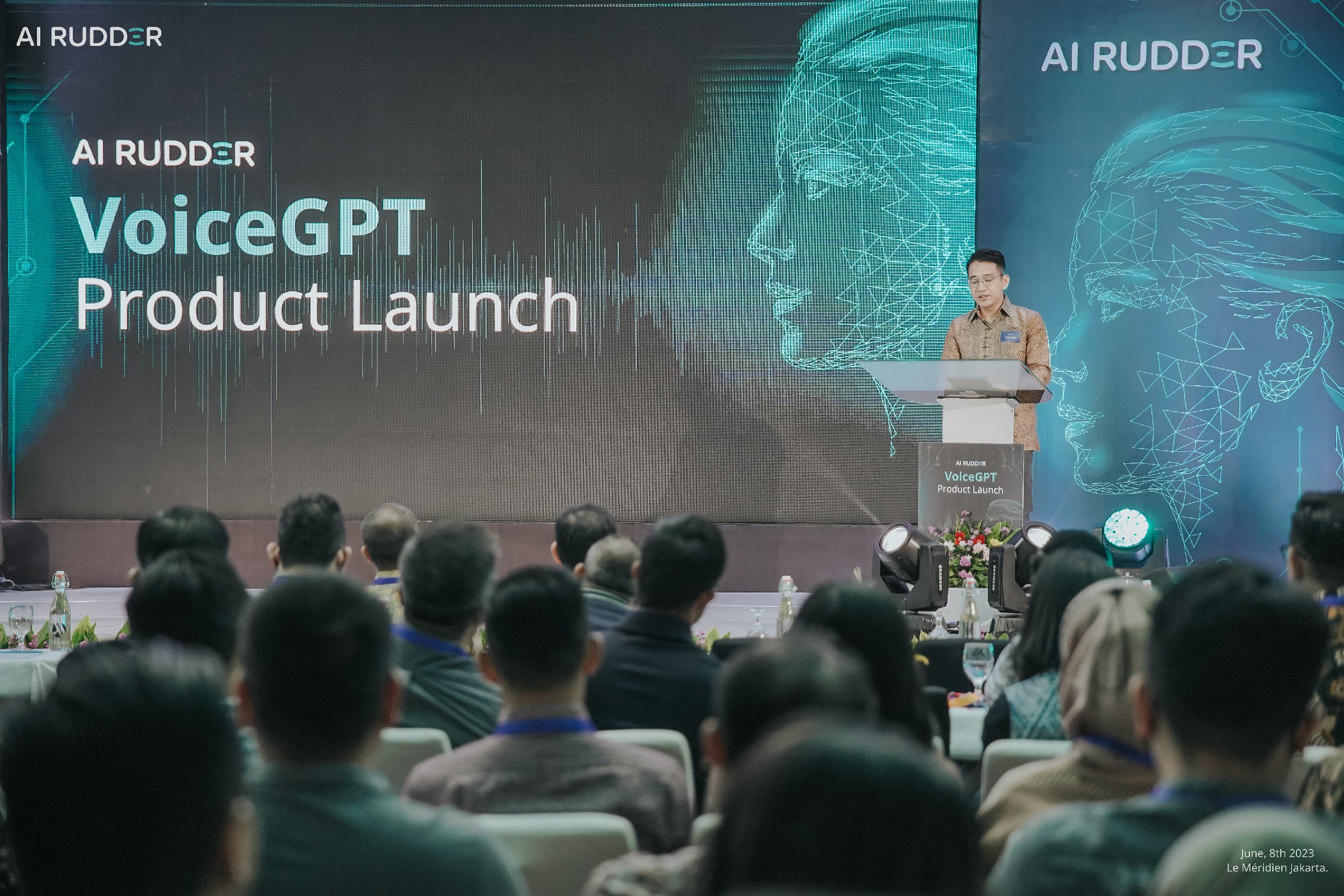
The 2023 launch of VoiceGPT was the inflection point. Before it, the bots followed decision trees. After it, they could handle the messy middle of a real conversation - a customer interrupting, changing the subject, asking something the script never anticipated.
06 / The moneyHow it earns, how it raised
The business model is B2B software: enterprises pay to run their calls and chats through the platform, priced largely by usage and subscription, and spending grows as call volume and use cases grow inside each account. The company reported 400% year-on-year revenue growth in 2021, with recurring revenue tripling that year.
Investors noticed. AI Rudder went from a US$1 million seed in early 2020 to a US$50 million Series B in March 2022, backed by Sequoia Capital India, Tiger Global, Coatue and Cathay Innovation, among others - more than US$60 million in total.
The math a buyer runs is simple. A human agent handles calls one at a time, needs breaks, and costs a salary in a market where wages are rising. A bot handles thousands at once, works around the clock, and its cost per call falls as volume climbs. For a lender making millions of reminder calls, even a small automation rate moves the numbers. The Series B was explicitly aimed at scaling that flywheel - doubling headcount into specialized technical roles and adding languages including Arabic, Cantonese, French, German, Japanese, Korean and Portuguese to widen the map of markets where the pitch works.
"AI Rudder's global approach and expanding market fit our thesis for AI-driven customer experience reimagination."Nicolas du Cray, Partner, Cathay Innovation
07 / The marketWhere it fits
AI Rudder sits at the intersection of two big shifts: enterprises automating customer operations, and voice AI finally becoming good enough to trust with a live call. Its chosen ground - emerging markets with high call volumes, many languages, and thin margins - is precisely the terrain where automated voice has the clearest payback.
The company now runs across nine-plus countries, with a headquarters in Singapore, a Shanghai R&D center and offices spread from Jakarta and Manila to Mexico and Brazil. CEO Teng Ren was named to Forbes China's Top Leaders in the 2025 Global Expansion 30 & 30. The next frontier, judging by its expanding language list, is everywhere a reminder call still gets made by a human who would rather be doing something else.
Which is to say: almost everywhere.