PolyAI raises $86M Series D • $750M valuation • December 2025 151 years of customer calls handled in 2025 alone Forbes 30 Under 30 Europe 2021 • Technology 200+ enterprise customers across 45+ languages Forrester: 391% ROI • $10.3M avg savings per enterprise PolyAI raises $86M Series D • $750M valuation • December 2025 151 years of customer calls handled in 2025 alone Forbes 30 Under 30 Europe 2021 • Technology 200+ enterprise customers across 45+ languages Forrester: 391% ROI • $10.3M avg savings per enterprise
Co-Founder & CEO • PolyAI

Nikola
Mrkšić

Voice AI • Cambridge PhD • $206M Raised

Built a voice AI so good that callers sometimes stop mid-sentence and apologize for being rude to what they realize might not be a person.

$206M
Total Raised
$750M
Valuation
200+
Enterprise Clients
45+
Languages
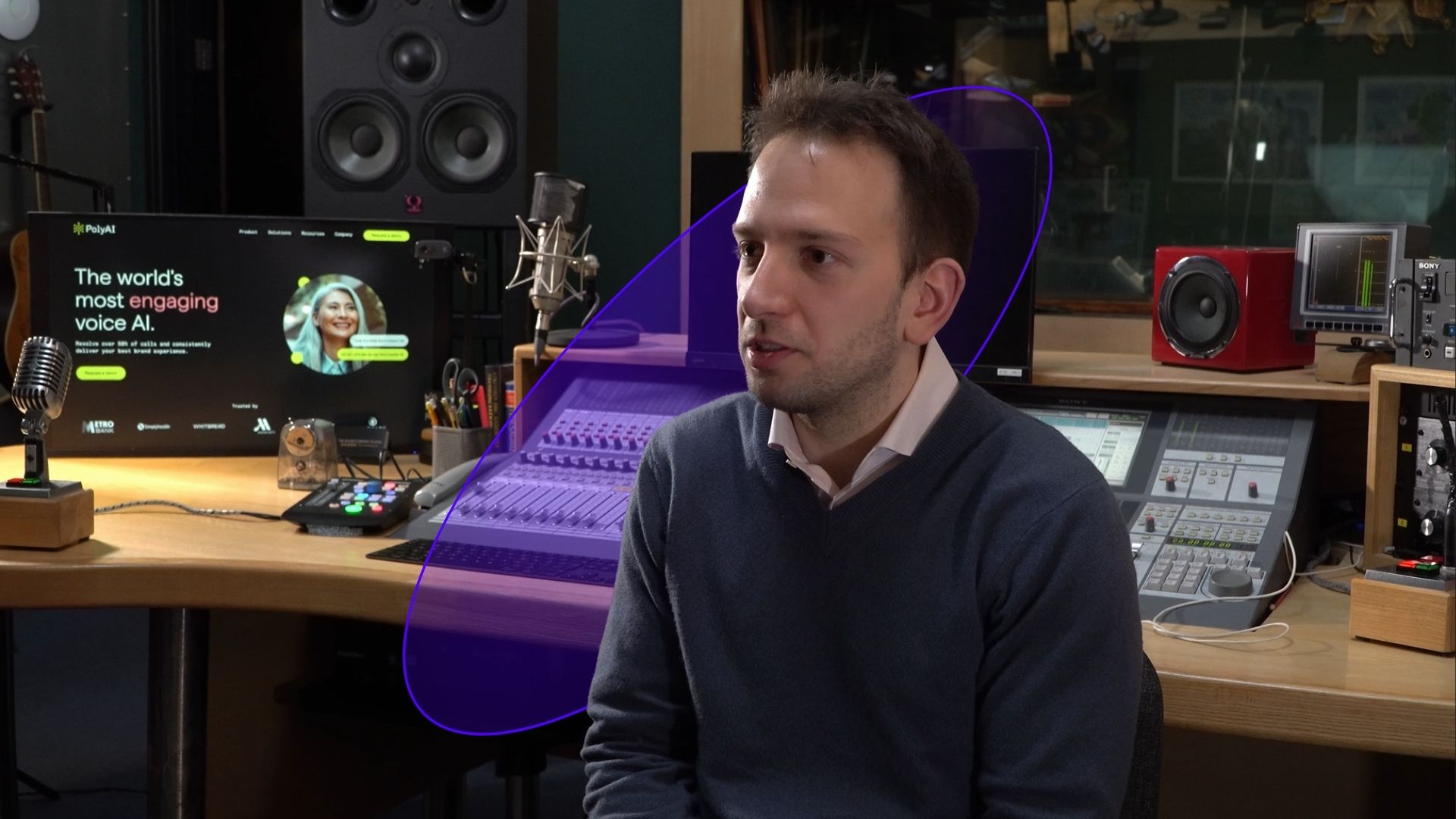
Nikola Mrkšić, co-founder and CEO of PolyAI

Callers using PolyAI's voice agents occasionally do something strange. Mid-sentence, they pause - sometimes during a complaint, sometimes mid-rant about a late delivery or a billing error - and apologize. Not because someone asked them to. But because a small doubt has crept in: what if this is a person? That moment, that flicker of uncertainty, is what Nikola Mrkšić has spent the better part of a decade engineering. Not a trick, not a parlor gimmick. The actual, hard, unsolved problem of building a voice AI that handles real conversations the way a skilled human agent would.

Mrkšić grew up in Belgrade in the early 1990s, when Yugoslavia was coming apart at the seams. He attended the Belgrade Mathematical Gymnasium - a competitive school originally designed during the Tito era to produce mathematicians and scientists. Whatever the curriculum was supposed to do, it worked on him. He developed an early obsession with mathematics and computation, the kind that earns full scholarships to Cambridge University.

At Cambridge, he landed in the Machine Intelligence Lab under Professor Steve Young - himself a founder of voice technology work - and completed a BA, MSc, and PhD on spoken dialogue systems. His dissertation: "Data-driven language understanding for spoken dialogue systems." One mentor, the famous machine learning researcher Zoubin Ghahramani, offered an instruction that Mrkšić has clearly internalized: "Don't just go and become a PowerPoint monkey."

"It's always been a gimmick. Now, finally, it's becoming infrastructure."
- Nikola Mrkšić on the evolution of voice AI

The Apple Detour That Wasn't

Before PolyAI, there was VocalIQ - another Cambridge spinoff working on real-world dialogue models. Mrkšić was its first technical hire, not an academic footnote but the person actually building the thing. When Apple acquired VocalIQ in 2015 to improve Siri, he went with it. For two years he worked on making Siri more conversational from inside one of the world's most secretive companies.

He left in 2017. Not to take a break, but to start over. He co-founded PolyAI in London with two colleagues from Cambridge's Machine Intelligence Lab: Tsung-Hsien Wen, who became CTO, and Pei-Hao Su, who became SVP of Engineering. Three researchers who had studied the same problem for years from a university lab decided to solve it properly, in the market, at enterprise scale.

The original bet was straightforward: voice was the natural interface for customer service. Not chat, not email - voice. People call when things go wrong, when stakes feel high, when they want a human response. The challenge was building a voice AI that could actually handle that complexity - identity verification, multi-step problem resolution, emotional tone, accents, interruptions - without falling apart the moment something unexpected happened.

The Architecture of Trust

PolyAI built a platform that handles the full surface area of a real customer service call. Not a basic IVR that routes calls to the right department. A system that can verify your identity, pull your account details, understand what went wrong, and resolve it in a single conversation - while adapting its voice, accent, and tone to match the brand it's representing.

The proprietary edge is data. PolyAI has accumulated a dataset of human-to-AI customer service conversations with outcomes that no competitor can replicate. Conversations with Marriott guests, Caesars Entertainment callers, FedEx customers. The system learns what resolution actually looks like in each industry, with each type of inquiry. The platform operates in 45+ languages, and is language-agnostic: an agent built in English can be ported to any other language without redevelopment.

151 yrs of calls handled in 2025
391% ROI for customers (Forrester)
50% of calls resolved end-to-end
$10.3M avg savings per enterprise

UniCredit improved its Net Promoter Score by 14 points after deployment. Forrester calculated that PolyAI customers average $10.3M in savings and a 391% return on investment. At multiple enterprise clients, the system handles the equivalent of 1,000+ full-time employees' workload. And it never calls in sick, never has a bad day, never loses patience on call number 400.

The ChatGPT Vindication

When OpenAI launched ChatGPT in late 2022, it quadrupled PolyAI's inbound leads almost overnight. For most AI companies, that was a surprise. For Mrkšić, it was a vindication - seven years of patient building, finally meeting a market that suddenly understood what voice AI could do.

His position on the channel debate has been consistent and blunt: "Start automating the phone now. Don't distract yourself with chat." The data backs him up. PolyAI's own research shows 86% of Gen Z and younger millennials prefer voice for customer support when something goes wrong. The phone call isn't dying. It's just waiting to be handled better.

His vision for the contact center is a structural reorganization: what he calls a "command center" model where AI handles 90% of inbound queries, and human agents focus exclusively on the conversations that require real judgment. Not a cost-cutting exercise, but a reallocation - where the humans who remain become genuinely more valuable, and the AI stops pretending to be a shortcut.

"The phone still reigns in customer service. Start automating it now. Don't distract yourself with chat."
- Nikola Mrkšić, PolyAI CEO

$206M - Four Rounds, Eight Years

Series A
Khosla Ventures • 2021
Undisclosed
Series B
Georgian • Twilio • 2022
$40M
Series C
Hedosophia • NVIDIA • 2024
$50M
Series D
Georgian • Hedosophia • Khosla • 2025
$86M

From Belgrade to $750M

The Series D closed in December 2025 at an $86M raise, co-led by Georgian, Hedosophia, and Khosla Ventures - a remarkable show of consistency from the original backers. The round valued PolyAI at $750M, with total funding crossing $206M. New investors included Citi Ventures, British Business Bank, and NVentures (NVIDIA's venture arm), which had first backed PolyAI in the Series C.

By early 2026, the customer list had grown past 200 enterprise brands - Marriott, FedEx, Caesars Entertainment, PG&E, Volkswagen, UniCredit, Foot Locker, Starling Bank, and Whitbread among them. In March 2026, PolyAI won the Gold Award at the Stevie Awards for Best Customer Support Solution. The 270-person company runs out of a London headquarters with a growing San Francisco presence.

Mrkšić's academic work runs alongside all of this. His Google Scholar profile shows 7,477+ citations - researchers who have built on his work in machine learning and spoken dialogue systems. He was named advisory board member by Serbia's Institute for International Relations, and appeared on Forbes 30 Under 30 Europe in 2021. The research never really stopped; it just moved into a company.

Quotes

"The phone still reigns in customer service."

"Start automating the phone now. Don't distract yourself with chat."

"It's always been a gimmick. Now, finally, it's becoming infrastructure."

"86% of Gen Z and younger millennials prefer voice for customer support when things go wrong."

"Contact centers should evolve into command centers where 90% of queries become automated."

"Don't just go and become a PowerPoint monkey." - Zoubin Ghahramani, the advice Mrkšić has never forgotten.

Forbes 30 Under 30 Europe 2021 - Technology category
🏆
Stevie Awards 2026 - Gold for Best Customer Service/Support Solution
🎓
Cambridge PhD on spoken dialogue systems - 7,477+ academic citations
💰
$206M raised across four funding rounds - $750M valuation at Series D
🌎
Platform operating in 45+ languages across 25+ countries
📞
PolyAI handled the equivalent of 151 years of customer calls in 2025
📈
Forrester-verified 391% ROI - average $10.3M savings per enterprise customer
🚀
First technical hire at VocalIQ before Apple acquisition (2015)

From Belgrade Gymnasium
to $750M Voice AI

1991
Born in Belgrade, Serbia during the collapse of Yugoslavia. Attends Belgrade Mathematical Gymnasium.
2011
Full scholarship to Cambridge University. Studies in the Machine Intelligence Lab under Prof. Steve Young.
2011-2015
First technical hire at VocalIQ - a Cambridge spinoff building real-world dialogue models for voice.
2015
Apple acquires VocalIQ. Mrkšić joins Apple's Siri team to make the assistant more conversational.
2017
Leaves Apple. Co-founds PolyAI in London with Cambridge colleagues Tsung-Hsien Wen and Pei-Hao Su.
2021
PolyAI closes Series A (Khosla Ventures). Named Forbes 30 Under 30 Europe - Technology.
2022
$40M Series B led by Georgian. ChatGPT launches and quadruples PolyAI's inbound leads.
2024
$50M Series C led by Hedosophia with NVIDIA. Valuation reaches ~$500M. 100+ enterprise customers.
2025
Launches Agent Studio (April). Closes $86M Series D at $750M valuation (December). 151 years of calls handled.
2026
200+ enterprise customers. Stevie Awards Gold for Best Customer Support Solution.
University of Cambridge
PhD, Computer Science - "Data-driven language understanding for spoken dialogue systems"
2011 - 2017 • Advisor: Prof. Steve Young
University of Cambridge
BA & MSc, Computer Science - Machine Intelligence Lab
2011 - 2015
Belgrade Mathematical Gymnasium
Secondary Education - Mathematics & Sciences
Pre-2011 • Belgrade, Serbia
Google Scholar
7,477+ citations. Research areas: Machine Learning, NLP, Spoken Dialogue Systems, Conversational AI
Academic contributions • Ongoing

Things Worth Knowing

Enterprise Customers Include
Marriott FedEx Caesars Entertainment PG&E Volkswagen UniCredit Foot Locker Starling Bank Metro Bank Whitbread Hopper Landry's