Founder · CEO · Alex AI
Aaron Wang
He built an AI named Alex that interviews America - thousands of conversations a day, on behalf of the firms whose front doors you have been trying to get through.
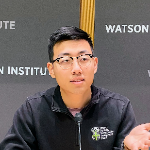 AARON WANG // SAN FRANCISCO
He built an AI named Alex that interviews America - thousands of conversations a day, on behalf of the firms whose front doors you have been trying to get through.
AARON WANG // SAN FRANCISCO
Somewhere right now, a candidate is being interviewed by Alex. Alex is patient, never double-books, and remembers every answer. Alex is also not a person.
Aaron Wang runs the company behind it, and the company is also called Alex. Same name, no accident. When you build the thing that asks the first question in a hiring process, you want a name people can say out loud without a syllable wasted. So when the domain alex.com came up for sale, Wang spent more than half a million dollars on four letters and renamed his startup - Apriora - after it. Referrals climbed. Inbound climbed. The name did the talking.
That is the kind of move that sounds reckless until it works. Wang's whole thesis runs on a similar inversion: the resume is overrated, and the conversation is underrated. His AI recruiter calls candidates, screens them by phone and video, checks backgrounds, talks salary, confirms availability, flags the ones gaming the system, and writes everything down - all before a human recruiter spends a minute. It does this thousands of times a day, for Fortune 100s, Big Four accounting firms, financial institutions, and the staffing agencies that move tens of thousands of people into jobs.
"Our thesis is that a 10-minute conversation with you tells me a whole lot more about you than your LinkedIn profile does."
Hold that sentence up to the light and you can see the entire company inside it. Wang is not trying to rank you by where you went to school or which logos sit on your timeline. He is betting that ten minutes of talking reveals the thing the paperwork hides. And he is willing to let a machine do the listening, around the clock, so that nobody waits two weeks for a callback that decides their month.
An agentic AI recruiter that autonomously runs phone screens, video interviews, technical and behavioral assessments, then syncs to your ATS in one click. Founded 2023. Y Combinator, Winter 2024.
Technical co-founder. In the YC shorthand: the one who "just builds." Wang handles the why and the who; Rytel handles the how.
Before Wang taught software to interview people, he spent a stretch at a quant hedge fund - Arrowstreet Capital - where the job is to find signal in oceans of noise and trust the math over the gut. That instinct never left him. Ask him how computer science, computational biology, and economics fit together and he shrugs: they are "different versions of applied math, applied to different datasets." He triple-majored in them at Brown, cross-registering at Harvard, as if collecting datasets to point the same toolkit at.
Then came Facebook AI Research, the FAIR lab in Menlo Park. Wang worked on self-supervised computer vision - the Barlow twins line of work - and on the Orion augmented-reality glasses, teaching a machine to recognize objects in the real world and stitch a personalized layer on top. It was bleeding-edge, and it taught him a lesson he repeats now: technology has to match its medium. Computer vision belongs on glasses. Voice belongs in an interview.
"There's a big why-now moment in AI." So he left the hedge fund and went looking for it.
Recruiting tech had been a graveyard for years - lots of tools, little value created. But voice AI and agentic systems changed the physics. A machine could finally hold a real conversation, not just parse a keyword. Wang aimed it at the hardest, highest-volume corner of the market: the enterprises drowning in applications, where a single role can pull thousands of candidates and the average screen costs thousands of dollars and a month of calendar time.
Y Combinator's Winter 2024 batch sharpened the aim. Wang credits an almost monastic focus on the right ideal customer profile for finding product-market fit. Apriora launched. The seed round - $3M from 1984 Ventures - came first. Then, eighteen months in, the company said it had helped tens of thousands of candidates get hired across hundreds of companies. In September 2025, Peak XV Partners led a $17M Series A, with Y Combinator, Uncorrelated Ventures, and a quiet roster of Fortune 500 CHROs writing checks. The people who run hiring at the biggest companies in America were investing in the thing that does their first interview.
“Our AI recruiter does thousands of interviews a day and helps people get hired at some of the biggest companies in the world.”
Aaron Wang · Co-Founder & CEO, Alex
Most founders would call it vanity. Wang called it growth. The day Apriora became Alex.com, word-of-mouth referrals and inbound pipeline jumped. A name you can say in one breath turns out to be a feature.
From building object detection for AR glasses to building a voice that conducts interviews, Wang's rule held: the technology has to fit the medium it lives in. An interview is a conversation, so the AI talks.
He calls the city's cycling culture communal and mind-clearing - the place he goes to think. A founder running an always-on machine still needs a way to switch his own engine off.
Reaches out. Candidates get an instant response by SMS or email - no two-week silence.
Self-schedules. Applicants book their own interview, day or night, no recruiter calendar tetris.
Interviews. Phone screen, video, technical, system design, behavioral - Alex runs the format the role needs.
Screens & checks. Resume review, background, salary expectations, availability - 20+ automated workflows.
Flags cheating. A fairness system watches video, keyboard, and attention to catch AI-assisted answers.
Hands off clean. Detailed notes and a one-click ATS sync, so humans spend time only on the qualified.
“They're all just different versions of applied math, applied to different datasets.”
On studying computer science, biology & economics at once
The company and its flagship AI recruiter share one name: Alex. You hire Alex to find people for you, from a company called Alex.
Alex clocks more interview hours in a single day than a human recruiter logs in years.
Quant trader, ML engineer, research scientist - Wang wore all three before turning "recruiter" into a software category.
Several Fortune 500 chief HR officers invested directly in the Series A - the buyers became believers.
Beyond Alex, Wang serves as a Venture Partner at Pioneer Fund, backing other founders chasing their own why-now moment.
Strip away the funding headlines and the domain story, and Wang is making one stubborn bet: that the hiring process is broken at the front, not the back. The resume screen - the part where a human skims hundreds of PDFs and guesses - is exactly the part that scales worst and judges least. It is slow, it is biased toward keywords, and it leaves most applicants in silence. Wang's answer is not to make humans skim faster. It is to give every candidate the one thing a resume can never deliver: a conversation, immediately, on their schedule.
That reframing matters because it changes who wins. When the first interview is free, instant, and available at 2 a.m., the candidate who would have been filtered out by a keyword mismatch gets heard. The enterprise that used to lose talent to a two-week callback delay closes the gap. Wang likes to point out that Alex maintains a 90%-plus interview completion rate and a 4.5-out-of-5 candidate experience score - numbers that argue people do not mind talking to a machine, as long as the machine respects their time.
He is clear-eyed about the arms race, too. As candidates reach for AI tools of their own, Alex turns into a referee as much as an interviewer, watching video, keyboard cadence, and attention to spot answers that are not really the candidate's. Wang calls it a cat-and-mouse game, and he does not pretend it is finished. It is the cost of doing the first interview at scale.
The endgame he describes is bigger than screening. He imagines agentic AI eventually running the whole recruiting cycle - sourcing, scheduling, interviewing, feedback - with humans freed to do the part that actually needs a human: building relationships with the people worth hiring. Whether that future arrives on his timeline or not, Wang has already moved the line of what a software company is allowed to automate. A few years ago, "AI recruiter" was a pitch nobody believed. Now it is a category, and his company owns the four-letter domain that fronts it.
It is a long way from a quant desk and an AR-glasses lab to a machine that interviews America. But the through-line is consistent: point the right toolkit at the right dataset, match the technology to its medium, and trust that ten honest minutes beat a polished page. Aaron Wang has built a company on that conviction - and named it, plainly, Alex.
Peak XV Partners (lead, Series A) · Y Combinator · Uncorrelated Ventures · 1984 Ventures (seed) · several Fortune 500 CHROs investing directly.
Fortune 100 companies, Big Four accounting firms, major financial institutions, nationwide restaurant chains, and high-volume staffing agencies.