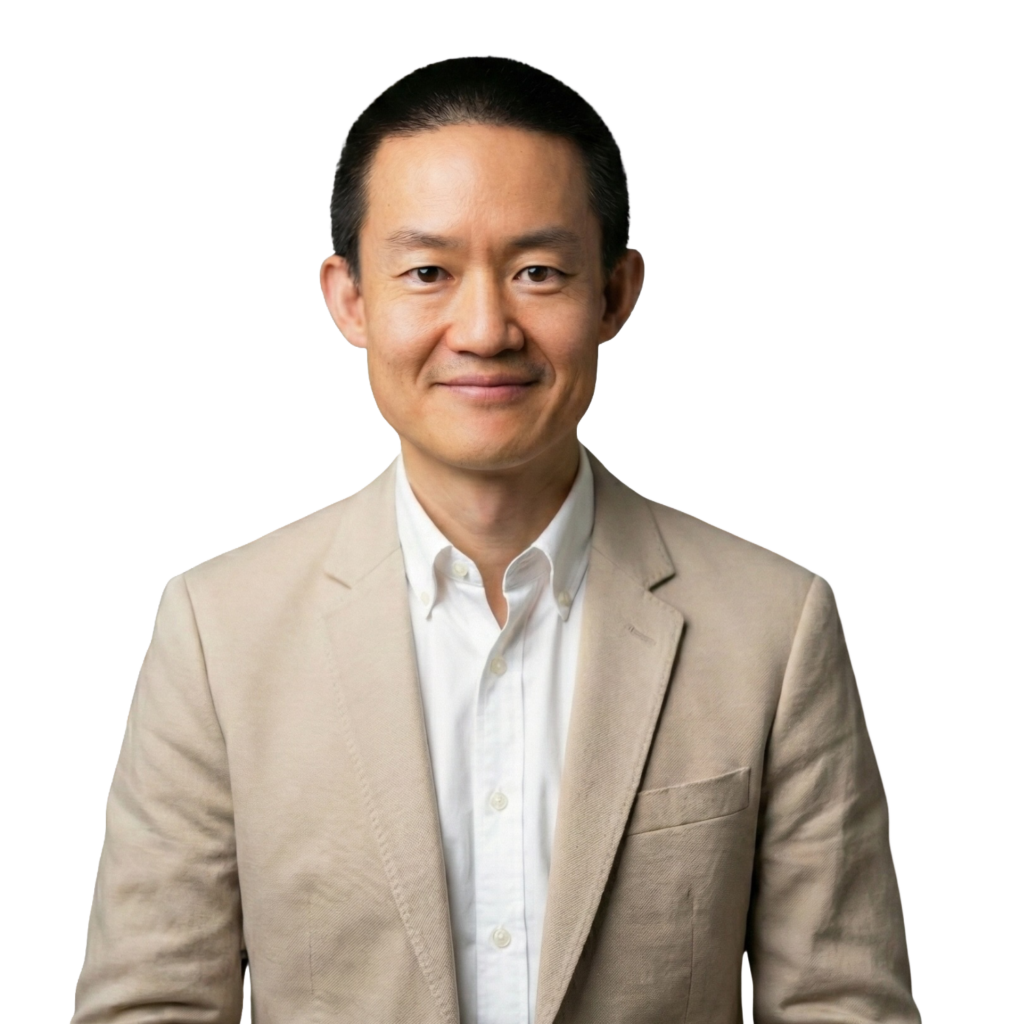
Data Anomalies to Disney Exits
Before Playdom, before Disney, before the arc that would make him one of Silicon Valley's more quietly impressive builders, Ling Xiao was at Google, puzzling over data anomalies. That's not a throwaway line - it's the whole thesis. Xiao sees things in data that other people walk past. It's what brought him to Stanford as a PhD candidate in computer science, where he researched scalable visual analysis of large datasets. It's what made him dangerous when he and his Berkeley co-founders decided to take a swing at the social gaming market in 2008.
Playdom launched in December of that year. The market for games played on social networks was valued at $300 million at the time - a number that felt large until it wasn't. Xiao took the VP of Engineering seat, which understates what he actually built. The analytics platforms, the monetization infrastructure, the systems that would eventually help Playdom serve tens of millions of players - those fingerprints are his. Within two years, Playdom had 42 million monthly players and the No. 3 position in social gaming.
In July 2010, The Walt Disney Company acquired Playdom for up to $763 million - $563 million upfront, with $200 million more in earnouts. It was, at the time, the richest deal the social gaming market had ever seen. Xiao moved into Disney as VP of Technology and eventually Chief Digital Officer of the Playdom unit, staying through the evolution of the acquired company until Disney closed Playdom's operations in 2016.
"22 percent of players have quit playing a game due to toxicity."
- Dennis Fong, GGWP CEO, on the problem Ling Xiao's team set out to solveThe Gaming Toxicity Problem
After Disney, Xiao didn't step back. In 2020, he joined forces with Dennis Fong (a legendary gaming figure), Crunchyroll co-founder Kun Gao, and data expert George Ng to co-found GGWP - named for the gaming phrase "Good Game, Well Played." The company built an AI-powered moderation platform to combat toxic behavior in online games. Xiao served as Chief Product Officer.
The product concept was precise: give game publishers a customizable moderation system with incident context, severity assessment, historical player data, reputation scores, and credibility ratings. Real-time, at scale. In 2022, GGWP raised a $12 million seed round led by Bitkraft Ventures, with backing that included Riot Games, Sony Innovation Fund, Twitch founders Emmett Shear and Kevin Lin, YouTube founder Steve Chen, and gaming personality Pokimane.
Now: Hunting Intellectual Property Pirates
Today, Xiao runs Ruvixx, Inc. as CEO - a San Francisco-based SaaS platform helping enterprise brands protect intellectual property, automate license compliance, and convert market opportunities into revenue. The clients include Adobe, Chaos, Dolby, HDMI, and Trimble. The mission: stop the revenue leakage that happens when software gets used without a license, and find the unlicensed users who could become paying customers.
Ruvixx's platform centralizes data and project management across internal teams and external partners, with analytics, workflow automation, and strong data management capabilities. The company runs dual tracks: brand protection - watching for counterfeits, gray market activity, and infringement - and license lifecycle management, from lead generation through royalty reporting and compliance enforcement.
The approach is explicitly technology-enabled but human-anchored. Ruvixx leans on OSINT specialists, investigative operations, and expert negotiators. The company thinks globally - with local market expertise and on-the-ground teams - which is the infrastructure that makes the "Think Global. Act Local. Win Everywhere." positioning more than a tagline. With 120 employees and annual revenue approaching $8.6 million in 2026, the company is growing.
Ruvixx Core Capabilities
- License lifecycle management: from lead generation to royalty reporting
- Brand protection: counterfeit detection, gray market control, infringement monitoring
- AI-powered analytics and real-time business intelligence dashboards
- OSINT investigation and expert negotiation
- Data waterfall, entity matching, and algorithmic validation
- Campaign management and digital event platforms
The Engineer Who Builds Boards
Parallel to the company-building runs a quieter thread: angel investing and board service. Xiao has held board seats or made angel investments at Reflektive (real-time performance management), Kenzie Academy, Brava Home Inc., and Green Chef - a range that signals he bets on people and product velocity, not just sector.
What ties these together isn't a theme - it's a methodology. Xiao starts with data, builds at scale, and moves the moment a problem proves interesting enough. Social gaming proved interesting in 2008. Gaming toxicity proved interesting in 2020. Intellectual property enforcement in an era of AI-powered counterfeit operations proved interesting enough to put him in the CEO seat.
His educational arc mirrors this pattern: EECS at UC Berkeley, computer science at Stanford (where he was a PhD candidate doing research in scalable visual data analysis), and time at Google working on search-adjacent problems. The PhD was left unfinished - not an abandonment, but a redirect. The company he built instead ended up being acquired by the same company that made Mickey Mouse.
The Edge
Why This Career Makes Sense
The Ling Xiao career doesn't fit a tidy narrative of "serial founder pivots from gaming to enterprise SaaS." It fits a tighter one: he goes where the data problems are unsolved and the stakes are high enough to build something real.
At Google, the problem was search data at scale. At Stanford, it was the visual representation of massive datasets. At Playdom, it was building the analytics and monetization layer that could serve 42 million players and attract Disney's checkbook. At GGWP, it was the pattern-recognition problem of toxic behavior across millions of real-time gaming interactions. At Ruvixx, it's the detection-and-conversion problem of unlicensed software use in global markets - a problem that's getting harder as digital goods proliferate and AI lowers the cost of infringement.
None of these are obvious. Each one required Xiao to apply his Berkeley EECS foundation and Stanford research instincts to a problem that looked like a product challenge but was actually, underneath, a data challenge. That's the through-line. And it's the reason Ruvixx's enterprise clients trust him to find revenue they didn't know they were losing.