The plane was heading from San Francisco to Las Vegas when the turbulence arrived. Wayne Slavin noticed the passengers around him gripping their armrests. He was working in payments, where transactions could happen in real time. Insurance, he thought, ought to be available with something approaching the same convenience. A flight was a particularly persuasive place to consider the proposition.
In his telling, the incident happened in 2014. He asked nearby passengers whether they would have bought coverage before taking off. They said yes. Airborne market research has certain advantages: the audience is captive, and nobody can leave the focus group before landing. Still, an enthusiastic answer on a bumpy flight leaves a rather large question about what someone will do back on solid ground.
Slavin went on to build a weekend prototype and run paid advertisements. He has reported a 15.91 percent rate of people moving from an ad click through the attempted purchase process. The test used a simulated checkout error; it was an experiment in demand, rather than a functioning insurance sale. The precision of that percentage mattered to an engineer trying to decide whether an odd idea deserved a year of his life.
Sure eventually launched in 2015. But the company that emerged would ask Slavin to reconsider who the customer actually was. He started with people looking at a phone. He would end up spending much of his time with businesses trying to make everything behind that phone work.
Before the policy, the product
Long before insurance, Slavin was immersed in computers and wireless networks. He grew up in Southern California after his family moved from South Africa to the United States. His recollections of the early internet include DOS, dial-up connections and bulletin boards, followed by the familiar progression from breaking the family computer to repairing other people's machines. Curiosity could become useful work. Useful work could become a business.
There is a public record of that interest in NetStumbler.com, where he was a founder and webmaster. In 2002, he was discussing wireless network security and the access points he had identified in the United States and Canada. His author archive later ranged across Wi-Fi, mobile devices and the practical business of getting connected. The technology has changed considerably; his interest in the machinery underneath everyday activity is easier to recognize.
His subsequent career crossed consumer electronics, enterprise software and mobile payments. He worked on Barnes & Noble's Nook, at Buddy Media, and as vice president of product management at Tapingo. He also sold the enterprise software business BackupRight in 2012. Those were different markets, with different customers, but each required software to survive contact with how people actually behaved.
At Columbia University, where he earned a master's degree, he sought out a program that connected students with senior technology executives. He has described deliberately shaping his academic work to find the sort of mentor he wanted. Technical competence had already opened doors. Management, incentives and learning from other people would determine what happened after he walked through them.
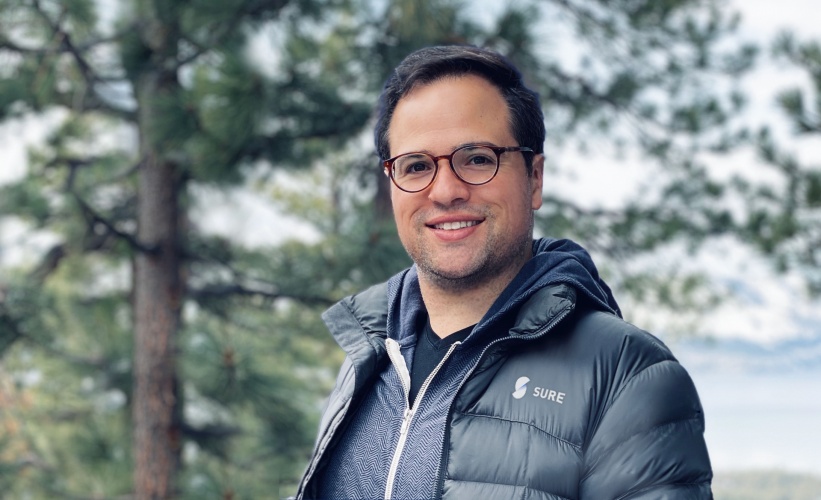
An app goes in. An infrastructure company comes out.
The early Sure app offered consumers a quick way to buy coverage, including baggage, flight and smartphone insurance. For someone with Slavin's background, a clean digital purchase was an intelligible ambition. A person encountered a need; the phone could provide a way to meet it. The app made that idea visible.
Getting the underlying insurance into place took longer. Slavin has described spending seven weeks in South Africa securing an early carrier relationship. His pitch came with a clickable prototype and a willingness to build the technology. That relationship helped him approach the carrier's American counterparts with something already operating. A working example could travel further than an explanation of what might someday work.
Then the meetings began to reveal an unexpected preference. Insurance executives would watch the consumer demonstration. When Slavin showed how the operations behind it worked, they pulled their engineers into the conversation. The software running the insurance business was attracting more interest than the shop window. The part he needed to build in order to sell his product was becoming a product someone else wanted to buy.
It was an awkwardly useful discovery. A consumer app needs people to find it, remember it and return when they need another policy. An infrastructure business can work with companies that already have those relationships. Slavin's team could concentrate on the transaction and the systems around it, while a partner supplied the familiar brand and the customer connection.
The turn that took more than one meeting
Slavin's own description of the transition is an “aircraft carrier-style turn.” The existing business continued while Sure found customers for its software. He has written that the change grew through skeptical thinking, rather than one decisive meeting. As of his October 2024 account, the first partnership secured under the infrastructure model was still going strong.
That is a more demanding version of changing direction than the word “pivot” usually suggests. There are existing customers to serve, people whose jobs depend on the old plan, and a new market that may be less welcoming than it first appears. Keeping the current operation alive makes the experiment slower and more complicated. It also preserves something valuable while the next proposition earns its place.
His practical warning is to keep the working business going “until proving that you can successfully do the new thing.” It is advice with very little theatrical appeal. Nobody gets to sweep the table clean. Someone still has to answer the old customers' questions on Monday.
The emerging offer covered more than putting a purchase button on a partner's website. Sure's infrastructure could support quoting, pricing, binding coverage, policy administration and servicing. Brands and insurers could use it across the insurance transaction. The screen was the visible fraction of a much longer sequence of decisions, calculations and records.
“I’m pretty skeptical by nature.”
Wayne Slavin · Fintech Leaders, 2024
A few seconds, a great deal of plumbing
The engineering detail explains much of Slavin's career choice. In 2020, Sure chief technology officer Yarden Sachs described the team's work on a rate order calculator. Its job was to take inputs, perform calculations and database lookups, and produce an insurance price. The team used Python for that work, alongside other languages elsewhere in the business.
For the customer, the ambition was a quote in seconds and a purchase without a phone call. For the engineers, those seconds contained a long list of operations. This is an unglamorous place to compete, which is part of its attraction. A polished interface is comparatively easy to admire. Correct calculations and dependable policy systems become interesting precisely when they fail to work.
Slavin also resists treating embedded insurance as an entirely new invention. Rental counters and travel checkouts had been offering coverage for years. What interested him was what data and software could do for those existing transactions. Sure brought technology and distribution; carriers brought insurance products. The arrangement gave each participant a defined piece of the job.
By 2023, the companies he publicly identified as partners included Toyota, Mastercard and Farmers Insurance. The appeal was contextual: someone buying a car could encounter the relevant coverage in the same journey. There is a modest but consequential promise here. A necessary purchase might demand less repetition, fewer forms and less time spent explaining something the customer had just explained elsewhere.
The numbers get bigger. The argument stays practical.
In October 2021, Sure announced a $100 million Series C, co-led by Declaration Partners and Kinnevik, at a $550 million valuation. That funding made room for further product work and international expansion. It also brought a different kind of examination: institutional investors were now assessing whether the machinery could support a much larger business.
Kinnevik described an end-to-end software platform serving insurers and brands. Its account of the investment included a useful connection: Betterment, another company in its network, was already a satisfied Sure customer. In enterprise software, a reference from someone operating the system carries a particular weight. The demonstration has to be good; the operation after the demonstration has to be better.
The same year, Sure placed thirteenth in Deloitte's Technology Fast 500 ranking, with reported growth of 15,232 percent over the ranking's measurement period. In March 2022, Slavin was named among The Financial Technology Report's Top 50 Financial Technology CEOs. His colleague Sachs singled out integrity and empathy in describing his leadership. The recognition added a human judgment to the financial measurements.
Those milestones sit beside a temperament Slavin has repeatedly described as skeptical. An early success still needs another customer, another functioning implementation, another reason to believe it will last. That habit helps explain why his account of Sure contains so much testing and so little faith in an attractive first answer.
Back in Las Vegas, with a different question
By July 2026, Slavin's public conversations were addressing AI, digital distribution and the organizational habits that slow change. He argued that leadership and change management can become larger obstacles than the technology itself. Years spent learning an unfamiliar industry had widened the problem. Building the system was one task; persuading an institution to work differently was another.
In September, Sure listed him on an InsureTech Connect panel in Las Vegas about embedded insurance and strategic partnerships, alongside leaders from Mylo and Coterie. The setting supplied a neat geographical return to the city at the end of that original flight. The question had grown from whether passengers would buy coverage to how companies could make insurance part of products people already used.
His stated ambition is for consumer brands to build substantial insurance businesses using Sure's infrastructure. It remains a proposition about where the relationship with the customer lives. A brand may already have the trust and attention; it still needs the systems to deliver the transaction. Slavin has spent the intervening years working on that second requirement.
The origin story is easy to remember because the plane moves. The more revealing story happens in meeting rooms, when an entrepreneur notices which part of his demonstration makes people sit up. Slavin brought an app to sell. His prospective customers kept looking behind it. He paid attention, and built a business around what they saw.
Keep the conversation going
- Sure · company website
- Wayne Slavin · LinkedIn
- Wayne Slavin · X
- Wayne Slavin · Facebook
- Fintech Leaders · watch the interview
- A Product Market Fit Show · interview & transcript
- What a Successful Pivot Looks Like · by Wayne Slavin
- FNO: InsureTech · July 2026 conversation
- Sure’s infrastructure discovery · BUILDERS recap
- The 2021 financing · Los Angeles Business Journal
- Inside the rate calculator · Built In
- ITC Vegas 2026 · panel details
- Deloitte · 2021 Technology Fast 500
- Kinnevik · the investment discussion
- NetStumbler · Slavin’s author archive
- The 2022 CEO recognition
- Career and origins · DealMakers interview