Michael Bertuch found an appealing way to deal with a graduate-school class: negotiate a different assignment. At Columbia University, he arranged with a professor to write a business plan instead of attending class. The plan earned him a good mark. It also became ViaTech, the company he founded in 1995. Most homework has the decency to end after the grading.
That small academic bargain is a useful place to begin his story. It contains a problem, a proposed alternative and a willingness to make the alternative concrete. It also puts a human scale on a business that would eventually connect software, printing, ordering and fulfillment. Before there were products to explain, there was a student making a case for doing something differently.
There is another beginning available. Bertuch was a lightweight boxing champion at Lehigh University. In an archival photograph, the ring ropes cut across the frame while the fighters are occupied with considerably more immediate matters than content management. Years later, ViaTech president Mike Fields would use the boxing connection to describe the founder’s influence on the business. The photograph supplies a welcome interruption to the usual corporate vocabulary.
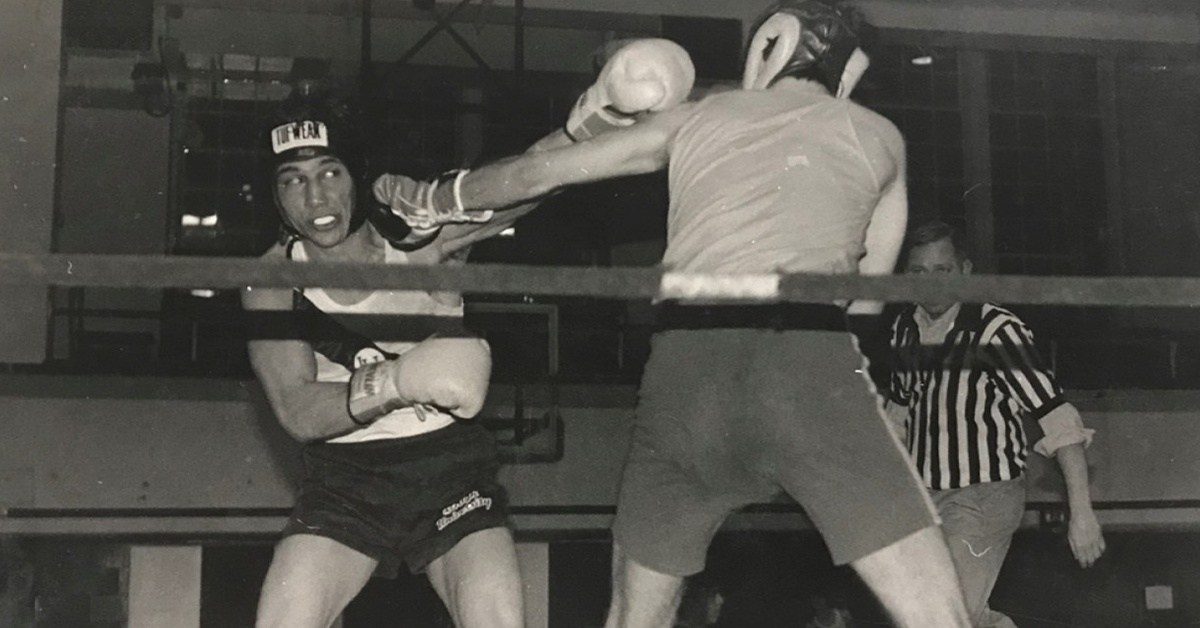
A professor accepts a different assignment
At Columbia, Bertuch was studying a change with an awkward consequence. The internet made gathering information easier. Publications could grow larger. The cost of moving all that material, however, could grow with them. Abundance had acquired a delivery bill.
His proposed business addressed that bill. He wanted to automate content delivery, reduce the waste associated with traditional publishing and help readers obtain information when they needed it. The emphasis fell on the journey between a piece of information and its eventual reader. Writing something and making it useful are separate achievements; organizations have ample opportunity to lose money between the two.
The business was incorporated in New York in 1995. Ron Simmons was Bertuch’s fellow founder. Both had worked in crisis management before ViaTech, helping large companies prepare for disruptive events. That background adds a practical dimension to the classroom origin. Their professional experience included thinking about what could go wrong before it did.
Consider the sort of problem this creates for a customer. A training document has to reach someone preparing to do a job. A marketing kit has to arrive where a campaign is running. Those are ordinary examples, but they explain why distribution can become an executive concern. The material may be beautifully prepared and still be useless in the wrong place.
A Columbia business plan becomes ViaTech, incorporated in New York.
The work after the printing
Bertuch’s company developed beyond its beginnings in traditional printing. Fields, describing his own arrival at ViaTech, explained a transition toward electronic workflows integrated with customers’ operations. That distinction matters. The company was taking responsibility for more of what happened around production: how materials were requested, managed and deployed.
For restaurant and hotel clients, that included e-commerce platforms for customized marketing and training materials. For training organizations, it meant managing both content and the logistics of a program. A printer can count the pages leaving a machine. A delivery business has to concern itself with what happens next.
ViaTech launched its first technology-enabled ordering site in 2001. Active Reader, its electronic delivery application, followed in 2015. Put the dates beside each other and a pattern emerges: the business kept finding additional points at which information could become difficult to manage. Ordering was one. Access on a reader’s device was another.
Active Reader brought secure enterprise documents to computers and mobile devices. Fields described searching across electronic documents and video, and making notes that could carry into a new version. These are useful details because they move the conversation away from the mere existence of a digital file. A file can be electronic and still be awkward company.
The reader’s experience introduces a different standard. Can the material be found? Can it be used without an unnecessary detour? Can an organization protect its intellectual property while giving people access? Bertuch’s original delivery problem becomes more recognizable when expressed as these everyday irritations.
A founder who thinks about the fallback
Bertuch’s earlier crisis-management work offers a way to understand his attention to delivery. Preparing a large company for disruption requires asking unfashionably specific questions. Which process depends on which other process? What happens if a connection fails? Who still needs the information?
Writing about ViaTech’s systems in 2020, he described building connections to customer systems with more than one fallback. His formulation was compact: “Every bridge we build is delivered with a backup, and then a backup to that.” It is a sentence with the personality of an operational checklist. The extra backup gets its own place in the room.
That concern fits a company whose customers depend on information to carry out work. Delivery is easy to discuss as a convenience. It becomes a different obligation when an unavailable document holds up someone else’s task. The distinction helps explain why a founder with a preparation background might stay interested in this business for years.
There is restraint in looking at Bertuch through the work itself. The boxing story provides color; the Columbia arrangement provides an origin. The systems explain what followed. A business plan has to survive contact with other people’s procedures, purchasing habits and deadlines. The resulting career contains many more handoffs than opening nights.
A legal business, 136 years in the making
In February 2023, Bertuch’s story met a much older enterprise. ViaTech acquired Blumberg Excelsior, the New York legal-products business founded in 1887. The acquisition announcement identified Bertuch as ViaTech’s CEO. Blumberg’s president, Robert Blumberg, was the founder’s grandson.
The acquired business supplied legal forms, corporate kits and other products used by attorneys and business owners. These were established purchasing needs, supported through a website, catalogs and office-product dealers. For all the attention paid to digital change, professional work still involves physical objects that have to be made and delivered.
ViaTech brought manufacturing and fulfillment operations in Atlanta, Dallas and Los Angeles. Blumberg brought its customer relationships and product history. Robert Blumberg described the fit in terms of technical capacity, efficiency and customer service. Bertuch focused on expanding ViaTech’s legal-services division to reach lawyers across the country.
“Blumberg’s reputation for quality and service resonates with every attorney,” Bertuch said. His ambition was substantial, but the business logic was familiar: combine the means of serving customers with products they already require. The acquisition widened the setting for the delivery work that had occupied him since Columbia.
A company founded in 1995 meets a legal supplier founded in 1887.
TWO BUSINESS HISTORIES, ONE 2023 DEAL
There is an agreeable historical wrinkle here. The younger business grew out of a question about the internet’s effect on publishing. The older one began in a two-room store in lower Manhattan. Their meeting suggests how often technological change proceeds through existing relationships and necessary supplies. Even a modernized order still needs to arrive.
The assignment continues
ViaTech now presents its business as a combination of software and physical delivery. Its services include inventory management, customized e-commerce, print production, kitting and fulfillment. Single Storefront connects different kinds of material in one branded ordering environment. The company lists Dallas as its headquarters, the same city Bertuch lists on his public professional profile.
That range can sound unwieldy until viewed from the customer’s side. A distributed organization may need digital documents, printed manuals and promotional items during the same rollout. Someone must coordinate the vendors and the inventory. The variety belongs to the job before it belongs to the service description.
The company also describes itself as employee-owned. That is a useful detail in a founder’s profile because a delivery promise depends on colleagues carrying it out. Production, technology and customer service are connected responsibilities. Bertuch’s initial proposal required people who could turn the idea into repeatable work.
His career is distinctive in its persistence around a specific question. The formats changed. The company added tools and acquired another business. The recurring task remained recognizable: connect information with its intended use, while managing the expense and friction along the way.
It is also a story about the lifespan of an idea. The Columbia proposal did not prescribe every later product or acquisition. It identified work that would keep appearing in different forms. A founder can be attached to a particular machine, or to a recurring customer difficulty. ViaTech’s sequence of ordering systems, reading tools and fulfillment services illustrates the latter possibility. Each asks the organization to think beyond the object it produces and consider the person waiting for it at the other end.
Return to the graduate student and his professor. The assignment had an academic ending: a mark. The problem inside it had a longer future. Bertuch built his working life around the distance between having information and getting it where it belongs. Thirty years is a considerable extension on a homework deadline.