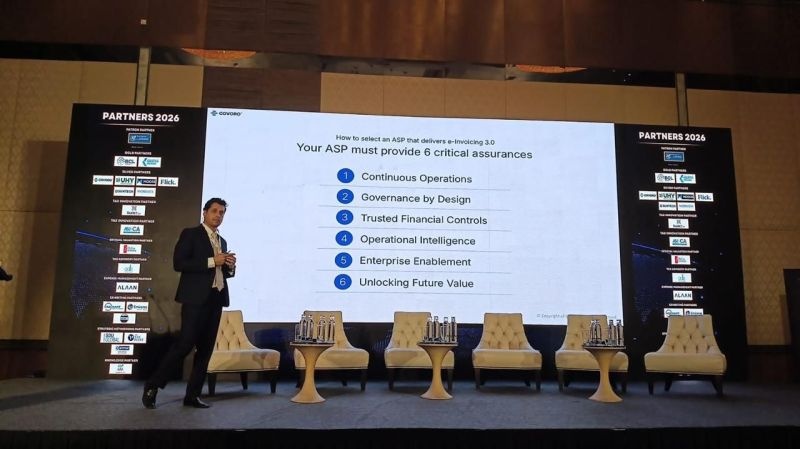
On the stage, the chairs are empty and the slide is crowded with responsibilities. Paresh Bafna stands to one side of a screen at the GATE Summit in Abu Dhabi. Behind him is a list of six things an e-invoicing provider should assure a customer. Continuous operations comes first. Unlocking future value comes last. Between them sit governance, financial controls, operational intelligence and enterprise enablement. The future is welcome, apparently, once the present has been persuaded to behave.
It is a revealing photograph of the CEO and co-founder of Perennial Systems. Bafna works in an industry fond of announcing what comes next. Here he is, discussing what has to keep working. His subject is an invoice, a document with a modest public reputation and an unusually demanding private life. Before it finishes its journey, several departments and software systems may need to agree about what it means.
Bafna’s career has brought him steadily closer to that problem. Perennial began in 2006 as a software engineering business. GSTHero, launched in 2017, gave the company a product centred on tax compliance. COVORO now places him in conversations about the machinery of finance across international markets. The thread is practical: how do you make complicated business activity run through software without asking the user to become an expert in everything underneath?
A computer scientist meets the business
The educational route runs through computer engineering at the University of Pune, now Savitribai Phule Pune University, and computer science at the University of Southern California. His postgraduate years there were 2004 to 2006. A public career listing also places him at Citicorp Development Center in 2005. The combination put software and financial operations in the same early professional frame.
In 2006, he co-founded Perennial Systems with Nilesh Bafna. Their leadership titles remain usefully explicit: Paresh is CEO; Nilesh is CTO. Those are two different responsibilities in a business where a customer’s commercial problem must eventually become something an engineering team can build and maintain. The customer arrives with a desired outcome. Somebody has to translate it into decisions.
Perennial’s work spans product engineering, enterprise systems, and data and AI. It offers dedicated teams as well as other engineering engagements, serving startups and established businesses. That breadth gives Bafna’s later focus on finance a useful setting. A specialist product can be narrow in what it promises while drawing on a much wider history of building software for organisations.
co-founded
launched
finance conversations
First, a brief change in the weather
There is a pleasing interruption in the financial narrative. Bafna’s project history includes Hurricane Weatherman, a social game that Perennial co-developed with Weather Decision Technologies in 2011. Its premise invited people to predict the weather. His professional profile dates the project from May to August of that year.
A weather game is a useful reminder of the range hidden inside the phrase “software company”. The interface has to give a person something understandable to do, even when the underlying subject is complicated. Weather forecasting and tax administration have very different audiences. Both punish the assumption that knowing the technical domain automatically means knowing how to make it usable.
The game also stops this career from becoming an immaculate procession of enterprise acronyms. Before the current discussions of finance operations and compliance automation, there was a project with room for curiosity and competition. It belongs in the story because it is specific, slightly unexpected, and recognisably the work of a product engineering company.
The invoice acquires a larger job
GSTHero launched in 2017. Perennial’s account of its development points to years of financial-sector projects and a team combining software expertise with chartered accountants, tax professionals and technical support. The product’s work includes return filing, reconciliation, e-invoicing and connections to accounting systems. These are tasks that recur, whether or not anyone has a fresh appetite for them.
That mix of people matters to Bafna’s story. A tax professional knows what an obligation requires. An engineer knows how to make a system execute a process. Support teams discover the distance between the intended workflow and the one a customer actually encounters. A compliance product needs all three kinds of knowledge to remain useful after its first demonstration.
Perennial is also listed among GSTN’s empanelled GST Suvidha Providers, with Bafna named as its contact. It is a concrete connection between the founder and the administrative network his software serves. The business lives where private enterprise software meets public infrastructure, with users expecting the connection to feel considerably simpler than the arrangements behind it.
The COVORO chapter extends that territory. Its stated scope covers compliance, finance operations and trade automation. Its public footprint includes India, the UAE, Malaysia and Singapore. Bafna now speaks to finance leaders about connected operations, governance and the decisions surrounding an e-invoicing provider. The invoice has become an entry point to a larger discussion about how a business organises its information.
COVORO reports integrations with more than 100 enterprise resource planning systems and more than 10,000 customers worldwide. These are company figures, describing the operating scale of the business he leads. They also explain why integration occupies so much of the conversation. A product reaching many businesses meets many existing arrangements. The software arrives in a world already furnished.
For Bafna, the international setting adds another dimension to the engineering problem. COVORO describes a platform spanning e-invoicing, tax returns, reconciliation, document capture and approval workflows. Those activities have to fit into an organisation’s existing responsibilities. Expanding the product’s reach means keeping the finance team’s daily work understandable as the number of connections grows.
It is an unusually concrete setting for a founder’s ambition. Growth brings more customers, but also more variations in how customers organise themselves. The same invoice can pass through a different chain of people and applications in each business. A software company earns its place by making those connections dependable enough that the customer can concentrate on the transaction itself.
There is still a place for an ordinary rule
For an executive discussing AI, Bafna offers a useful distinction. In a December 2025 discussion of tax automation in Dubai, he separated processes that can follow predefined rules from those with multiple unpredictable paths. Straightforward movement from one step to another can be handled by rules. More uncertain work calls for interpretation and learning.
“AI excels in non-deterministic processes.”
Paresh Bafna · December 2025
His examples included reconciliation and responding to notices, as well as the complications of export-import activity. These are areas where a record may need checking against another record or a transaction may require interpretation in context. His explanation begins with the character of the task. The technology follows from that assessment.
This gives the founder’s public thinking some texture. He can advocate automation while still distinguishing between kinds of work. It is easy to attach the same fashionable label to every box in a software diagram. It is more useful to ask which boxes contain a predictable instruction and which contain a judgement. A finance team has to operate both.
A conceptual explanation of Bafna’s approach, rather than a product performance comparison.
The engineer has colleagues
Perennial’s portrait of Bafna describes a hands-on engineer who mentors younger engineers. On its leadership page, his message is about employees growing and the company growing with them. Alongside it, Nilesh Bafna’s message centres on teams. The pairing offers a compact view of how the two founders choose to describe the organisation they lead.
There is a practical reason to keep people in this account of systems. Enterprise software depends on accumulated understanding: what a client meant, why an integration works a particular way, which exception appeared last time. Documentation carries some of that memory. Engineers and their conversations carry the rest. Mentoring is one way a business passes that understanding along.
Bafna’s current public appearances also put him among other disciplines. COVORO’s Beyond the Numbers discussions bring technology into the same conversation as finance leadership and tax expertise. The August 2026 panel included finance leaders Chandra Vikram Prahladka and Alia Saleh, ScaleX Tax founder Ekansh Agrawal, and moderator Rahul Dev Swarnkar. Bafna supplied the technology and enterprise transformation perspective.
The format suits the subject. A financial process crosses professional boundaries long before it crosses a software interface. A CFO, a tax practitioner and an engineer can look at the same transaction and notice different ways it might go wrong. Putting those views together makes the problem more accurately described, even if it makes the meeting longer.
What remains after the deadline
By October 2026, Bafna’s public argument had become especially pointed about provider selection. Speaking as COVORO UAE’s CEO, he described the choice as an infrastructure decision with consequences beyond the immediate compliance deadline. The scale of an enterprise, its transaction volumes and the complexity of its systems belong in that decision.
The stage photograph supplies a neat companion to that argument. Continuous operations, governance and financial controls are promises a customer will test during an ordinary working week. Future value is harder to discuss convincingly if the present operation keeps stopping. A founder who has spent years around engineering projects has reason to take the ordinary week seriously.
COVORO’s stated ambition reaches beyond individual transactions into broader compliance automation. Bafna’s contribution to that ambition is most legible at the smaller scale: the interface, the reconciliation, the provider decision, the handoff between teams. The invoice keeps turning up because it makes the abstraction tangible. Somebody needs to send it. Somebody needs to receive it. The information needs to survive the trip.
That is where this career finds its continuity. The weather game asked people to participate in a complicated subject. Perennial built software around business problems. GSTHero and COVORO bring the same practical challenge into finance. Bafna’s work keeps returning to the distance between what a system knows and what a person needs it to do. An invoice is a small object on which to hang a career. It turns out to have plenty of room.