Before a contractor can pick up a hammer, someone may ask for a certificate of insurance. The work is waiting. The customer is waiting. Somewhere, a document has become the most important thing in the room. NEXT Insurance found a business in that gap between being insured and being able to prove it.
- Digital insurance built around the chores of running a small business.
- More than 750,000 U.S. business customers, across 1,300-plus professions.
- A $2.6 billion acquisition brought NEXT inside ERGO in July 2025.
The document before the job
In April 2023, NEXT disclosed a wonderfully unglamorous detail: some construction customers shared insurance certificates nearly 200 times a year. Its customers had created an average of 16,314 certificates a month during 2022. Construction accounted for more than half. The purchase was occasional; the paperwork kept returning.
NEXT already offered round-the-clock access to live certificates. Its COI Analyzer added another shortcut: upload a sample document, let the software read it, then review or edit the extracted information before generating a customized certificate. The company said the process could take less than a minute. Optical character recognition and object detection were doing a job that otherwise required typing, correspondence and waiting.
There is a useful product lesson here. Watch what customers must do after they buy. A contractor does not wake up hoping to administer insurance. They want permission to start the work. Removing that recurring interruption gives an abstract financial product a practical role in the working day.
a sample
the details
the certificate
A carrier behind the screen
Guy Goldstein, Alon Huri and Nissim Tapiro founded NEXT in 2016. They had worked together at Check, the payments company acquired by Intuit. Buying insurance for that earlier business had exposed them to the problem firsthand: too much time and effort spent obtaining and maintaining coverage.
Their answer became a digital small-business insurer serving cleaners, consultants, tradespeople, retailers, fitness professionals and restaurants. Eligible customers can buy coverage online in about ten minutes and obtain proof of insurance. The ambition reaches beyond a quick application: quote, purchase, manage the policy and retrieve documents through the same digital experience.
The products remain recognizably insurance. General liability addresses specified third-party injury and property-damage risks. Professional liability addresses eligible claims arising from professional mistakes. Workers’ compensation concerns work-related employee injuries and illnesses. Commercial property protects covered business property. In June 2024, NEXT introduced a Business Owner’s Policy combining general liability and commercial property.
Its difference lies in packaging that coverage by profession and controlling more of the machinery behind it. By the end of 2018, NEXT reported carrier licenses in 15 states. Today the group combines an underwriting carrier, agencies and outside insurance providers. It earns premiums through insurance entities and can receive compensation for placing other carriers’ products.

Then the bill arrived
Building that machinery required serious money. A March 2021 financing announcement put total funding above $880 million and the valuation at $4 billion. NEXT was financing products, technology and expansion in an industry where someone must ultimately carry the risk.
In July 2022, the company announced plans to cut 17% of its workforce. Goldstein linked the decision to worsening economic conditions, profitability and cost management. The reset exposed a constraint familiar to many venture-backed businesses: growth had to be reconciled with the expense of producing it.
Allstate and Allianz X supplied another $265 million in November 2023, alongside commercial relationships. By then NEXT reported more than $1.1 billion in venture funding. The money came with distribution opportunities and a deeper reinsurance relationship, rather than a funding announcement standing alone.
The full acquisition by Munich Re, through ERGO, closed on July 1, 2025, at a $2.6 billion equity valuation. That figure valued all the shares; it was not another venture round. ERGO gained a U.S. small-business operation and proprietary digital underwriting technology. NEXT gained a place inside an established insurance group. The ERGO NEXT name followed in January 2026.
The agent stayed in the picture
A revealing part of NEXT’s evolution is its investment in agents. Copilot, launched in March 2024, gives an agent a personalized link that customers can use to quote and purchase online. The agent keeps earning standard commissions and can choose to review the quote before purchase.
That design makes commercial sense. Small accounts still need attention; automation can reduce the labor involved in serving them. In a 2024 interview, Goldstein described agents using technology to make smaller accounts more workable. Digital purchasing and human distribution could share the same system.
Embedded partnerships apply that thinking elsewhere. NEXT and Gusto expanded their workers’ compensation and payroll relationship in 2023. In May 2026, ERGO NEXT announced insurance access for eligible TikTok Shop sellers through Seller Center. Put the offer near the activity that creates the need.
The next waiting room
In October 2026, ERGO NEXT announced self-guided commercial property inspections using vision AI. Direct customers could submit an inspection in about 15 minutes. The feature takes another appointment out of the process and gives the business owner another task to complete by phone.
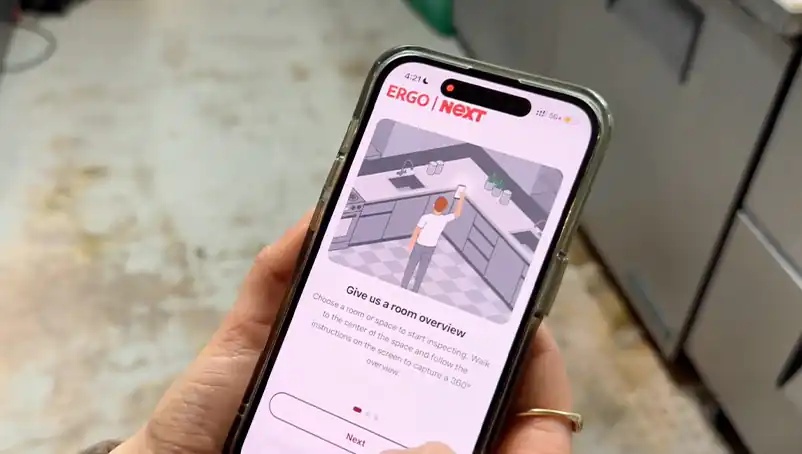
“Small business owners already have enough priorities competing for their time.”Effi Fuks-Leichtag, Chief Product Officer
Price still needs context. NEXT’s June 2026 guide listed general liability from $19 monthly and said 45% of its customers paid $45 or less for that coverage. Those figures describe particular policies, not a complete protection package or a guaranteed quote. Occupation, location, limits and claims history affect the price.
For buyers comparing NEXT with Hiscox, biBERK or a local agent’s options, the useful comparison includes exclusions, eligibility and required limits. Unusual risks may require more advice or another carrier. A certificate documents coverage; it does not expand it. NEXT’s most transferable idea is narrower and more useful: find the interruption between a customer and their next job, then make it smaller.