Imagine an electrician who has won the job but cannot start it. The customer wants proof of insurance. Somewhere between the estimate and the first ladder, a document has become the most important tool in the business. Coverdash has built an insurance agency around these moments: the ordinary administrative handoffs that stand between a business owner and the work.
- Buy commercial coverage directly or inside a partner’s business software.
- Compare carriers, manage policies and produce proof of insurance.
- Payroll integrations can connect workers’ comp premiums to actual wages.
The trick is placement. Rather than asking every owner to remember another website, Coverdash puts quoting and purchasing inside banking, payroll and industry software. Insurance arrives alongside the task that makes it necessary. For a product people often postpone, location is a surprisingly consequential feature.
01 / The policy has found the customer
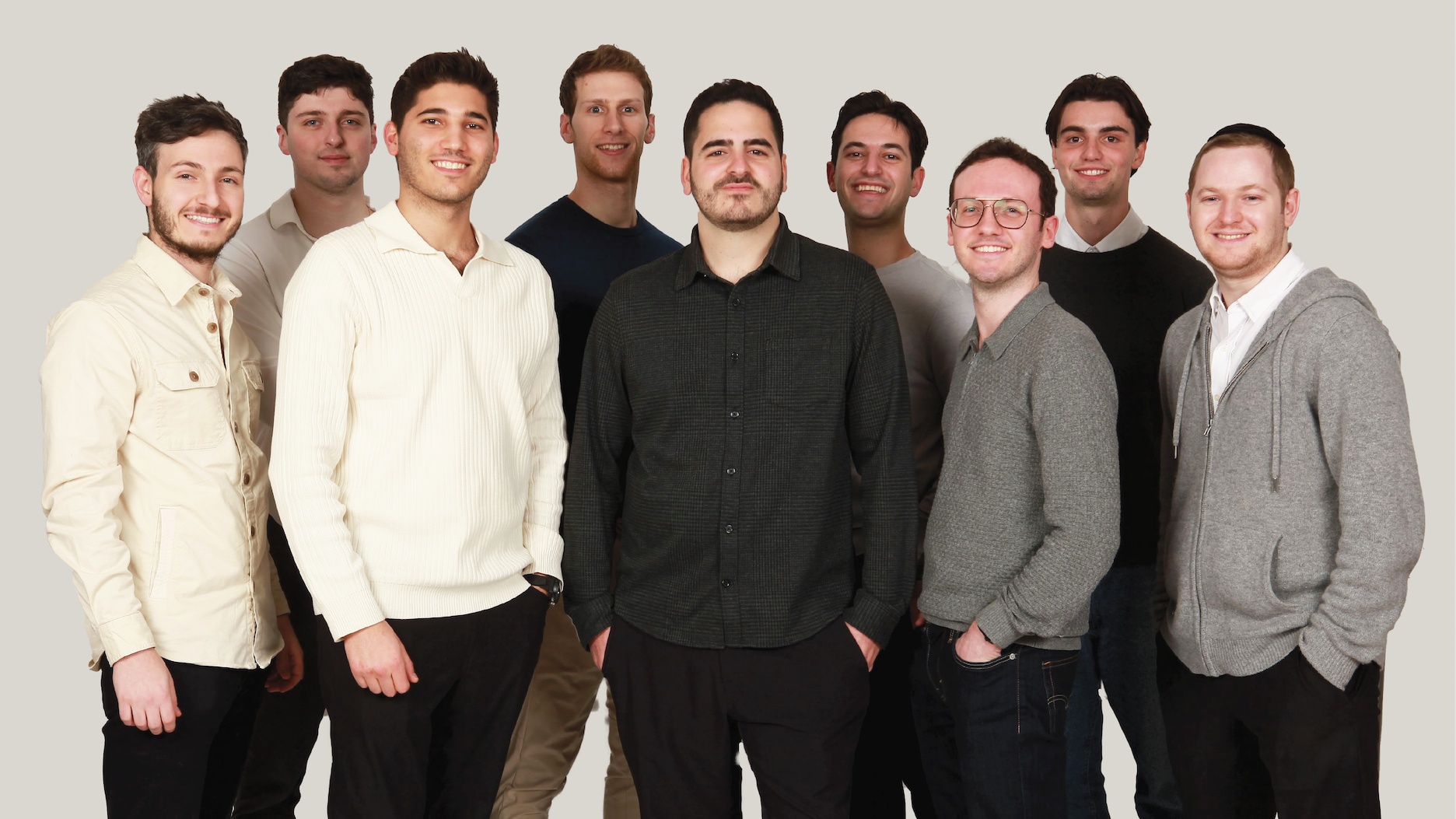
Ralph Betesh, David Vainer and Avery Rubin founded Coverdash in 2022. Betesh leads the company as CEO; Rubin leads its technology. The business officially launched in January 2023 with a $2.5 million seed round led by Bling Capital. The proposition was commercial insurance for smaller businesses, delivered online and made available through other companies’ platforms.
There are two doors. Owners can visit Coverdash directly, or encounter its marketplace inside a partner’s product. Coverdash is an agency: insurers supply the coverage, while its technology and licensed advisors help businesses find and manage it. That distinction matters. The company changes how insurance reaches the buyer without having to manufacture every policy itself.
“The trick is to be there before the customer even knows they need us.”
Ralph Betesh · PROOF founder interview, August 2026
In that interview, Betesh described an early focus on businesses with frequent, fast-moving insurance needs. He also described backing a small, technically fluent team. The logic is sensible: solve a demanding workflow first, then carry the habits elsewhere. That is his account of the strategy, rather than proof that every customer’s experience is equally quick.
02 / A better place for an inconvenient errand
The partnerships make the idea tangible. LendingTree added Coverdash-powered business insurance in November 2024. Viably followed in December, giving e-commerce merchants access to coverage inside their Global Account. These are different businesses sharing an obvious advantage: the owner is already there, attending to money and obligations.
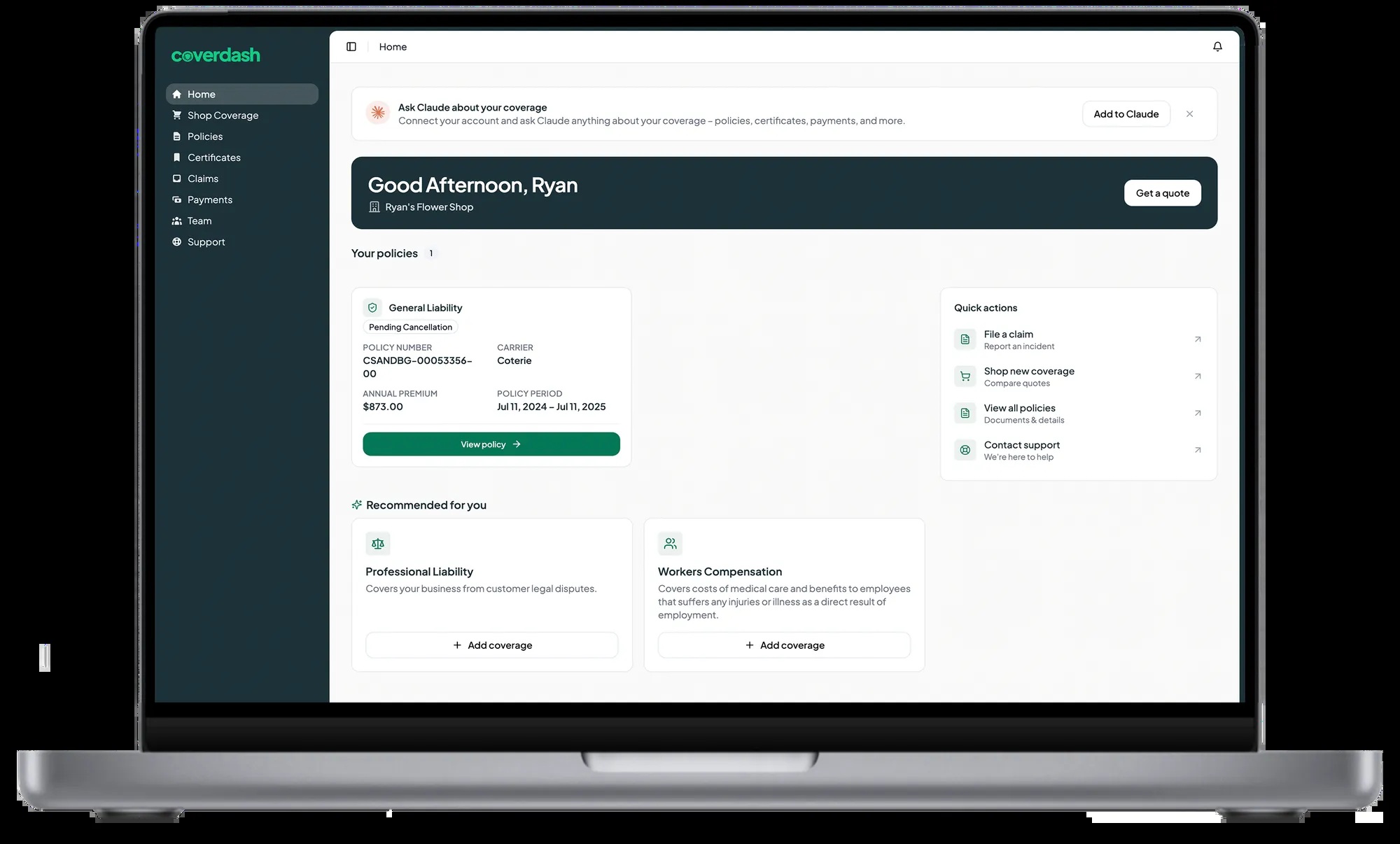
Housecall Pro’s partnership, announced in August 2026, places coverage inside software used to schedule, dispatch and invoice home-service jobs. Users enter its Insurance tab under My Money, answer business questions, compare options and buy a policy. They can then download certificates of insurance. Commercial auto takes a different route: users schedule a consultation with a licensed agent.
- 01A business taskHire, finance or take a job
- 02Coverage in contextCompare, select and purchase
- 03Back to workDownload a certificate
The available products include general liability, a business owner’s policy, professional liability, cyber coverage and workers’ compensation. They answer different problems. General liability addresses covered third-party injury and property claims. A business owner’s policy combines liability with property and business-interruption protection. Professional liability concerns claims about work or advice; cyber coverage addresses specified digital risks.
A certificate is particularly useful because it turns an insurance purchase into something another person can accept. Coverdash’s help center describes selecting a policy, supplying third-party details when needed, and generating a downloadable PDF. It also distinguishes instant certificates from requests needing an agent, which can take up to two business days. Speed has a useful boundary.
03 / Payroll already knows the answer
Workers’ comp provides the clearest example of why embedding can improve the actual process. Payroll holds wages and employee classifications. Asking an owner to reconstruct those details elsewhere introduces another task. In eligible Housecall Pro payroll accounts, pay-as-you-go coverage uses payroll activity to calculate premiums, allowing the insurance bill to adjust as wages change.
That can make costs easier to manage than an annual estimate followed by reconciliation. Housecall Pro says the approach helps reduce the likelihood of a large year-end adjustment. It still requires accurate employee classifications and eligibility. Treating every payroll-linked policy as a promise that audits vanish would turn a useful convenience into an extravagant claim.
The September 2026 Lumber partnership takes the same idea into construction workforce software. Lettuce Financial’s August partnership puts commercial insurance alongside the taxes, payroll and bookkeeping of a business-of-one. The common ingredient is an existing workflow with a reason to buy, plus data or documents that can make buying easier.
04 / The price of removing the detour
Coverdash raised a $13.5 million Series A in February 2024, led by Nyca Partners, taking announced funding to $16 million. The stated uses were expanding distribution, hiring and broadening carrier access. Partner demand persuaded the founders to raise capital rather than risk losing opportunities while onboarding more slowly. Capacity was the pressure point.
The company now reports more than 150 live embedded platforms and over 50,000 policies sold. Those measures describe distribution and transactions, respectively; neither supplies a count of individual insured businesses. Its carrier panel offers choices, but the number on a website cannot tell an owner which insurer will accept their particular risk.
The customer’s arithmetic is separate. Coverdash says software use is free, but its compensation disclosure includes commissions and a nonrefundable technology access fee on purchased policies. It may also negotiate client fees. A buyer should compare the total payable alongside coverage limits, exclusions and service. A shorter checkout does not make the underlying contract interchangeable.
The service obligation continues after checkout. In March 2026, Coverdash appointed Mike Downey, who had built renewal operations at Vouch, to lead account management. The appointment points to the less photogenic part of insurance: keeping policies appropriate as the customer’s business changes, and making the next renewal worth staying for.
Coverdash competes for a job owners could give to a local agent, another online broker or a carrier directly. Its distinctive bet is to place a multi-carrier agency inside the tools where that job begins. Software builders can copy the reasoning: find the obligation interrupting a customer’s task, and connect the service to that moment. Without a relevant trigger, suitable coverage and dependable service after purchase, another embedded button is merely another button.