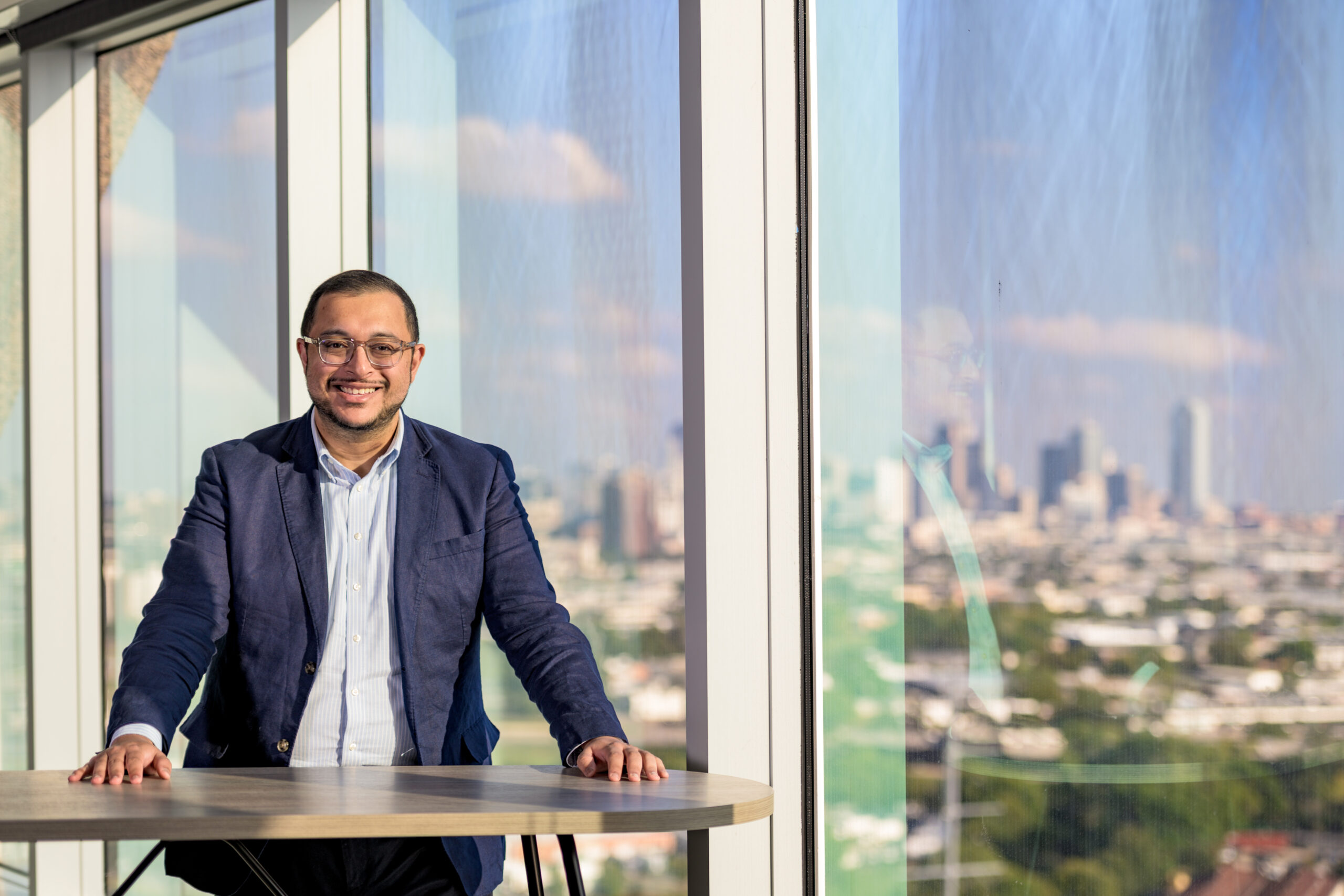
Ritish Patnaik’s route back to North Texas passed through New York, Stanford and the business of turning research into a company. By the time Curve Biosciences established its headquarters at Pegasus Park in Dallas, he had collected a doctorate, experience in corporate partnerships and an earlier startup’s education in getting things built. Home was familiar. The professional opportunity he saw there had changed.
The return gives his career a useful shape. Raised in Plano, Patnaik went to Columbia University for a bachelor’s degree in biomedical engineering. At Stanford, he added a master’s in management science and engineering and a doctorate in bioengineering. The degrees suggest someone comfortable with several kinds of homework. The company-building began before all the homework was finished.
Curve announced $40 million in funding in October 2025, with Luma Group leading the financing. A company announcement can make a founder’s career look as though it begins with a large number. Patnaik’s begins more modestly: a teacher, a science fair, a university laboratory, a student publication. The interesting part is how those smaller commitments accumulated into a job that requires him to bring other people along.
Before the company, a classroom
Asked about the influence of his Plano school years, Patnaik named Cathy Bambenek, his tenth-grade chemistry teacher and science fair coach. They remain in touch. It is a pleasingly specific answer from someone whose biography could easily disappear into university names and executive titles. Chemistry had a teacher. Science had a coach. The relationship survived the qualifications that followed.
His education also included the Texas Academy of Mathematics and Science in Denton. At home, his parents’ working lives brought teaching and engineering into the same family: one was a teacher, the other a Texas Instruments engineer. Later, his professional life would keep moving between explaining an idea and working out how to make it function.
At Columbia, Patnaik pictured an academic future. As an undergraduate receiving a Goldwater Scholarship in 2015, he wanted to become a university research professor. He had already sought research experience beyond his own campus, and he saw teaching as part of the life he hoped to build. The ambition was concrete: develop expertise, conduct research and help younger engineers find their way into it.
He also became editor-in-chief of the Columbia Undergraduate Science Journal and vice president of the university’s Biomedical Engineering Society. Those roles sit comfortably beside the research ambition. Editing asks whether an idea has been explained clearly enough for someone else to follow. Student leadership asks whether people will give their time to something. Both questions have a habit of returning when a scientist starts a company.
Scholar
BS
PhD
A startup before the doctorate
Patnaik graduated from Columbia in 2016. That year, he and Jason Kang shared the department’s Reiss Prize, an award given to graduating seniors whom the faculty judge likely to contribute substantially to the field. It was recognition at the point of departure, with the contribution still largely ahead of them.
Another departure was already taking shape. Luso Labs grew out of a Columbia senior design project and announced its launch in June 2016. Patnaik was one of four co-founders, alongside Jahrane Dale, Olachi Oleru and Stephanie Yang. His responsibilities covered long-term strategy, prototyping and fundraising. It is an unusually compact description of a very full calendar.
The division of work matters. Dale worked on the application and algorithm. Yang led day-to-day work and interface design. Oleru’s responsibilities included manufacturing operations. Patnaik worked across the longer view and the practical question of financing it. The venture’s public team page reads like a reminder that even a small company contains several different jobs, each capable of becoming urgent at once.
By 2017, the team was placing in university venture competitions. Columbia recognized Luso Labs with a second-place finish in its global technology competition, following recognition for its earlier incarnation in 2016. Patnaik was continuing into graduate research while a project from his undergraduate years was acquiring the demands of a business. The transitions overlapped; they did not wait politely for one another.
A larger prize followed in 2018: $200,000 from the Vodafone Wireless Innovation Project. Rice’s later alumni directory recorded the award and Luso’s participation in its business plan competition. The sum belongs to the team’s history, years before the much larger financing associated with Curve. It gives the early chapter a scale of its own.
Luso’s progress updates describe an education through revisions, meetings and questions from competition judges. Prototypes brought fresh problems as well as improvements. Feedback sent the team back to its designs. The account is candid about the distance between a promising version of an idea and something ready for its intended setting. A prize could finance another round of work. The work still had to be done.
Learning to read the room
While pursuing his Stanford doctorate, Patnaik also helped Silicon Valley Bank make sense of investment activity. Its 2018 report credited him with developing classification schemes, analyzing datasets and helping produce slides and takeaways. These are the quieter verbs of the startup economy. Someone has to decide what belongs in a category before anyone can announce a trend.
That work placed him beside the flow of capital while he was still doing research. Organizing a dataset for an investment audience requires choices about what another person needs to see. A table can be accurate and still leave its reader bewildered. A useful analysis has to preserve the detail that matters while giving the reader a way through it.
The bank’s 2020 report again identified him as a consultant and credited his analyses of several industry subsectors. By then, his biography listed the Stanford management master’s alongside his Columbia engineering degree, with the doctorate still in progress. The combination was becoming visible in the work: technical training paired with attention to how organizations allocate money and make decisions.
Stanford’s 2021 commencement program records his doctorate in bioengineering. The date closes one educational chapter. His later role in business development at Genentech placed him in another kind of conversation, working on partnerships involving artificial intelligence. The task had moved toward finding the fit between an external opportunity and an organization capable of doing something with it.
“I love learning, and I love people.”
Ritish Patnaik
His own introduction on LinkedIn puts those two interests side by side. The sentence is short enough to survive a biography crowded with credentials. It also fits the range of settings he has worked in. A journal, a startup team, an investment report and a partnership all require knowledge to travel between people.
That is one way to read the route to Curve’s chief executive role. The earlier jobs gave him repeated practice at the handoff: from a technical question to an explanation, from an explanation to a decision, from a decision to a team with responsibilities. A CEO spends plenty of time at those junctions. Patnaik had been visiting them for years.
A headquarters with a hometown attached
At Curve, Patnaik leads a team whose members bring their own histories of research, technology and operations. Its leadership includes Nathan Hunkapiller, Alice Chen, Chuba Oyolu and Stanford professor Shan Wang. Their titles distribute responsibility across science, operations, technology and innovation. The company is a larger setting for the problem his early venture already posed: how to bring different kinds of expertise into the same undertaking.
The move to Dallas gave that undertaking a new center. Curve retained a California presence, so Patnaik’s return did not erase the geography of his career. It added North Texas to an organization already shaped by work elsewhere. Dallas could be home and a place to build, with both meanings carried into the headquarters decision.
Funding announced by Curve Biosciences, led by Luma Group.
The financing brought investors from several firms into the story, including First Spark Ventures and Techas Capital. Patnaik’s responsibility now includes the expectations that accompany company funding. The money supports an organization with people to hire, plans to carry out and decisions that will be judged by what follows the announcement. The headline figure is a beginning for that work.
His confidence in Dallas is explicit. In late 2025, he predicted that it could become a third major bioscience hub alongside San Francisco and Boston. Predictions are easy to deliver from a stage. Establishing the company’s headquarters at Pegasus Park gives this one a practical commitment attached. The region’s future has become part of his own operating plan.
There is something satisfying about the scale of the return. A student once imagined a career as a professor; a founder now brings a company back to the region that first encouraged his scientific interests. The original ambition left room for other forms of work. Teaching, explaining, organizing and building relationships remain useful even when the job title changes.
The hometown connection is still personal enough to include a tenth-grade teacher. The company is substantial enough to require more than sentiment. Patnaik’s next chapter sits where those two facts meet: familiar ground, new responsibilities, and an education that has found another use.