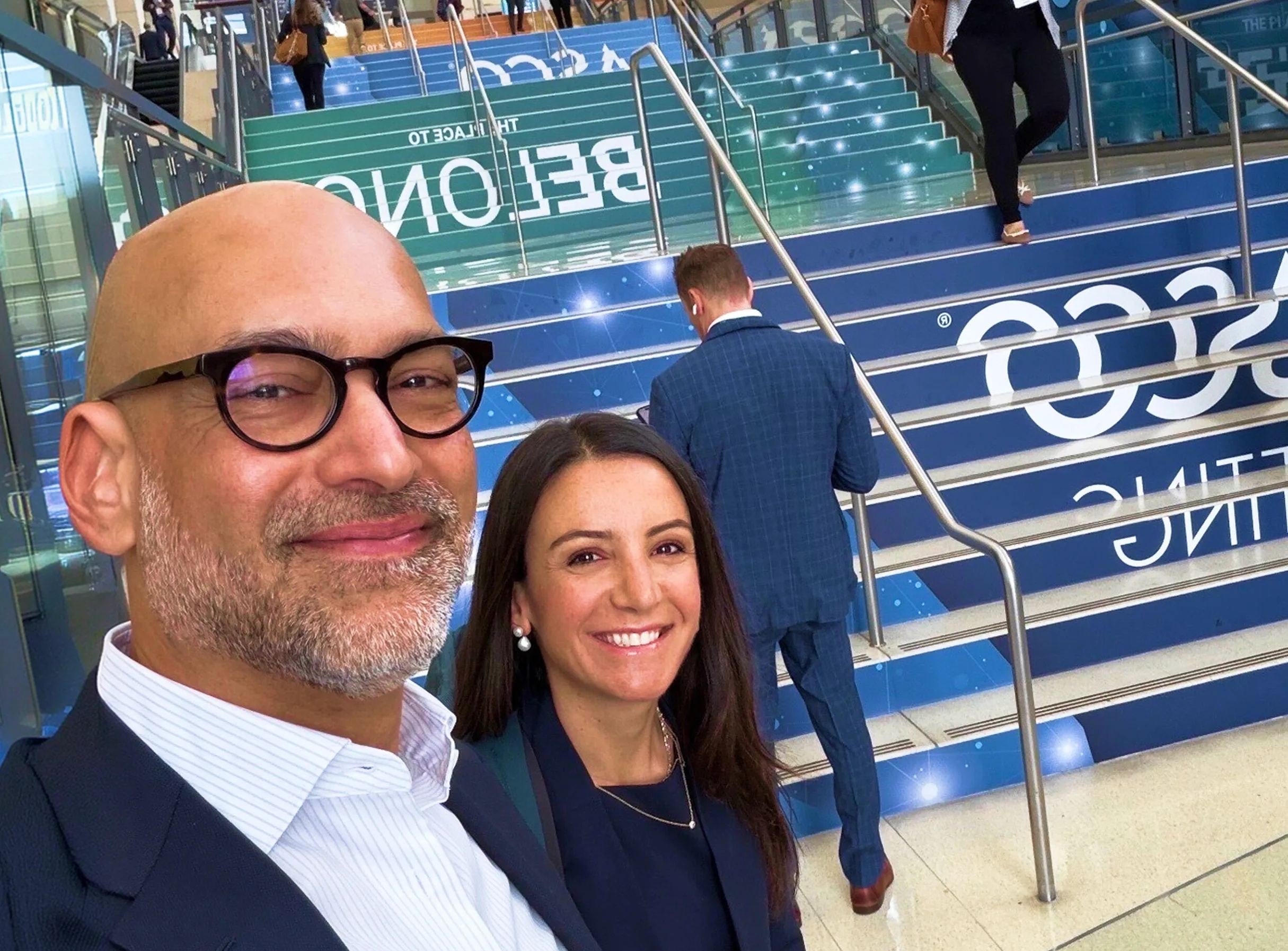
When Hala Borno’s sister visited San Francisco, the occasion offered a small interruption to the business of running a company. Ruba Borno was in town for an Amazon Web Services startup gathering. Hala runs Trial Library. Two sisters working in technology had a chance to spend time together, and Hala found herself thinking about the family they came from.
The connection she drew was about partnership. Their jobs were different, but both required finding other people willing to build something together. She traced that expectation back to home, before the titles and professional introductions. The visit supplied a quieter way into her own career: a founder looking at her sister’s work and recognizing a familiar habit.
“Neither of us gets anywhere alone.”
Hala Borno, reflecting on her sister’s visit
01 Two sisters, one working theory
A family resemblance can take a professional form. In Borno’s account, the shared inheritance was a sense of what deserved their effort and an expectation that meaningful work would involve other people. That makes partnership more personal than the usual corporate vocabulary allows. It belongs to the story of how she learned to work.
Look at a founder through that lens and the supporting cast becomes easier to see. An advisor who explains an unfamiliar process matters. So does a colleague who helps turn an idea into a product, or an investor prepared to support the next stage. The individual remains responsible for decisions. The biography gets more accurate when the other names stay in it.
There is a little comedy in the title of founder. It gives one person a wonderfully compact introduction to an undertaking that soon requires a great many calendars. Borno’s public reflections leave room for the calendars.
02 Before the first deck
Borno arrived in the United States as a refugee of the first Gulf War. Her family had fled Kuwait. She learned English as a second language and grew up in North Carolina. The experience of entering an unfamiliar society would later inform the importance she placed on inclusion.
Her education took her to the University of North Carolina at Chapel Hill, where she graduated with honors in biochemistry. Further study and training eventually brought her to the University of California, San Francisco. She became a researcher and a faculty member. The academic career was substantial before entrepreneurship entered the picture.
Scientific training gives this story its particular pace. There are years of preparation before a company appears, a long stretch in which learning is itself the work. A launch date can compress that history into a single line. Borno’s route asks for a longer view, one that includes the education behind the decision to try something different.
- KuwaitFamily fled during the first Gulf War
- North CarolinaChildhood and university education
- San FranciscoUCSF and entrepreneurship
03 An idea learns to speak business
The entrepreneurial turn came with instruction. At UCSF, Marlene Grenon encouraged Borno to consider building a company informed by her research. Grenon helped with the first company deck, market research interviews, and a business plan. She explained the steps involved in starting a venture-backed business and remained a friend and advisor.
Those details rescue mentorship from abstraction. A first deck is a document somebody can read. An interview is a conversation somebody must arrange. A business plan makes an idea answer questions about how it might work. Encouragement becomes useful when it helps produce the next piece of work.
In this part of Borno’s story, expertise and beginnerhood occupy the same room. An established researcher still has things to learn about entrepreneurship. That is an appealingly ordinary fact beneath an unusual career change. Starting again does not require erasing the years that came before; it does require finding people who know the unfamiliar parts.
04 Purpose, with paperwork
Borno built Trial Library as a public benefit company. In describing that choice, she has emphasized a commitment to the public good. It is a useful detail in a founder profile because it places purpose inside the organization she chose to create.
A company has to do more than explain why its founder cares. It needs a structure, a team, and a way to continue operating. The public benefit designation belongs to that practical side of the story. It gives the stated ambition a place in the business’s identity, alongside the everyday demands that come with running it.
Trial Library emerged publicly on August 18, 2022. The launch announced $5 million in seed financing. The date marks a change in visibility: work that had been developing inside a university setting now had a public company name and an announcement attached to it.
For a reader arriving at the story through a later funding round, this earlier milestone helps restore the sequence. There was preparation, then a launch, then more building. The announcement was one event in a continuing job.
05 The numbers acquire company
On December 2, 2025, Trial Library announced a $10 million Series A. SemperVirens Venture Capital and Next Ventures co-led the round. Participants included Sanofi Ventures, Lux Capital, Civilization Ventures, How Women Invest, and Overwater Ventures.
Put the two announced rounds beside each other and the milestones are easy to grasp: $5 million at the seed stage, then a $10 million Series A. They describe financing events at different moments. They give the business story dates and scale without pretending to tell the whole story of the person running it.
Round sizes shown separately. Public announcements: August 2022 and December 2025.
The investor list also brings more people into view. Capital arrives through firms, but the resulting relationships become part of a founder’s working world. Borno’s earlier emphasis on partnership gives the list a place in the narrative beyond the ceremony of a financing announcement.
Funding provides a business with resources for the work ahead. The round itself is a milestone; what follows is another period of decisions, hiring, product work, and conversations. A number can be printed in large type. Running the company still happens at ordinary size.
06 A title that comes second
In a 2022 interview, Borno put motherhood first among her identities. She described having three children and acknowledged that home life could feel chaotic. A supportive partner was part of her account of how she managed work and family.
It is a revealing choice of emphasis for somebody discussing a new company. Founder and CEO might lead the professional introduction, but she supplied her own order of importance. The distinction makes the portrait more human. A job title is convenient for everyone meeting you; it need not be the title you use to understand yourself.
Her description leaves the untidiness intact. That matters. A polished account of career and family can become so efficient that the people disappear from it. Borno allowed for chaos. There is room in that admission for the practical circumstances of a life, rather than a set of instructions about how everyone else should arrange theirs.
07 The work between announcements
The team around Borno has its own working arrangements. Trial Library’s recruiting materials describe a remote team, paid parental leave for full-time employees, support for working from home, and an interest in career development. These are concrete details about the organization she leads, with consequences for the people who join it.
Her public life extends beyond the company’s announcements. Refugees International listed Borno and Rajaie Batniji together among the Leader sponsors of its 2025 Advocacy Awards. The event took place in Washington on May 7. For a founder whose childhood included displacement, the appearance of her name in that community adds another thread to the public record of her interests.
In 2026, she was also listed on the program at Transform, alongside Allison Baum Gates and Lance Armstrong. Such appearances put a founder in conversation with people outside the immediate team. There is work in explaining an undertaking to another room, hearing the questions it raises, and returning to it afterward.
08 Keep the door open
Borno has advised prospective entrepreneurs to pay attention to the idea that keeps returning, and to take action when it persists. Her own career gives that advice a practical background: years of study, an emerging possibility, a mentor, and the work of putting a company together.
The appeal is in the sequence. An idea can begin as something worth investigating. The next step can be small enough to complete: a conversation, an interview, a document. A career change grows more legible as those steps accumulate. Nobody needs to pretend that the first deck already contains the whole future.
Return to the visit with her sister and the story acquires a fitting scale. Two people in the same family, working in different organizations, recognize how much their work depends on others. Borno’s founder title remains hers. Around it are the people who helped her learn the role, the colleagues who share the work, and a family that gave partnership an early meaning.