Hala Borno has a memorable way of describing the old business of finding a cancer trial: it is like searching for a flight without knowing whether the plane has any seats. You can find an itinerary. You can even admire the destination. Then, at the moment a patient is ready to go, you discover there is nowhere to put them.
Borno is an oncologist and physician-scientist who founded Trial Library in 2022 after work at the University of California, San Francisco. Her complaint was more pointed than the familiar one about medical information being hard to search. A trial listing may say “recruiting,” but a clinician also needs a plausible match, a live site, an available slot, a referral route and a patient who can make the journey. An answer that stops at the listing is only the beginning of an answer.
The short version
- Trial Library helps oncology clinicians find and refer patients to relevant trials during routine care.
- Its Ally Navigators help with the next steps, including records, scheduling and practical barriers.
- The company reported 642 referrals in one year with The Oncology Institute; that is a referral count, not an enrollment count.
- Its buyers include practices, health systems, drug sponsors, payers and employers. Public prices are undisclosed.
The first failure happens in the clinic
Patients often imagine trial discovery as something they must do themselves, late at night, with a diagnosis in one browser tab and a vast registry in another. Trial Library works from a different observation. In Borno’s account, roughly eight in ten people who enter a clinical trial do so after a provider recommendation. The useful place to intervene, then, is the appointment in which treatment options are discussed.
That appointment is short. Community oncologists may not have a research coordinator at hand, and a search that requires a second login or a half-hour of reading can be postponed until it vanishes. A clinician in a 2024 Trial Library conversation described the practical result: patients get standard treatment while the intended trial search waits for a “next time” that never comes. The immediate competitor is therefore not just another software firm. It is the handwritten note, the email to an academic center, and the search that nobody has time to finish.
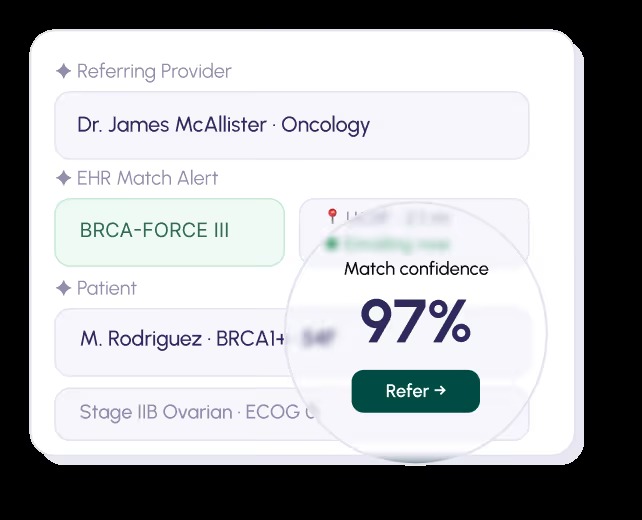
Trial Library’s provider decision-support tool began in community oncology with prostate cancer in 2023. Its current search asks about clinical history and uses that context to narrow recruiting studies. The company says it augments registry data with sponsor and site information, including the kind of slot verification that makes a referral worth pursuing. In May 2026 it launched Conversational AI Trial Search, which asks follow-up questions rather than forcing every case into a fixed form. The company says the workflow can reach clinicians without a new login.
“Finding a trial isn’t enough. Getting a patient through it is what matters.”Hala Borno, founder and CEO
A search result cannot drive a patient to the site
The second half of the company looks less like software and more like a careful travel office. After a clinician discusses a study and refers an interested patient, Trial Library’s Ally Navigation team helps assemble records, communicate with the trial site and sort through obstacles such as transportation, language, food and scheduling. Its own guidance says it does not approach patients before the care team introduces the trial. That order matters: it keeps the treating clinician in the conversation and turns a cold lead into a supported handoff.
From listing to living person
The trial site still makes the final eligibility decision; the patient still chooses whether to participate.
This is Trial Library’s distinctive commercial shape. It offers providers a fast path to a plausible study, sponsors a way to reach patients outside the usual academic-center orbit, and health systems a way to find potentially eligible people already in their records. Its Patient 360 service and Pre-Screening OS work on that last problem. Payers and employers are also prospective buyers of trial access as a member benefit. Trial Library does not publish a price list or contract economics, so the cost visible from outside is its financing: a $5 million seed round and a $10 million Series A announced in December 2025.
The number to read carefully
In its work with The Oncology Institute, Trial Library says it generated 642 patient referrals in one year. It is a useful number because it counts a concrete action: someone was identified and sent toward a study. It is also a number to handle honestly. A referral is not an enrollment, much less evidence of better survival. Clinical eligibility, available places, patient preference and travel can all alter the result after that point.
Company-reported figures. Network size is reach; it does not measure patient enrollment.
The partnerships show what the company has tried to copy from one setting to another. American Oncology Network placed Trial Library in three practices across ten locations in Missouri, Ohio and North Carolina, and said the tools identified tens of eligible solid-tumor patients in the first quarter. Texas Oncology announced a collaboration to put personalized trial navigation into its operations. Johnson & Johnson Innovative Medicine expanded work with the company on oncology development and medical affairs. Each arrangement tests a different link: finding patients, making a referral, or getting a sponsor’s study in front of the right clinicians.
The equity question has an operational answer
Borno’s founding argument included a simple concern: who gets offered a trial often depends on where they receive care. In 2024, the American Cancer Society, Trial Library and the Prostate Cancer Clinical Trials Consortium announced a program to improve Black patient recruitment in prostate cancer studies. The society offered grants of up to $200,000 a year for two years to community practices and hospitals to build research capacity. That figure is a program grant ceiling, not Trial Library’s product price.
There is an important distinction between promising a fairer funnel and demonstrating one. A matching model can widen the list of possible candidates, but it cannot manufacture staff time, an open slot, consent or a ride across town. Trial Library’s bet is that those mundane constraints belong inside the product and service, not in a footnote after the referral. Its human navigators are as central to that wager as the AI in its search box.
For a clinic considering the approach, the copyable lesson is modest and practical. Put trial discovery where the treating clinician works. Verify that a study is truly actionable. Have a named person own the handoff, records and patient barriers. Then measure referrals separately from screenings and enrollments. The workflow is likely to struggle where the clinic cannot introduce studies to patients, where trial sites do not keep availability current, or where no one can support the patient after a match. Trial Library has raised money to make that chain repeatable. Whether it can make it routine is the more interesting test.