A doctor has a patient whose case sits just outside the neat lines of a clinical trial. The guideline is useful, but the patient has other illnesses, an unusual treatment history, or a combination of risks that the study never quite covered. Somewhere in the hospital’s records are people who look a little more like this one. The maddening part is that the doctor cannot easily ask what happened to them.
That is the problem Atropos Health was built to address. It turns de-identified patient records into retrospective studies that can help clinicians and researchers judge outcomes for a defined group. The company began as Stanford’s Green Button informatics consult service: a physician sent a question; data experts searched past cases and returned an analysis. The commercial company, founded in 2020, has since wrapped that logic in software, a data network and, lately, AI interfaces.
- Clinicians ask what happened to patients with similar characteristics and treatments.
- Green Button returns a clinician-reviewed observational report, generally within 48 hours.
- ChatRWD, GENEVA OS and the Evidence Agent automate more of the question-to-study route.
- Health systems use the evidence for care and pharmacy decisions; life sciences teams use it for research and analytics.
The question was the product brief
Stanford physicians had been asking biomedical informatics professor Nigam Shah to find answers in electronic medical records. His team’s Green Button idea made a service of that recurring request. Shah, physician-scientist Saurabh Gombar and healthcare entrepreneur Brigham Hyde later founded Atropos Health. It was an unusually good way to discover a market: the customer had already written the first set of product requirements in the form of actual clinical questions.
The early version was deliberately practical. A clinician could describe a case in a few sentences, much as they might email a colleague. The response, called a Prognostogram, set out a cohort, methods and results from an observational analysis. This is quite different from asking a search engine for a paper that may not contain the patient group you need. Atropos’s proposition is to create a new analysis from relevant records when published research leaves a gap.
“The promise of learning from the care of past patients is a concept that has been discussed for a generation now.”Nigam Shah, co-founder
That promise is also easy to overstate. An observational study can compare what happened to groups in routine care; it does not turn an association into a randomized trial. Confounding, incomplete records and small cohorts remain stubborn companions. Atropos’s answer is methodological: define the question carefully, use statistical adjustments, show the work and grade whether a dataset is fit for the particular question.
Describe the patient group and outcome that matters.
Find records and test whether they can support the question.
Build the cohort, compare outcomes and expose methods.
Bring the result to care, research or policy decisions.
From a consult to a machine for consults
Green Button still offers the human-facing version: send a question and receive a clinician-reviewed report in under 48 hours, according to the company. In 2023, Atropos launched GENEVA OS and ChatRWD. The latter lets a user refine a clinical question conversationally, then request an observational study. Its point is not the chat bubble. It is the structured journey behind it: population, intervention, comparator, outcome, timeframe, cohort and analysis.
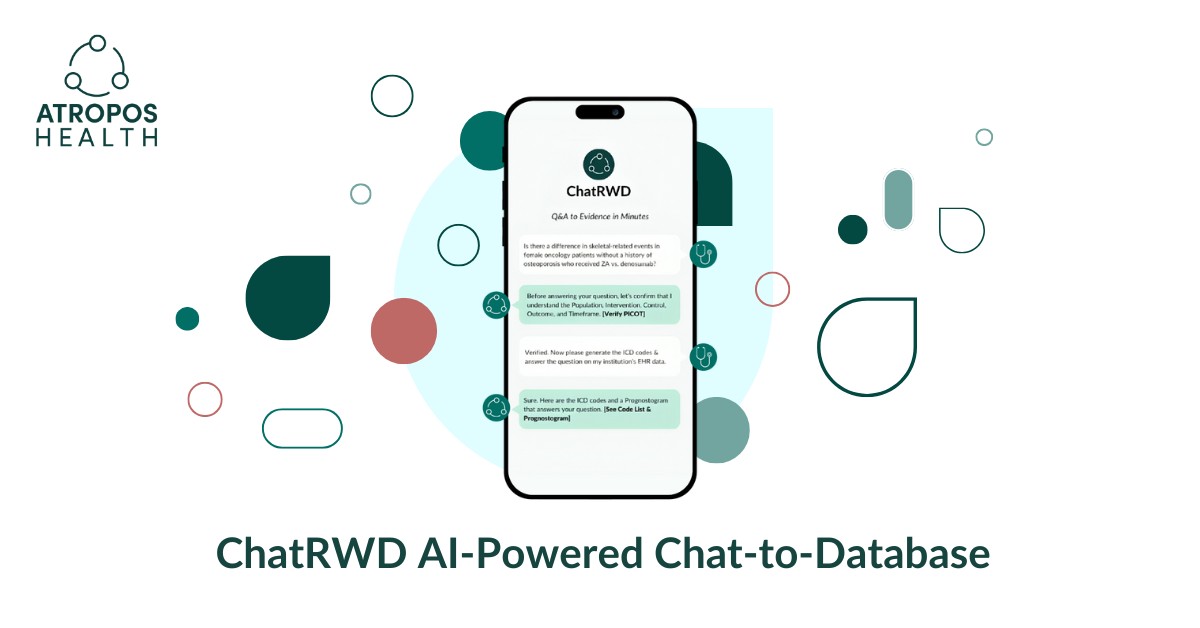
The network beneath the interface matters as much as the interface itself. Atropos’s Evidence Network lets members query multiple de-identified datasets through a federated architecture, with underlying records remaining under their holders’ control. The company introduced a general Real World Data Score and a question-specific Real World Fitness Score in 2023. A large dataset can still be the wrong dataset if the relevant treatment, follow-up period or patient subgroup is missing. That bit of skepticism is a feature.
The other change has been from a single study to a reusable body of evidence. Alexandria, its evidence library, contained more than 33 million artifacts by the company’s 2026 count. Atropos also announced a layered review process involving automated checks, optional clinical review and an independent audit model. That is an admission embedded in a product decision: when evidence can be produced at machine scale, the hard question becomes which findings deserve to be trusted and retrieved.
Two buyers, one difficult promise
A hospital buys Atropos for decisions it already has to make. A physician may want a treatment comparison; a pharmacy committee may want local outcomes before changing a formulary; a quality team may want to test a care protocol. Emory Healthcare has described using the platform for medication formulary design and protocols. Stanford is both the birthplace of the idea and a site where the newer Evidence Agent operates inside the clinical workflow.
Life sciences teams buy the same engine for a different calendar. Merck’s announced collaboration covers rapid cohort creation, analytics and study replication. Oncology is another natural fit, because treatment sequences, subgroups and changing standards make the literature perishable. An earlier partnership with ASCO’s CancerLinQ sought to make oncology records useful for questions that published trials had not settled.
The business model follows these institutional buyers. Atropos sells platform access and evidence services to organizations rather than as a consumer app. Earlier reporting described subscriptions plus charges tied to Prognostogram volume or user count. There is no public price card, so the honest cost comparison is operational: months of analyst work and delayed decisions versus the expense of an integrated, governed evidence service. The company’s own savings figures are useful leads for a buyer to audit, not a substitute for a local return-on-investment calculation.
The answer has to arrive where the decision happens
Atropos has increasingly moved toward the doctor rather than asking the doctor to visit another portal. Its Evidence Agent launched at Stanford Health Care in 2025, where the company says it can use the patient record through Stanford’s ChatEHR tool to bring relevant evidence into treatment discussions. A Microsoft Dragon Copilot collaboration extends that idea to ambient clinical work. In 2026, an Evidence Agent MCP listing on Databricks Marketplace carried the same logic into data teams’ existing environment.
The company raised a $33 million Series B in 2024, led by Valtruis with strategic investors including Cencora Ventures, McKesson Ventures and Merck Global Health Innovation Fund. That money financed a wider evidence network, specialty integrations and ChatRWD. By September 2026, Atropos said its network covered more than 330 million U.S. patients through expanded data partnerships. Coverage is an input, however, not a clinical outcome. A useful answer still needs the right data, the right method and a clinician willing to inspect the result.
There is a lesson here for anyone building tools around expert judgment. Atropos did not begin by inventing a broad AI assistant and looking for a question. It began with questions physicians were already sending, found that the bottleneck was the repeatable production of credible evidence, and built interfaces around that work. Where a cohort is too small, a record too thin or a study too confounded, the system should resist the temptation to sound certain. Medicine has enough eloquent guesses. A button that remembers well may be more valuable.