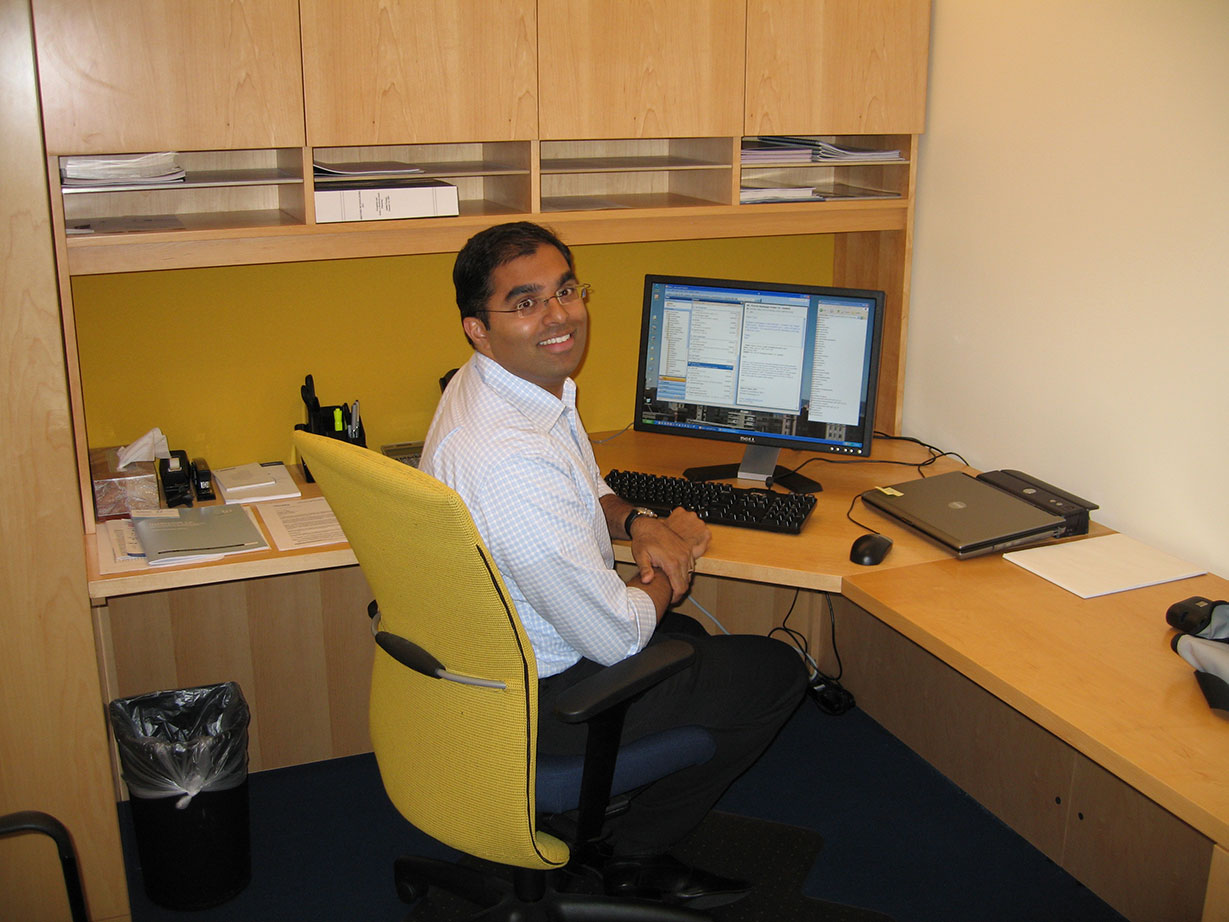
The photograph is from 2007: Uday Kumar in iRhythm’s first office space. It belongs to the portion of a company’s life when the address is more certain than the outcome. Nine years later, another photograph catches the iRhythm team celebrating its public listing in Times Square. Between an office and a stock exchange lies the work that a founder’s biography tends to compress into a verb: built.
Kumar has had occasion to use that verb more than once. He founded iRhythm in 2006, founded Element Science in 2011, and spent fourteen years leading the latter before handing over the CEO position in 2026. Alongside those companies runs another occupation: teaching other people how to decide what is worth building.
The two activities belong together. An inventor needs ideas, certainly. Ideas are rarely shy. The harder task is deciding which deserve years of someone’s life, which features justify their expense, and which assumptions should be sent back for further questioning. Kumar’s career is interesting at precisely those junctions.
A year outside the expected route
His education offered a fairly legible route forward. He earned an undergraduate degree at Harvard, graduating magna cum laude, then completed his doctorate there in 1998. He took a year after that to try working at a startup. The experiment came early, before founding companies became the organizing fact of his professional life.
There is a pleasing inconvenience in that sequence. A long education is meant to make the next step clear. Kumar inserted a question into it. Trying a startup did not require a permanent declaration about who he would become. It gave him an encounter with a different kind of work, one in which an institution has to be assembled rather than entered.
In 2005–06, he joined Stanford’s Biodesign Innovation Fellowship. The program supplied a framework for identifying needs and developing inventions around them. iRhythm emerged from that fellowship in 2006. A year spent learning a process became the beginning of a company.
The elegance of leaving something out
One revealing decision in the early iRhythm story concerned technology that was available but deliberately omitted. Wireless connectivity and real-time transmission were becoming possible. Kumar explained that including them would have made the initial solution too expensive and less accessible. The attraction of another capability had to compete with the purpose of the whole design.
“Instead, we kept it simple”
Uday Kumar, reflecting on early iRhythm design decisions
That is an unglamorous sentence for an inventor to say, which is part of its charm. The usual vocabulary of invention favors additions: more power, more information, more features. Leaving something out can look like a failure of ambition until someone asks who must live with the addition.
A feature carries obligations. Someone has to pay for it, manufacture it, explain it, maintain it, or tolerate it. Its value depends on the job it performs in the finished experience. The designer gets the pleasure of adding it once; the user may inherit the consequences indefinitely. There are occasions when restraint is the more considerate form of ingenuity.
This helps explain the practical cast of Kumar’s approach. A complicated system need not present every complication to the person using it. Different parts can carry different burdens. The work of the inventor includes deciding where those burdens belong, rather than distributing them according to whatever happens to be technically convenient.
The classroom travels
Kumar’s teaching brought that attention to context into collaborations far beyond California. He directed fellowship training for Stanford-India Biodesign, established in 2007. He also directed training for Singapore-Stanford Biodesign, whose first fellows arrived in January 2011.
The international model had a useful modesty. Participants learned the process at Stanford, then returned to apply it in their own setting. Kumar emphasized that innovators from a country understood its cultural and societal circumstances through experience. A visiting expert could bring a method; familiarity with everyday life could not be packed so conveniently.
“Universal but applied.”
Uday Kumar on teaching the process across countries
The distinction gives teaching a different ambition from exporting an answer. A method has to help someone notice what the teacher does not already know. Otherwise, the classroom produces imitators who are very well prepared for somebody else’s problem.
His teaching has also continued at Stanford, where he serves as a senior advisor to Biodesign. The 2024 alumni survey records more than 150 people formally trained by Kumar and another 160 informally coached or mentored. These are dated figures, but they give the educational side of his career a visible scale.
Mentoring does not offer the neat photographic finale of an IPO. Its consequences travel with other people, into decisions the mentor may never attend. In a career usually described by companies founded, that is a substantial second line of work.
people formally trained in Biodesign principles
others informally coached or mentored
A different kind of conversation
Another company in Kumar’s history broadens the picture. He was a co-founder and board member of Qurious.io, a business built around AI speech analytics. Pegasystems announced its acquisition in January 2021. The buyer did not disclose the terms.
Qurious worked on the conversation happening between a customer and a service agent. Its software combined speech-to-text, language processing, and other analytical tools to offer insights and coaching while a call was underway. Here, the setting was the customer-service desk, with its own pressures and interruptions.
Kumar’s connection to that business is a reminder that a founder’s interests need not fit neatly inside the label attached to his most familiar company. It also provides a concrete example of software intended to sit within an existing task. The conversation was already happening. The proposed value lay in helping the person handling it.
The acquisition adds another kind of endpoint to his record. iRhythm became a public company in 2016. Qurious became part of a larger software business in 2021. These are different organizational outcomes, and neither explains the career on its own.

Back at the workbench
On January 22, 2025, Kumar returned to Stanford for From the Innovator’s Workbench, this time as the interview subject. Across from him was Kate Rosenbluth, a fellow inventor and a 2012–13 fellowship alumna. Lyn Denend introduced the conversation.
The pairing made the occasion more than a return visit. Two alumni could discuss the process from different positions in their careers. Kumar’s account included an appreciation for simple solutions and the importance of considering both choices to make and choices to avoid. The latter category deserves a chair at more planning meetings.
He thanked Rosenbluth, Denend, and the organizing team afterward, noting the significance of being the first fellowship alum to appear as a guest in the series. There is a satisfying circularity here: the former trainee became a founder, continued as a teacher, and returned to be questioned about what the intervening years had taught him.
A good interview leaves room for the inconvenient parts of a career. The Stanford event was framed around its highs and lows, the challenge of building experiences, and the lessons of mentoring. Those topics make a richer account than a procession of announcements. They allow the successful outcome and the difficulty of reaching it to occupy the same room.
Making room for the next CEO
Fourteen years is a long time to hold the responsibility of a young company. In March 2026, Kumar passed Element Science’s CEO role to Douglas Devine and became Founder & Senior Advisor. The company announced the appointment on March 18.
Devine had previously held several executive positions at iRhythm, including chief financial officer, chief operating officer, and interim CEO. The connection gave the transition a specific professional history. A company Kumar founded earlier had also been part of the incoming leader’s preparation.
Kumar said he would continue supporting Element Science while initiating plans for his next venture. The two intentions can coexist. Founding creates a relationship with a company that a change of title need not exhaust. Advising gives that relationship another form, while a successor takes responsibility for the next phase.
There is no need to pretend a handoff is effortless to see the judgment involved in one. The business has its own changing demands. A founder who has spent years asking what belongs in a design can eventually face a related question about his place in the organization.
- 2006iRhythm founded
- 2011Element Science founded
- 2016iRhythm IPO
- 2026Founder & Senior Advisor
The office photograph from 2007 remains a useful place to end up. It shows an early point in a company’s life, long before the later photographs made its outcome familiar. Kumar is now considering another venture with considerably more experience behind him. The question he has taught others to ask still comes before the answer: what problem is worth the work?