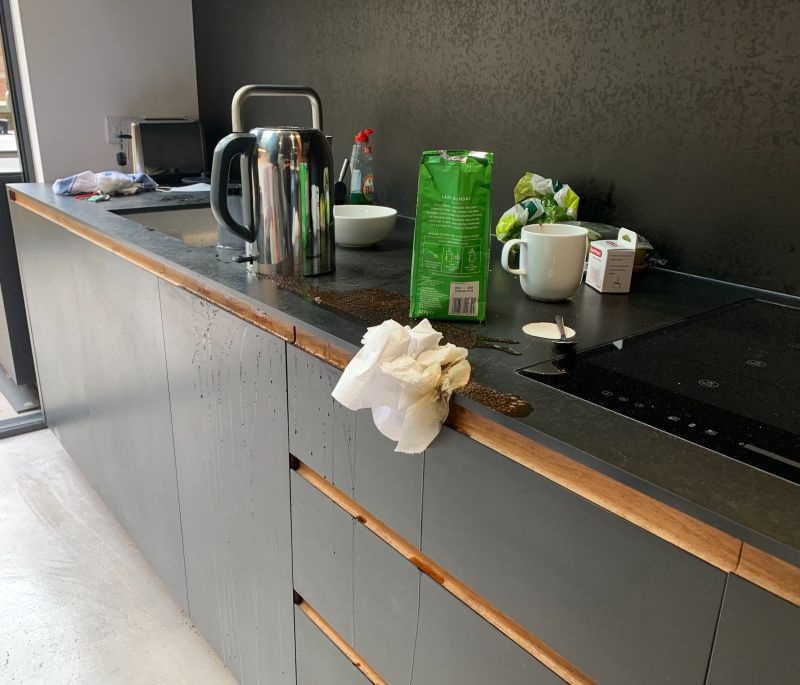
The coffee had escaped. In a photograph Simon Rohrbach later shared from Plain’s beginnings, it is spread across a kitchen counter and running down the cupboards. There is a kettle, a mug, a bag of coffee, and some paper towels doing their modest best. A company can have ambitions for the future and still lose an argument with a hot drink.
Rohrbach and his co-founder, Matt Vagni, had rented a flat for a couple of weeks after closing their first funding round. Before hiring anyone, they wanted time together. They wrote values, made sketches, and talked through their ambitions and fears over meals and wine. They bought domains, too, settling on a name they subsequently discovered was already thoroughly trademarked by a large public company.
The recollection is affectionate without pretending that the early ideas were all correct. Some were wrong; some contained the beginnings of what followed. The durable part, in Rohrbach’s telling, was the trust. That would prove useful when the company began asking questions neither founder could settle with a sketch.
A designer discovers the size of the job
Before Plain, Rohrbach had watched another company expand around him. He joined Deliveroo in 2014 as its first designer. The business was still small; by the time he was speaking about his experience in 2019, it operated across 14 countries and 500 towns, with around 2,000 employees. His own responsibilities had expanded from making products to leading the content, research and design organisation.
His conference talk that year was called Pixels, Products and People. It described a journey into becoming a manager of managers. An interface lets a designer arrange what someone encounters on a screen. An organisation asks who makes decisions, who has information, and how the work reaches the next person. The subject had grown considerably larger than the canvas.
In his account of 2017, the design organisation had passed 30 people. Research took place in markets including Hong Kong, France, Dubai and the Netherlands. A UI Infrastructure team built shared components and processes so people could move faster without repeatedly solving the same problems. He explicitly resisted treating team size as a goal or a certificate of success.
What mattered was the work the organisation could do. There was research to bring into decisions, repetition to remove, and progression to make clearer. His year-end reflection spent time on those questions and thanked colleagues by name. Growing a team meant making room for more people to contribute, rather than simply adding chairs.
The rebrand supplied a rather physical lesson in coordination. Rohrbach and Courtney McNeil helped lead the design work with DesignStudio and Brake. New equipment for 20,000 riders had to reach roughly 100 cities together. The distribution schedule set the launch date; digital products, marketing and internal communications had to organise themselves around it.
The project took about a year. Keeping colleagues informed while maintaining momentum was part of the design problem. A rider’s jacket could not be updated by pushing a new version of an app. Somewhere between the brand presentation and the street, someone had to make sure the boxes arrived.
“Drop shadows won’t get you to PMF.”
Simon Rohrbach, on the responsibilities of design founders
Customers wanted dinner
One lesson from that period sounds peculiar coming from a designer: a good interface is not always the reason a customer chooses you. Rohrbach remembers joining Deliveroo when there was no app and the website did not work properly on a phone. Customers still worked their way through the inconvenience because the restaurants they wanted were available.
As competitors offered similar services, he argues, design and brand became more consequential. Demand for the underlying service had come first. The value of making the experience better changed as the market changed.
At Plain he saw a different starting point. Customer support was already an established, crowded market. Quality, performance and the experience of spending hours inside the software could influence the choice from the beginning. These two situations gave him a more conditional view of his craft. The question was where design would help the business, and why.
The years that refused to look like a success story
Rohrbach spent a year as Mentor in Residence at Index Ventures after Deliveroo, helping other companies with products and teams. In 2020 he and Vagni started Plain. They had worked together at Deliveroo, where Vagni had been a design engineer before moving further into engineering.
The original idea put infrastructure at the centre: an API-first support platform that companies could build on and customise. At its 2022 seed announcement, Plain’s pitch emphasised putting live customer information beside conversations. Engineers and support colleagues would be able to work with the same underlying context, with fewer improvised connections between systems.
Rohrbach put the problem succinctly: “The fundamental problem we’re solving is context:” A person answering a customer needs to know what has already happened. When that information is scattered, even an uncomplicated reply can require a small expedition through the company’s software.
Funding did not remove the difficulty of finding buyers. Looking back on Plain’s fourth anniversary, Rohrbach described roughly the first three years as building and iterating without much traction. Judged by the revenue of that period alone, he said, the business would have looked like a failure. The following year told a different story.
He drew lessons about working on the company’s biggest problem, even when that required learning an unfamiliar job. Closing a customer and hiring someone could demand his attention on successive days. With Vagni, he learned to separate responsibilities and hold each other accountable for outcomes. They also worked with a coach.
- 2014Deliveroo’s first designer
- 2019Mentor in Residence at Index
- 2020Plain begins with Matt Vagni
- 2022$6m seed announced
- 2025$15m Series A announced
- 2026Expanded Sidekick launches
In a September 2025 conversation with Pascal Unger, he explored the difference between a company’s eventual vision and the first product a customer can actually adopt. A broad infrastructure pitch could ask too much of engineering teams before demonstrating enough immediate value. Agreement with an idea was also a poor substitute for willingness to buy.
The positioning became more specific: developer tools, technical support, then B2B support. Conversations were moving into Slack, Teams and Discord, while support tools still carried assumptions inherited from email ticketing. That gave Plain a concrete place to begin. It could help teams manage the work already happening across those channels, while retaining the infrastructure underneath.
Three things a good interface cannot do alone
Rohrbach’s advice to designers separates three jobs that can look deceptively similar from inside a product team. First comes making a good product. Then comes making a financially viable business. Then comes building a company capable of attracting people who can improve both.
He has interviewed hundreds of designers and argues that too many equate product quality with commercial success. The distinction is blunt: a business must make enough money to pay salaries. The company must also make talented people want to join and do useful work together. An attractive screen cannot answer those questions on its own.
His argument about design founders follows the same sequence. Caring about the business creates the conditions for caring about the design. It can mean spending less time in the tools that made you employable and more time confronting the questions that decide whether your company can continue employing anyone.
That helps explain the changed job description. The designer who once improved a product now has to decide which problem deserves attention at all. Craft remains useful, but the founder has to earn the opportunity to practise it.

A sales call with an unexpected recommendation
One of Rohrbach’s public sales lessons begins with a competitor. When a prospective customer’s needs are a better match elsewhere, he says he recommends an alternative. He has described a conversation in which he suggested Front or Intercom instead of Plain.
The prospective customer was surprised, then offered to recommend Plain to someone whose needs did fit. Rohrbach’s reasoning connects honesty to the economics of the business: poorly matched customers can leave unhappy and tell others; people who receive useful advice can remember it. Accepting every possible sale is expensive when the product cannot make the promise work.
It also requires knowing the limits of what you are selling. A founder who can explain where another product fits better has to understand his own customer clearly. After years spent refining Plain’s proposition, that precision carries more weight than a claim to be suitable for everyone.
The investigation before the answer
In February 2025, Plain announced a $15 million Series A led by Battery Ventures, with Index Ventures and Connect Ventures participating again. The plans included a San Francisco office and investment in the product and team. Sanity, Laravel, Stytch and Raycast were among the customers named at the time.
By July 2026, Rohrbach was describing an expanded Sidekick: an AI agent within Plain that could investigate across support threads and connected tools. It grew out of customers asking questions that required looking beyond a single conversation, such as whether a bug was fixed or which accounts were affected by an incident.
The design challenge reaches into responsibility. The system gathers information, prepares conclusions and handles some reversible internal work. Actions with greater consequences require human approval. A shared workspace shows investigations, results and decisions awaiting attention. People retain judgment about priorities, exceptions and how to communicate with customers.
Rohrbach’s ambition is for support workers to have agents that understand their particular systems and customers. The daily task moves towards directing investigations and deciding what to do with them. For someone whose earliest Plain pitch centred on context, the continuity is clear: the reply improves when the background has been assembled.
His home is now San Francisco, after years in London. Away from Plain, his personal site mentions Jules, his partner, and their dog Percy. Long-distance running gives him another way to spend his time. There is a company to run, too, and its demands have repeatedly changed what he needs to learn. The early flat contained sketches, serious conversations, and coffee to clean up. The sketches changed. The habit of working through the next problem remained.