Slide the screen upward and a keyboard appears. Beneath it sits a computer running Windows, with the familiar machinery of files, applications and menus. In October 2004, this was OQO’s proposition: take the PC you already understood, make it roughly the size of a personal digital assistant, and let the laptop bag stay at home. The entry price was $1,899. Convenience had acquired a rather expensive tailoring bill.
The object makes the argument before anyone speaks. A pocket computer promises fewer things to carry, less ceremony before beginning work, and access to the software that normally lives on a desk. OQO pursued that promise with unusual literalness. It preserved the PC while reducing its dimensions. The interesting question is how much of a desktop experience survives the reduction.
The story in four points
- The proposition: full Windows applications in a handheld with a sliding physical keyboard.
- The price: Model 01 started at $1,899; Model 02 arrived from $1,499.
- The customer: a mobile professional whose work required more than a PDA or phone could provide.
- The ending: financial distress, canceled successor preorders and closure in 2009.
The desktop, without the bag
OQO was founded in 2000 by Jory Bell, Jonathan Betts-LaCroix, Andrew Popell, Michael Prichard, Nick Merz and Robert Ford. Bell’s background included Apple’s PowerBook design team. The company demonstrated its concept at WinHEC in 2002, presented the Model 01 at CES in 2004, and finally shipped that October. The distance between showing the idea and selling it matters: a convincing prototype is an invitation to solve all the problems that remain.
The original machine weighed about 400 grams. Its five-inch display showed 800 by 480 pixels; inside were a 1GHz Transmeta processor, 256MB of memory and a 20GB hard drive. It ran Windows XP. These specifications describe a small PC, which was precisely the attraction. A PDA could be light and useful, but a buyer needing a particular desktop application faced a compatibility problem. OQO offered a route around it.
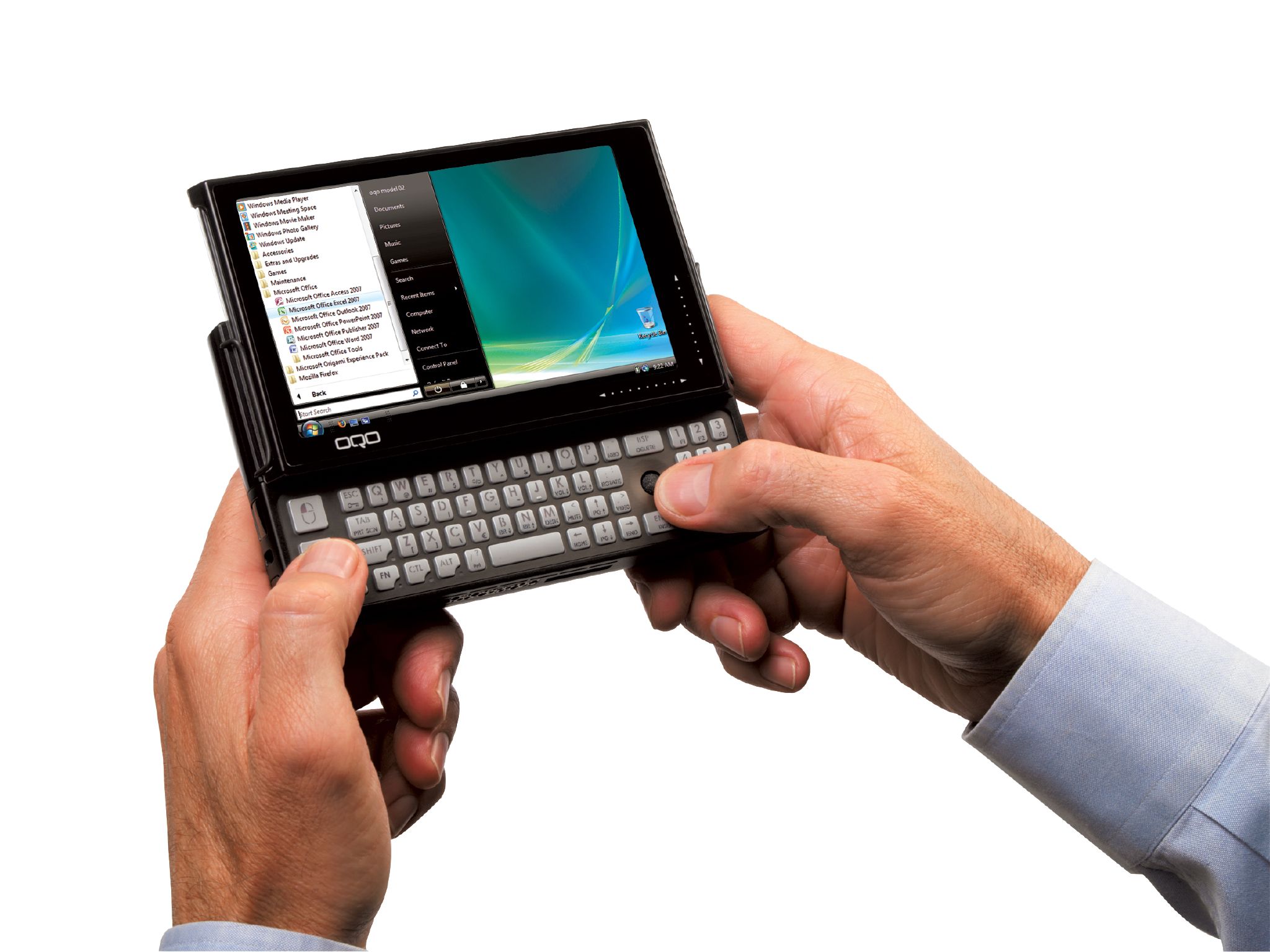
Think of the difference between reading a document and working inside the application that produced it. For certain jobs, access to the actual program is the requirement. Contemporary reporting identified medical, military and other enterprise users with that need. Those were plausible customers for a device that could travel farther from a desk than an ordinary laptop without requiring a different software environment.
The business followed the object. OQO sold premium hardware, configuration upgrades and accessories through its own store and resellers. International distribution widened the opportunity. The money came from selling the machine; cellular service, where offered, belonged to a separate carrier relationship. Each sale therefore needed to justify the hardware price on its own merits.
Five inches of familiar trouble
The Model 01’s appeal was also its difficulty. Windows applications had been designed for more generous displays and ordinary pointing devices. In Pen Computing’s review, small text, crowded application bars and troublesome pen accuracy made the miniature desktop demanding. Heat and uneven performance supplied additional friction. The machine could run familiar software, but familiarity did not enlarge its controls.
That distinction is easy to overlook on a specification sheet. Compatibility answers whether an application can operate. Usability answers whether a person can finish the task comfortably. For a brief interaction in the field, the first may outweigh the second. For a long document or hours of spreadsheet work, the bargain becomes less attractive. Human hands have proved stubbornly resistant to miniaturization.
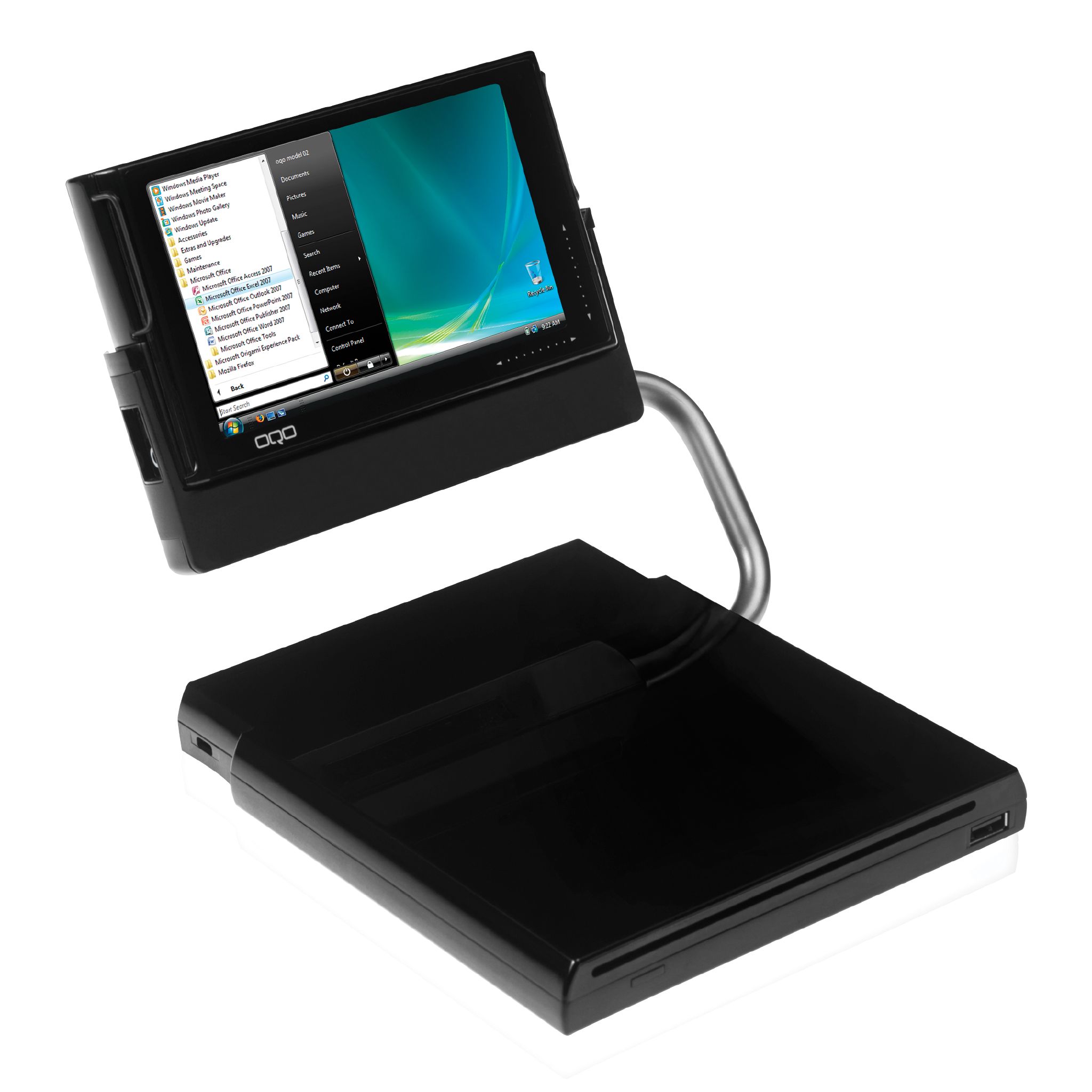
Docking offered a sensible accommodation: carry the computer, then connect it to larger peripherals when stationary. The attraction was continuity. The same machine could accompany its owner and later behave more like a desktop. Yet this arrangement asked the buyer to accept the handheld’s compromises between docking points. Its value depended on what happened during those intervals.
A better machine, a cheaper alternative
OQO kept revising the proposition. The 2005 Model 01+ increased memory and storage and added USB 2.0. In November that year, a $20 million financing round brought backing from Paladin, AsiaTech, Azure and Motorola Ventures. The stated goals included stronger sales and marketing and faster development of the next generation. Engineering had earned another chance to turn interest into purchases.
At CES in January 2007, Bill Gates introduced the Model 02 during his keynote. The redesigned machine had a backlit keyboard, a VIA processor and optional integrated cellular broadband. It started at $1,499. Sprint and Verizon connectivity made the handheld less dependent on finding Wi-Fi; a Novatel Wireless HSDPA demonstration signaled ambitions beyond US networks. Mobility meant both carrying the computer and keeping it connected.
The shrinking entry price / US dollars
Base configurations at the stated dates; nominal prices, without inflation adjustment. The striped bar is an announced price for an unshipped product. Specifications and included options differed.
Price cuts accompanied the improvements. But the relevant comparison was changing. Buyers could consider other handheld PCs, including Sony’s VAIO UX and Samsung’s Q1 family, or choose a larger, cheaper netbook. Smartphones also competed for parts of the mobile workload. In editorial terms, OQO was selling the preservation of a whole computing environment while alternatives sold enough computing for the immediate job.
That is the strategic discomfort. A specialized user might pay to avoid changing software. A general buyer might prefer to carry a slightly larger machine or accept a different application. A product can solve a real problem and still encounter a narrow willingness to pay.
The successor that stayed on the stand
The Model 2+, announced at CES in January 2009, was a substantial attempt to improve the offer. Intel Atom replaced the earlier processor platform. The planned entry configuration cost $999; a $1,499 version included an OLED touchscreen and stronger specifications. Optional Qualcomm Gobi technology promised broader 3G compatibility. Crucially, the cheapest announced machine used an LCD. The OLED attraction and the entry price belonged to different configurations.
The proposed starting price. A demonstration and a preorder were as far as the commercial launch went.
By April, the financing problem was public. Sales and marketing executive Bob Rosin had described working capital as very tight. Distributor reports then said successor preorders would be canceled. Closure was confirmed in May, and service support ended. The visible failure was the company’s ability to fund and deliver its next product.
“working capital has been very tight”
BOB ROSIN · REPORTED IN APRIL 2009
There is a second account worth keeping beside the market story. In a 2012 retrospective, former patent-portfolio lead Erin-Michael Gill wrote that OQO had 13 granted patents and more than 90 pending. He argued that delays limited the collateral available when the company needed financing. This was an insider’s explanation, with its own emphasis. It adds a concrete financing mechanism to a history often reduced to expensive gadgets meeting cheaper rivals.
What survives the pocket
The public product record shows continued commitment to pocketable Windows computing: new chips, better connectivity, revised displays and lower starting prices. It does not show a wholesale abandonment of that premise. OQO changed the machine more readily than it changed the central idea. By the final announcement, the company was trying to make that idea both more capable and less expensive.
For someone designing a product today, the useful move to copy is the attention to a specific constraint: carrying a bag can prevent work from happening at all. The corresponding test is practical. Put the device into a real workflow. Ask which application must run, how long the interaction lasts, which controls matter and what the buyer would otherwise purchase. Then attach a price to the improvement.
This approach becomes difficult when the workflow requires prolonged typing, generous screen space or long periods away from power. It also becomes commercially fragile when customers can perform the important task on a much cheaper alternative. Those conditions explain why shrinking a computer and enlarging its market are separate undertakings.
OQO leaves an appealing object and a less comfortable business question. A PC really could fit in a pocket. The customer still had to decide what that pocket was worth.