A shopper looks at a drawer system for a pickup truck. The photographs are handsome. The specifications are plentiful. Neither quite answers the question that matters: will this thing survive the weather? In Remark’s product illustration, that question appears beside the product, ready to open a conversation. The interesting invention is the placement. Advice arrives while the uncertainty is still warm.
- The product: AI shopping guidance and service software for retail brands.
- The difference: human product expertise informs the answers, alongside merchant knowledge and shopper context.
- The test: do shoppers make better purchases, and does the retailer earn more after costs?
Online retail has become accomplished at moving money. It is less accomplished at helping someone choose between two nearly identical things. A store associate can ask where you hike, what you cook, or how much room sits beneath your bathroom mirror. A filter menu mostly asks you to know the answer already. Remark’s business occupies that awkward gap.
The shopkeeper becomes training material
The company’s founders are Theo Satloff, Carl-Philip Majgaard and Ian Patterson. Their proposition is straightforward: knowledge accumulated by people who use products should help people who are about to buy them. Remark’s 2024 funding announcement described a network of 50,000 domain experts, including athletes, makeup artists and chefs, whose experience helped train AI personas.
This is a useful distinction from a bot that merely recites a catalog. A catalog knows a jacket’s fabric. Someone who has worn it knows which question a nervous buyer will ask. Remark says its experts contribute knowledge and advisory styles, and its stated commitment includes paying people for that expertise. The human contribution is part of the product’s economics.
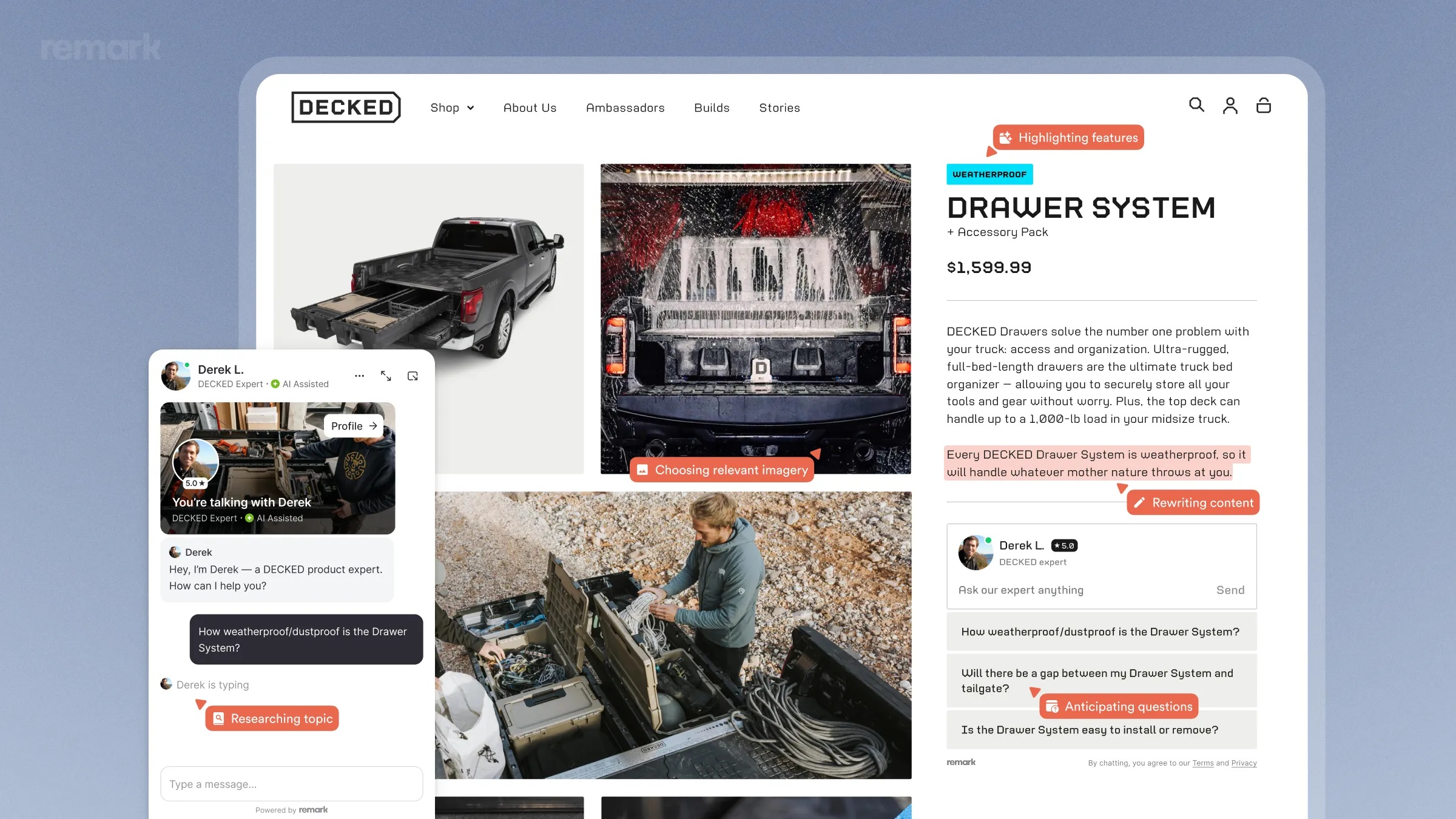
The ambition is personal guidance at online scale. Shoppers can ask about fit, compare options and describe what they actually need. Brands get a way to answer before the visitor wanders off to another tab. The company’s current positioning favors prestige retail, but its public customer examples range from outdoor equipment to cookware and custom furnishings.
Three products, one memory
Remark now organizes its platform around Chat, Inbox and Intelligence. Chat handles recommendations and purchase questions. Inbox addresses service requests, automates workflows and sends complicated cases to people. Intelligence connects brand knowledge with preferences, purchases and interaction history. The point is continuity: a customer should not have to become a stranger each time the channel changes.
Its integrations include Shopify, WooCommerce and BigCommerce, alongside support systems such as Zendesk and Gorgias. Those connections matter because useful advice has operational consequences. Recommending an unavailable size is irritating. Promising an exchange that the merchant cannot honor is worse. Remark advertises live availability, brand rules, human review and escalation controls.
There are plenty of alternatives: store-employed advisors, quizzes, reviews, search and AI support agents. Remark’s claim to a distinct place combines specialist knowledge with assistance before purchase and service afterward. Some adjacent tools are also integrations. Retail software competition is a crowded dinner party where the rival may be seated inside your own product.
A mirror makes the numbers clearer
Consider MirrorMate, which sells custom frames for existing mirrors. Its shoppers need more than inspiration. They have measurements, installation questions and doubts about compatibility. Remark’s June 2026 case study describes putting immediate guidance into that decision. It reports a 32% conversion rate among shoppers who engage with Remark, more than $1 million in annual chat-driven revenue and 99% customer satisfaction.
The denominator deserves attention. People who open a product conversation may already be unusually motivated. Chat-driven revenue records purchases associated with those conversations; it does not, by itself, establish how many purchases the software caused. A retailer deciding whether to buy should keep that distinction close at hand.
The customer pattern is more instructive than any isolated percentage. Pepper Home’s configurable furnishings invite questions about fabrics and measurements. Seattle Coffee Gear’s machines invite questions about routines, space and maintenance. Sur La Table’s kitchenware invites questions about cooking habits. Each sells products for which an explanation can be worth something.
“We needed a way to take all the stuff our team knows about fit, fabric, conditions, and activity”Patrick Calavan, BlackStrap, in a Remark customer testimonial
Advice acquires a checkout button
Remark’s 2026 releases show where the company is heading. In May, Checkout from Chat let Shopify shoppers manage a cart and proceed to checkout within the conversation experience. Configurable AI actions can add recommended products. The change addresses a mundane weakness: a helpful answer still loses momentum if acting on it requires another small expedition.
June’s Fitment API tackles compatibility. Merchants supply relationships between products and vehicles or equipment, allowing recommendations to narrow around what the shopper owns. August’s real-time Virtual Try-On adds moving garment visualization in the browser. It launched with an initial group of fashion partners. These features extend guidance from words into selection and action.
The bill, and the experiment worth copying
The company announced $10.3 million in seed funding in May 2024 and a $16 million Series A in July 2025, led by Inspired Capital. Those are financing amounts, not a retailer’s software bill. Remark’s public pricing calculator bases tailored quotes on annual engagements and offers a proof of concept. Its projected savings are assumptions to test.
A practical imitation starts with the unanswered questions. Collect them. Connect reliable product and compatibility data. Decide which answers require a person. Then compare a guided experience with a control group, measuring margin after software costs, returns and service expense. That is a more useful experiment than counting conversations alone.
The fit is strongest where uncertainty obstructs a worthwhile purchase. A routine replenishment may need little persuasion; incomplete data can make confident guidance unhelpful. Remark’s proposition rests on a pleasingly old retail observation: before customers need an easier way to pay, they may need someone who understands what they are trying to buy.