At lunch in Concord, Massachusetts, Gina Ashe put down her sandwich and challenged a friend’s comfortable assumption. Robert Eccles had told her he saw little reason to bring artificial intelligence into his own life. Ashe, who was already using it, suggested that opting out would put him on the wrong side of a consequential divide. The sandwich had apparently reached the end of its speaking slot.
Eccles dates the conversation to February 26, 2025, at Main Streets Market & Café, a regular meeting place for their planning sessions. He remembers her looking stern. By May, he had opened an AI account. A year later, he was writing about how far that decision had taken him. Ashe’s intervention had become the opening scene of someone else’s account of learning.
The episode offers a useful introduction to the founder and former CEO of ThirdChannel. Her work has moved between consumer technology, retail operations, energy infrastructure, and conservation. Across those settings, a recurring question emerges: what are people failing to notice, and what would help them act? That is a reading of her career, rather than a slogan she has attached to it. The particulars are more interesting than a slogan anyway.
Before the shelf, the sneak preview
Before ThirdChannel, Ashe led Krush, a company built around discovering products and consumer interest before the ordinary retail transaction. In January 2012, the startup raised $4.5 million. It operated from Nashville and Boston, and Ashe was its Boston-based co-founder and CEO. Its predictive-network proposition put consumers’ responses near the beginning of a product’s commercial journey.
That March, Krush was preparing to extend its previews and pre-sales beyond action sports into basketball, baseball, hockey, and other sports. The plan involved Boston Celtics co-owner Jim Pallotta. The language of the moment was “pretail”: shopping’s impatient younger sibling, arriving before the merchandise had properly entered the room.
There is an instructive change of viewpoint between that business and ThirdChannel. Krush looked toward demand before release. ThirdChannel examined execution after delivery. Both occupied places where a brand’s plans met other people’s behavior. Forecasting interest and observing a store floor are different jobs, but each exposes the limits of making decisions from headquarters alone.
The product had arrived. The information had not.
Ashe joined Redstar in 2013. The venture foundry was created by Jeet Singh and Joe Chung, founders of the ecommerce company ATG. Through relationships with brands including Oakley, GoPro, and New Balance, she encountered an awkward retail problem: a company could develop a product, sell it into a chain, and then lose a clear view of its life inside individual stores.
ThirdChannel combined observations from people working on the ground with sales and inventory information. The aim was to identify problems and direct useful changes. Customers helped fund the development. That matters to the story: the business had to earn its place inside an existing operation, with a problem customers recognized well enough to support.
Ashe later described persistence as her measure of success. She also gave herself cheerful credit for finding capable people. There is a little executive vanity in that answer, and a practical point. A business built on observing physical places needs people who can notice what a dashboard has yet to learn.
“For me, it’s about persistence.”
Gina Ashe, 2018
Five questions from the shop floor
Her retail thinking became especially concrete in a 2017 discussion about brands and retailers competing for consumer attention. She asked where a product was placed, what sat beside it, whether its display was correct, which displays produced sales, and how much store associates understood about what they were selling. These are questions a customer encounters with their eyes and feet.
Placed together, they describe an information problem with a very human texture. A product can exist in inventory and still be difficult to find. A display can satisfy a plan and fail to help a shopper. An associate can be available without having the answer a customer needs. Ashe’s questions locate the work at the moment a purchase becomes possible.
The appeal of this approach is its modest unit of attention. Instead of beginning with a sweeping verdict on an entire retailer, it begins with a placement, a neighbor, a conversation. The store floor supplies particulars. Managers can then decide which of those particulars deserve a change.
- 01Find the product
- 02Look at its neighbors
- 03Check the display
- 04Connect displays to sales
- 05Ask what associates know
Seven million dollars for a closer look
In November 2017, ThirdChannel announced a $7 million Series A led by Fung Capital. Ashe said the investment would expand engineering and analytics capabilities as customer needs grew more complex across retail categories. At the time, the company had 35 employees in Boston and was recruiting across product, engineering, analytics, data science, and marketing.
The funding announcement described a feedback loop from stores: product demand, merchandising, inventory, traffic, and even weather could inform decisions. The point was to shorten the interval between discovering an execution problem and doing something about it. A photograph of the platform on a tablet makes the ambition rather tangible. The shop floor had acquired a reporting interface.
Fung Capital’s retail and supply-chain connections also gave the round a specific context. This was money going toward a business that paired software with people in physical locations. For Ashe, the commercial task included persuading customers to invest in that combination while retail itself was undergoing visible upheaval.
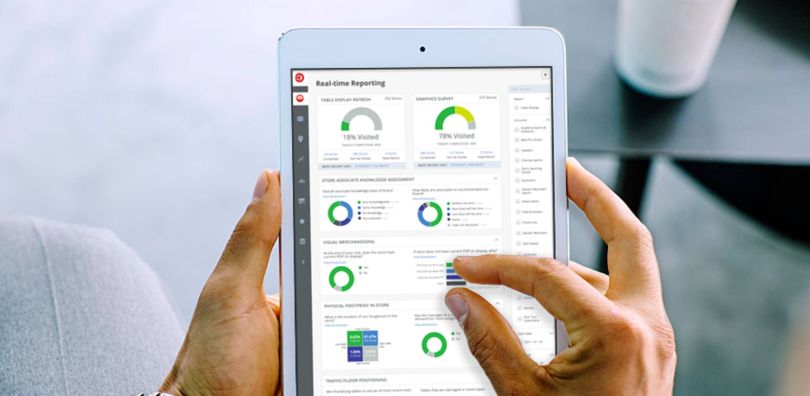
Funding led by Fung Capital to expand ThirdChannel’s reach and capabilities.
A supermarket sample with homework
Ashe’s interest in the store extended to the humble product demonstration. In early 2018, she argued that grocery demos needed updating. They could introduce shoppers to products and encourage purchases, but they also consumed stock and interrupted employees. A little tasting table could carry a surprisingly large operational bill.
Her suggestions included better signage, more considered setups, and brand ambassadors who could explain products and collect useful observations. The transaction therefore had two audiences: the shopper learning about a product, and the brand learning about the shopper. Someone had to make that encounter useful for both.
In her January 2018 writing on physical retail, Ashe also pushed against the assumption that store-closure headlines told the whole story. She discussed openings, smaller formats, local assortments, and stores supporting digital orders. It was an argument for looking underneath a convenient industry narrative. Different stores could be doing quite different things, even when the headline bundled them together.
The next blind spot runs on electricity
Today, NextGen Energy lists Ashe as chief commercial officer. Her education combines a bachelor’s degree in computer science from Columbia University with an MBA from NYU Stern. Before her current position, she worked on corporate strategy and project finance for Utah Hydrogen Products. The combination places technical systems and their financing within the same career.
NextGen’s business is community energy infrastructure: financing, building, and operating projects sized for municipalities and other institutions. Its HERO Hubs are intended to support resilient local power. The company’s proposal carries an obvious practical burden. Equipment, financing, public decisions, and ongoing operation all have to agree with one another.
Ashe has explained her move into energy through the importance of affordable, reliable, carbon-free power to communities and the economy. Her public reflections also emphasize residents having a meaningful place in the process. Selling an infrastructure proposal to a town requires people to understand what they are being asked to support. Electricity may be invisible; its bills and interruptions are considerably less shy.
A town meeting is part of the technology
In January 2026, Ashe and NextGen colleagues Kimberly Johnston and Riccardo Bertocco presented an energy proposal to Harvard’s Select Board. In March, the board approved a nonbinding memorandum to explore a community network of carbon-free microgrids in the five-to-ten-megawatt range. Harvard would help convene other participating municipalities. The agreement was exploratory and carried no financial commitment for the town.
Ashe also appeared before Ayer’s Select Board on March 3 to discuss a possible partnership and feasibility work. The minutes record a proposed ten-megawatt community microgrid, an estimated $375,000 study, and a possible $75,000 contribution per town depending on grant funding. Those figures belong to a proposal and its assessment, rather than a completed deployment.
The distinction is essential to understanding this stage of her work. A promising design must pass through questions about costs, ownership, maintenance, and municipal obligations. The public meeting is where those questions acquire named participants and recorded answers. It makes a commercial pitch answerable to the place where the infrastructure would operate.
discussion→Feasibility
assessment→Decisions on
deployment
Forty-six acres, and a longer clock
Ashe is also president of the Harvard Conservation Trust. In June 2025, at a Boxborough planning hearing, she asked whether proposed open space would be protected after a permit was received even if construction never happened. The question separated a promised benefit from the development schedule attached to it.
A September letter she signed supported the Park at Beaver Brook application subject to conservation and stewardship commitments. It described roughly 94 acres proposed for permanent protection, including a 46-acre parcel intended for the trust, and called for long-term management. Support came with conditions about what would endure.
In August 2026, the trust completed an acquisition of just over 46 acres along the Boxborough border. Ashe and fellow trustee Marc Sevigny credited trustee Tom Cotton’s years of work. The land linked surrounding protected areas. The achievement belonged to a patient, collective effort, and Ashe’s public response directed attention toward the colleague who had spent years pursuing it.
Getting people into the picture
The conservation work also has a more sociable face. At a winter night hike in February 2026, participants encountered volunteer drummers; two enormous drums had crossed Bare Hill Pond by sled. Ashe spoke about the community’s protected conservation land. It is a pleasingly physical way to make an abstract asset felt: take people outside and let the evening do some of the explaining.
Across these episodes, her work repeatedly brings distant decisions closer to the people affected by them. A store associate contributes observations. A municipal board asks about a feasibility study. A conservation trustee presses for protection that will outlast a construction plan. A friend at lunch receives an inconvenient invitation to learn.
That lunch ends where this story began, with the sandwich temporarily abandoned. Eccles remembers a challenge sharp enough to stay with him for months. Ashe had identified a decision he was treating as settled and reopened it. Her career gives that small scene its wider resonance: look again, get the relevant people involved, and then do the work that the new view demands.
Follow the work
- Gina Ashe on LinkedIn
- NextGen Energy leadership
- The 2018 conversation about ThirdChannel
- ThirdChannel’s 2017 funding announcement
- Harvard Conservation Trust
- Harvard’s community energy discussions
- The 2026 conservation land acquisition
- Robert Eccles on the lunch that changed his approach to AI
- Ashe’s writing on physical retail