The guest had been discussing the downfall of Encyclopaedia Britannica. He was James Goulka, a former chief operating officer of the business, and the conversation seemed to have gone rather well. Then the team behind Failure - The Podcast discovered a small operational problem: nobody had pressed record. A program devoted to business mistakes had produced one of its own. The title was doing rather more work than anyone intended.
Ziad Moukheiber and David Powsner, the Boston Harbor Angels members behind the show, let the mishap become an episode topic. Their April 2018 account treated the missing recording as something to examine and laugh about. It is a useful opening to Moukheiber’s story. The investor who asks other people about their judgment has also been willing to put his own team’s error on the table.
His working life offers several places to look for that habit: an IT services company, an angel investing group, a classroom of teenagers and a microphone. The settings change. Each puts him in conversation with someone trying to make a business work.
An operator before an investor
Moukheiber earned a BA from the American University of Beirut in 1992, followed by a master’s degree in 1996 from the Interactive Telecommunications Program at New York University’s Tisch School of the Arts. It is an interesting academic address for a future investor. His graduate education belonged to a school associated with creative work, in a program concerned with interactivity and emerging media.
He moved to Boston after NYU. In 1998, he founded SilverSword, providing outsourced IT services to small and medium-sized businesses in New England. The work extended across the unglamorous necessities of running a company: operations, service delivery, sales and customers. In November 2015, NSK acquired the business. When Boston Harbor Angels announced his appointment as CEO the following September, it also noted that he remained a senior advisor to NSK.
Running SilverSword brought him into contact with hundreds of clients across different industries. He described learning entrepreneurship from those businesses as well as his own. By 2018, his next chapter included partnering with BHA founder Mic Williams, launching Beacon Hill Ventures and joining Jason Kraus to launch EQx Fund. The experience he carried into investing included the everyday demands of a service business, where a customer’s problem is unlikely to wait politely for the strategy meeting.
A first impression, revised
In a 2017 mentoring account, Moukheiber described a teenager who seemed disengaged. The student spoke little and left sessions twenty minutes early. Moukheiber’s first interpretation was that he was difficult to reach. While helping with a PowerPoint presentation, he tried again. Eventually he asked about languages. The student spoke Creole and French. Moukheiber spoke French too.
The switch changed the session. The teenager had recently arrived from Haiti, and his early departures were explained by an after-school job. Moukheiber recorded his own irritation before describing the discovery. That admission gives the story its weight. The mentor had enough information to form an impression, and too little to understand the person. He stayed long enough to correct it.
His commitment to BUILD had begun around an invitation to a gala host committee. A guest mentoring session drew him toward more regular work with students. By May 2017, he was meeting weekly with seven ninth graders in Dorchester. Their business, Emerge Kit, offered affordable roadside emergency kits for stranded drivers. A venture did not need an elaborate valuation to deserve his attention.
“The biggest challenge of mentoring is earning their respect.”
Ziad Moukheiber, on mentoring BUILD students
The weekly schedule is the telling detail. A guest visit gives someone an audience; returning gives both sides time to know each other. The students were learning to launch a small business. Moukheiber was learning how to be useful to them. Respect, in his telling, was part of the work rather than a privilege attached to his business card.
The room does not write one check
At Boston Harbor Angels, the people across the table have their own decisions to make. Members choose individually whether to invest and work together on due diligence. The organization can help assemble a deal, supply expertise and syndicate with other investors. Its leadership operates within a community whose members retain their judgment about committing money.
The group’s published focus includes early-stage companies seeking rounds of $250,000 to $1.5 million. Those figures describe the size of a company’s intended raise, rather than a promise that BHA will supply the entire amount. Its geographic emphasis is the United States and Canada. The network gives a founder access to several kinds of experience, but access still leaves a business case to be made.
- ReviewMembers examine the business.
- CollaborateDue diligence draws on shared expertise.
- DecideEach investor chooses independently.
Conceptual view of the group’s published model.
EQx Fund provides another structure. The affiliated early-stage and angel investment fund is intended for accredited investors seeking a portfolio approach, and it co-invests with BHA. Moukheiber’s work as a managing partner sits alongside his angel-group leadership. For someone approaching him, the distinction is practical: a fund and a membership organization do not turn interest into investment in precisely the same way.
A little humor in the due diligence
In his 2021 answers to founders, Moukheiber offered five qualities the group had borrowed as a shorthand: humility, honesty, hard work, hunger and a sense of humor. A later seven-part graphic added hurry and humanity. The 2022 version extended the expectations to investors, advisors, employees and other stakeholders too. The people assessing a founder were included in the assessment.
Humor has a visible place in his public work. One Failure discussion examined the value of an MBA with Anthony Gellert and Kristin King. Another, with industrial-design practitioners, asked when a company should stop trying to do everything itself. The questions leave room for disagreement about what a founder actually needs. An impressive credential or a confident pitch cannot answer every operating question.
There was also a dinner with chef Peter Agostinelli to discuss restaurant failure. The hosts acknowledged their interest in food and the difficulty of staying on topic. It is an agreeable confession from people asking why businesses lose focus. Moukheiber’s later coast-to-coast show with Faz Bashi likewise mixed investing and entrepreneurship with restaurants and other conversation. The public persona allows business to occupy a seat at the table without taking every seat.
Let the founder have a turn
The podcast gave entrepreneurs room to question investors too. A 2018 conversation with Daniel Barenboym concerned the friction of raising capital. Its introduction described markets as exchanges in which a product or pitch meets a response, changes and returns. Having a founder discuss fundraising frustrations makes that exchange audible from the other side of the table.
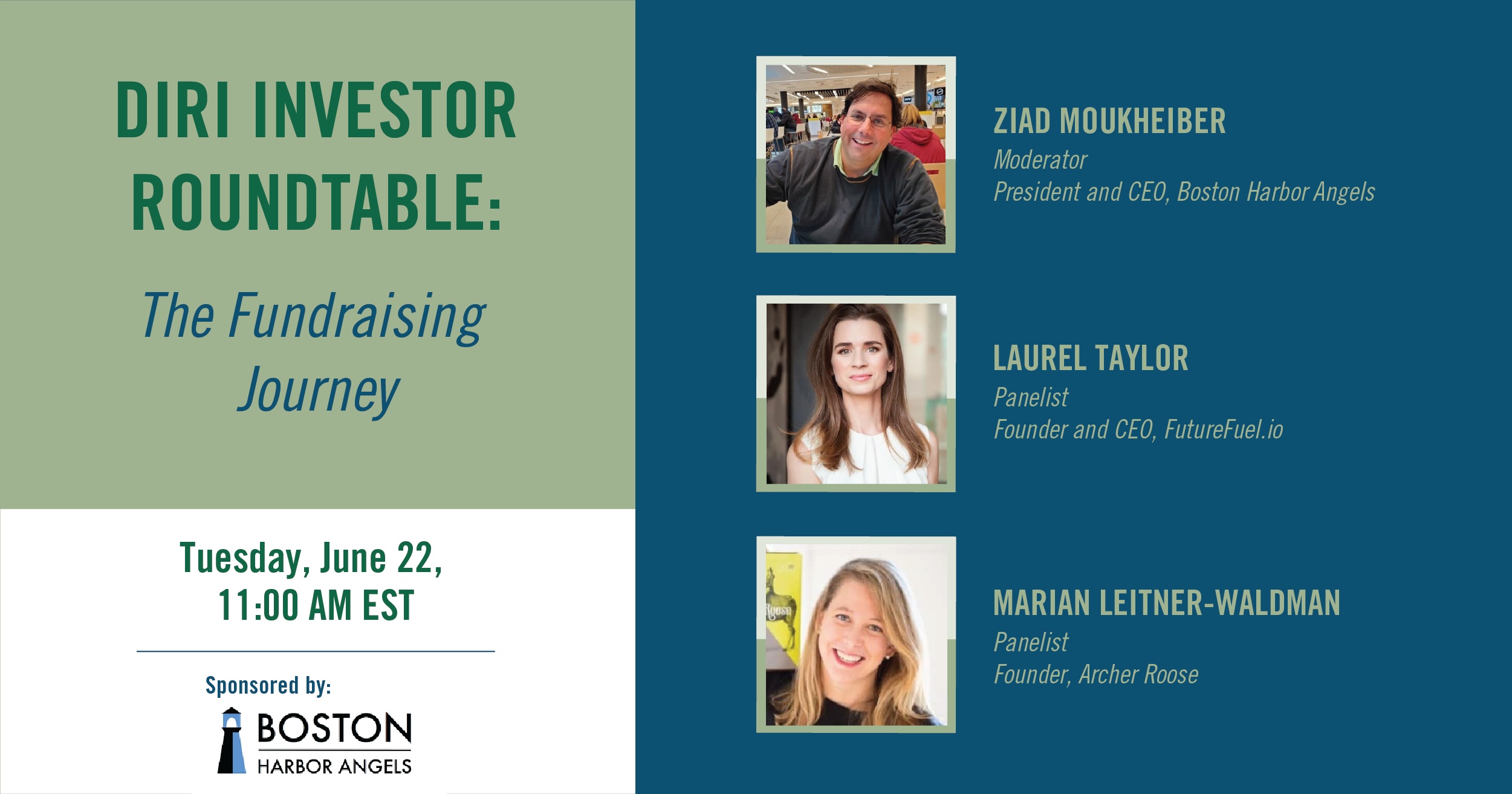
In 2021, Moukheiber moderated a fundraising roundtable with Laurel Taylor of FutureFuel.io and Marian Leitner-Waldman of Archer Roose. The discussion was framed around their experiences of raising money. This is another recurring choice in his work: founders have operating knowledge to contribute, even when the nominal subject is capital.
At BHA’s twentieth anniversary in 2024, Leitner-Waldman singled out Moukheiber’s role in setting the community’s tone and supporting portfolio companies along an uneven entrepreneurial journey. Taylor discussed the value of the group’s expertise. These are accounts of a relationship after the introduction and the pitch, when the company still has work to do and the investors still have something to contribute.
From cloud storage to chopped onions
Never a Dull Moment, his later podcast, keeps the discussion close to the work of running companies. David Friend described talking with Moukheiber about creating an environment in which Wasabi’s team could flourish, including a clear vision and adequate funding. A March 2025 episode with Wasabi CFO Michael Bayer explored the finance executive’s responsibilities and the idea of the CFO as a storyteller.
Then, in June 2026, the program spent thirty-five minutes with Marc Brown, founder of ON-O-IN, which sells chopped onions in a jar. The description promised food science and retail business. A conversation that can accommodate cloud storage and onions has a useful breadth. The kitchen ingredient brings its own questions about making something people will buy. Everyday products can support a perfectly serious discussion of entrepreneurship.
Moukheiber’s public letter to founders asks for preparation, patience and an understanding of the audience. It also makes room for ambition. His paid consultation offering concerns business models, focus and funding strategy, with an explicit separation between buying advice and improving the chance of BHA funding. Both place responsibility on the founder to understand the business and the conversation being entered.
The missed recording remains a fitting detail. The team had a guest, a subject and a conversation worth having. One ordinary action still mattered. Across Moukheiber’s career, the useful moments often have that scale: returning to a classroom, asking about a language, letting a founder speak. And, when the microphone is ready, checking the button.
Keep the conversation going
Public profiles, conversations & further reading
- Boston Harbor Angels Organization website
- Moukheiber on LinkedIn Personal profile
- Moukheiber on X Personal account
- Never a Dull Moment Listen to the show
- The ON-O-IN conversation June 5, 2026
- Practicing What You Preach The recording mishap
- Always a Way to Get to a Smile! His mentoring account
- BUILD’s mentoring profile The Emerge Kit team
- The 2018 career conversation Boston Voyager