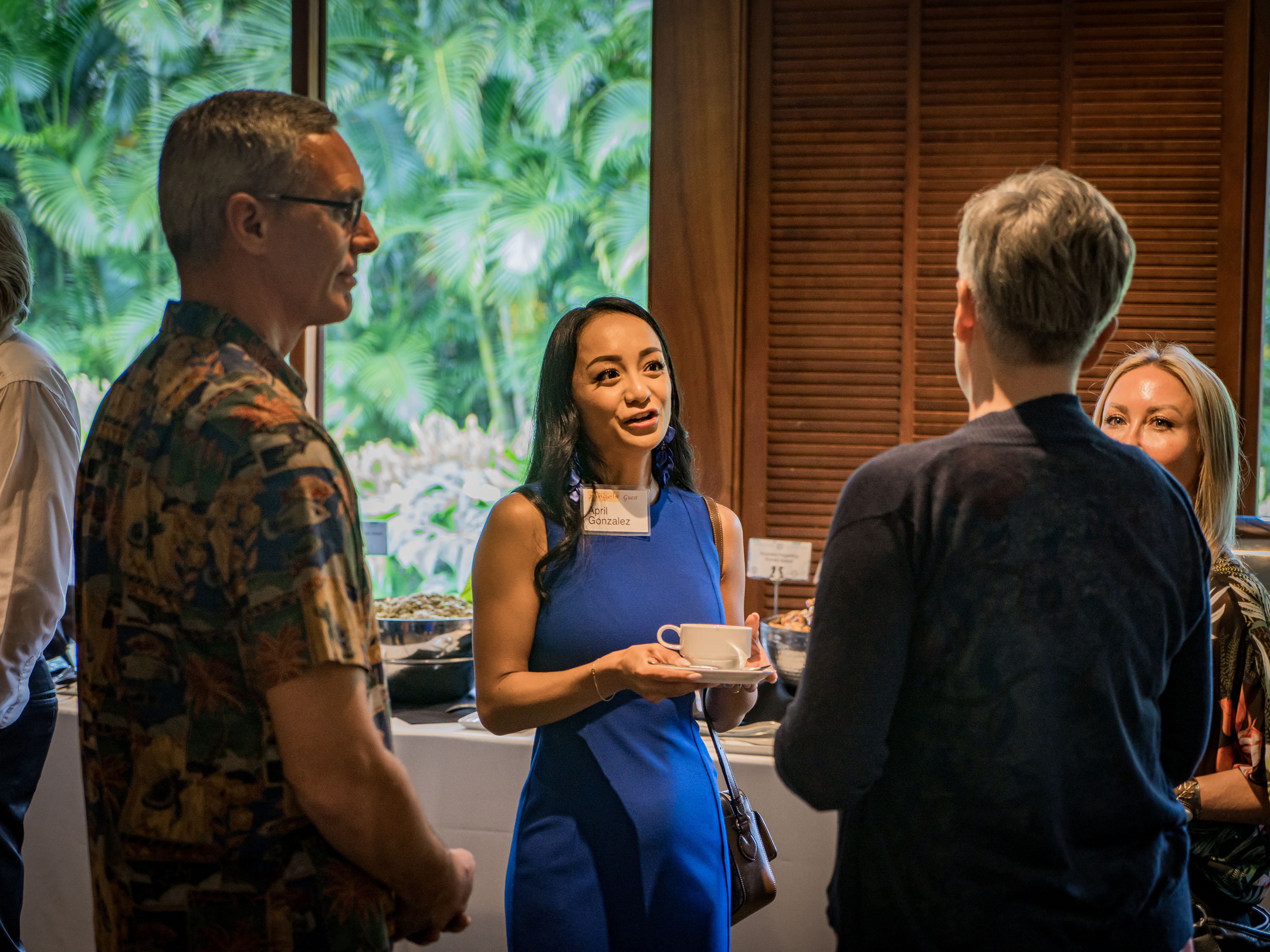
At Hawaiʻi Angels, the decisive room has lunch in it. Selected founders attend the Pacific Club in Honolulu, where investors hear their pitches and decide whether to investigate further. The meal is free for presenting founders. The flight, if they need one, is theirs. It is a small detail with a large implication: access has a price even when nobody sells tickets to the pitch.
- Founders pay no fee to pitch; selected presenters attend in person.
- Members invest individually, often collaborating on research.
- The network and its partners report $75 million-plus invested since 2002.
The website’s numbers suggest how much work precedes that meal. More than 500 pitch decks arrive each year. A screening committee reviews four to six deals a month. Two companies get the main presentation slots at member meetings, alongside occasional extra opportunities. A founder sees a lunch invitation. Behind it sits a system for deciding whose uncertainty deserves everyone’s attention.
The lunch is the last step you see
Applications arrive through Gust, with a pitch deck required. The managing director selects candidates for the screening committee. Feedback there can sharpen a presentation before it reaches the full membership. After the lunch, interested investors move into due diligence. Getting invited is progress; getting funded remains a separate persuasion exercise.
A member becomes the “Deal Honcho” for a startup that attracts interest. The title has the welcome informality of someone who might also know where you parked. The job is quite specific: assemble diligence information with the founders and arrange a Zoom discussion, typically about a week later. Investors and founders can then negotiate privately.
A pipeline built after the tax-credit years
Robert Robinson and Chenoa Farnsworth cofounded the network in 2002. Robinson brought experience from Harvard Business School and expertise in angel investing. The group initially operated as UH Angels. Its university beginnings help explain an enduring combination: education for investors, preparation for entrepreneurs, and actual money at stake.
The early machinery included an affiliated Heaven Fund, launched in 2005 during Hawaiʻi’s investment-tax-credit era. Later, deal flow slowed. In a 2024 interview, Farnsworth recalled discussions about whether to do something else. An accelerator offered a way to develop companies before they reached investors. Blue Startups, founded in 2012, became part of that pipeline.
Another weakness surfaced during COVID. Farnsworth said paying membership dropped to perhaps ten or twenty and the group paused for at least a year. Rebuilding meant recruiting, including younger participants. Joey Katzen took over as managing director in 2024. These were problems of participation and opportunity supply: an investor network needs people willing to show up, and businesses worth showing them.
“I’m more interested in getting good deals than more members.”Joey Katzen · 2024 interview
The checks belong to the people
Hawaiʻi Angels occupies the space between a founder’s personal network and later venture financing. Its founders and directors connect university entrepreneurship, accelerator experience, and private investment. Today’s management page names Katzen as managing director and Alexi Drouin as assistant director. Robinson and Farnsworth remain directors, alongside Clif Purkiser.
The organization is a 501(c)(6) nonprofit. Its 2024 tax filing reports $75,300 in revenue and $58,630 in expenses. The revenue breakdown identifies $72,300 in membership dues. Those figures describe the machinery that keeps the network running. The much larger investment total describes capital deployed by members and partners into companies.
Startup investment by the network and partners, cumulatively since 2002.
Organization revenue in fiscal 2024. The lunch network’s operating budget.
Standard individual membership costs $1,500 annually; qualifying off-island membership costs $750. Individuals are expected to invest at least $25,000 in presented opportunities during their first year, then every two years thereafter. Corporate and venture-firm membership costs $2,500 annually and carries no investment commitment. Dues buy participation. Investment capital goes into businesses.
There is currently no official pooled syndicate. Members choose their own investments, although they often discuss opportunities together. A founder must therefore convince people with separate judgment and separate checkbooks. Compared with approaching one seed fund, that creates several possible conversations, with no single committee vote that promises everyone’s money.
Oysters belong in this conversation
In May 2026, Pacific Hybreed announced a $1 million round with participation from Hawaiʻi Angels and Blue Startups. The Big Island company develops oyster and clam seed through hybrid breeding. It said the money would expand hatchery production and farm-specific breeding programs. The round’s total is not a disclosed check size from Hawaiʻi Angels.
The company reported working with more than twenty farm customers and research sites across North America. Demand exceeded its production capacity. That is a concrete funding problem: proven customer interest, constrained supply, and a proposed use for capital. CEO Melissa DellaTorre described the move as going “from proven field results to scaled commercial production.”
Software attracts much of the network’s attention, but its portfolio also includes physical technology, science, food, beverages, and other consumer goods. Its ecosystem relationships extend to Builders VC, OM/VC, Alpaca VC, and ThriveHI. In July 2025, a joint event with Hawaiʻi FoundHer offered five businesses five-minute pitches and live feedback. An investor community can develop opportunities through several doors.
What to bring before you buy the ticket
For founders, the useful question is fit. Hawaiʻi Angels generally favors early-stage companies with traction and ambitions beyond one city or state. Its published guidelines recommend at least $25,000 in committed annual revenue, with an exception for research-intensive science, and a path to $10 million in annual revenue within five years. Hawaiʻi businesses already making $500,000-plus annually may sometimes be considered for alternative arrangements such as royalties. A promising neighbourhood business and a venture-scale startup require different financing conversations.
Apply through Gust, attach the deck, and prepare for scrutiny before arranging travel. Screening and diligence calls happen virtually; selected main-meeting pitches happen in person. The lesson another founder group can copy is straightforward: filter opportunities, offer feedback, and give one person responsibility for the next conversation. Good introductions become useful when somebody remembers to follow through.