Before Palash Soni had a company to sell, he had a second-hand video-game console and children in the neighborhood willing to pay to play it. This was an early business: a piece of equipment, a small audience and a reason for that audience to come back. The transaction was uncomplicated. Nobody needed to attend a webinar about the value proposition.
Years later, his work would concern a rather more elaborate version of the same question. How do you make something people want to return to? Goldcast, the company he co-founded in 2020, started by helping businesses run digital events. It grew into a platform for producing, editing and distributing video. On December 15, 2025, Cvent announced its acquisition.
The interesting part lies between those descriptions. An event finishes. A useful conversation can keep working. Soni’s business developed around that interval, the unglamorous stretch after the speakers have thanked everyone and the marketer is left with a recording, a deadline and several incompatible tools.
“same-day, on-brand video”Palash Soni · December 2025
A small market, close to home
Soni was born and raised in Sagar, in the Indian state of Madhya Pradesh, and moved to Bhopal at sixteen. He traces his interest in entrepreneurship to his mother, who tried selling milk and running a snacks business to supplement the family’s income. Those ventures did not succeed. He remembers the willingness to try.
There is a useful distinction in that memory. The activity inspired him; the markets, viewed in hindsight, looked difficult. It is a less tidy inheritance than the familiar story of a child watching a parent build an empire. You can admire the effort and still learn to question the opportunity.
His father’s movement from poverty into India’s growing middle class shaped his outlook too. Soni describes optimism as his defining trait. He also reads science and history, and has spoken of his fascination with companies such as Microsoft, Verizon and Disney: businesses that found long-running trends and developed the resilience to stay with them. His interests make a curious pairing. The boy charged for turns at a console; the adult studies companies built to outlast many turns of the market.
The engineer discovers the story
At IIT Kanpur, Soni trained in electrical engineering. His LinkedIn profile lists a 2011-2012 thesis on using airstrip visual data to calculate an aircraft’s approach parameters. Altitude, distance, orientation: these were problems with a wonderfully literal destination. The aircraft had to land.
His next professional destination was manufacturing at ITC. In his own account, those three years changed how he understood value. He became interested in the power of marketing around consumer products, the part of a business that explained why an object mattered to the person buying it.
He later put the lesson into writing when Goldcast announced its Series A. His professional life had begun in manufacturing, but storytelling around a consumer product had caught his attention. That observation helps explain why an engineer would eventually spend his time worrying about the appearance of a webinar. A working product has accomplished only part of its job if the audience sees nothing worth caring about.
At InMobi, Soni worked across customer-facing responsibilities and product management. By 2019, he had a practical reason to pursue Harvard Business School: he wanted to build a company serving American customers and felt too far from that market while working in India. Business school offered a place to explore ideas, find collaborators and learn the country in which he hoped to sell.
He arrived with entrepreneurial intent. The MBA would become an unfinished chapter. He took leave to build Goldcast.
A crowded room needs a particular guest
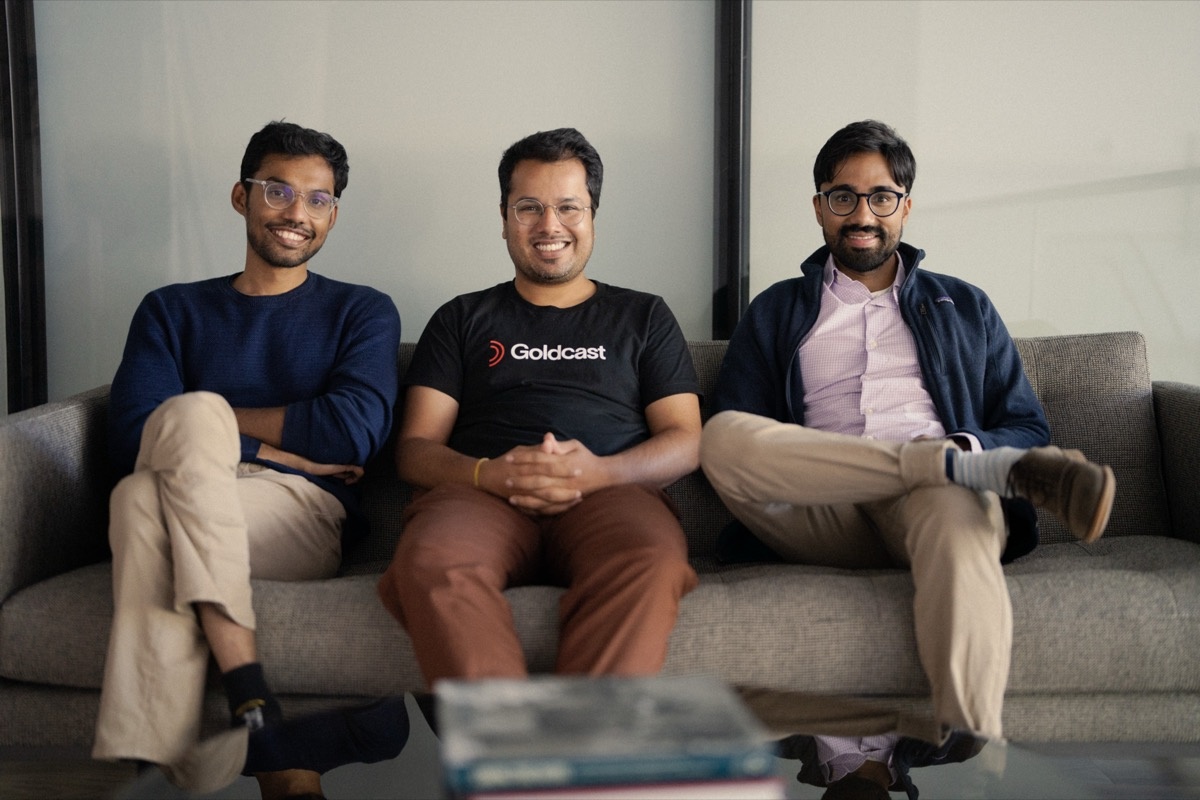
Soni, Kishore Kothandaraman and Aashish Srinivas founded Goldcast together. Soni and Kothandaraman had met through the Harvard cohort’s network in India. They explored ideas, including a customer relationship management system for events. Then the shutdown of in-person gatherings in 2020 altered the opportunity almost overnight.
In a later account of the pivot, Soni described months already spent persuading investors and building around the original idea. Moving into digital events required a different product. It also put them in a market filling quickly with competitors. Being early to notice a change is rather different from being alone in noticing it.
The founders cold-emailed event marketers to understand their needs. They chose business-to-business marketing teams, whose events had to connect to sales systems and produce usable evidence of engagement. A registration was useful; knowing what the prospective buyer actually did could be more useful still. The intended customer gave their engineering work a direction.
That choice also gave Soni a language for refusal. In his account of Goldcast’s strategy, events contain many different businesses. A trade show, a customer webinar and a community gathering may share a calendar invitation while serving quite different purposes. Trying to cover them all creates conflicting demands. A narrower customer group can make the next decision clearer, even when the wider market looks more impressive on a fundraising slide.
- 2019Harvard Business School; exploring a US startup.
- 2020Goldcast founded; digital events become the entry point.
- 2022$10M seed announcement, followed by a $28M Series A.
- 2025Cvent announces the acquisition on December 15.
The customer votes for a better-looking room
Choosing a market did not immediately produce sales. The early product had a problem Soni had underestimated: its appearance. Potential customers cared about how their brands looked inside the experience. Technical functionality could not compensate for a room they did not want to invite people into.
The team rebuilt the interface in an intensive, roughly five-week effort. The change helped them gain traction. It is an appealingly awkward episode for an engineering-trained founder. The customer could appreciate the machinery and still dislike the furniture. Both judgments counted.
Drift became an important early customer. When the marketing company ran events on Goldcast, other marketers could see the platform in use. The demonstration was embedded in the event itself. For a company selling to marketers, an event hosted by a marketing company offered an unusually concentrated audience of prospective buyers.
Soni later described Drift’s signing as an inflection point. Goldcast had been at roughly $30,000-$40,000 in annual recurring revenue; he said it reached $1 million within three months. Those figures belong to his recollection of that early period. Their significance is the change in momentum after the team found a customer whose use of the product made its value visible to others.
That experience also explains the appeal of running Goldcast’s own events. In a 2024 discussion, Soni identified them as the largest source of customer pipeline. The company could demonstrate its software while making something useful for its audience. A sales pitch had acquired a second occupation.
Led by WestBridge Capital and Unusual Ventures.
What happens when everybody logs off?
As the digital-events market slowed, Goldcast considered moving into hybrid events. It chose another direction. Customers wanted better ways to host and reuse their video. The recording was becoming a starting point for more content, with a life beyond the original invitation list.
The distinction mattered. In-person events offered relationships and shared experiences. Digital events also produced material that could travel: a customer explaining a decision, an expert answering a question, a conversation worth revisiting. Goldcast developed AI-powered tools for editing and repurposing that material, including Content Lab.
Soni’s ambition for marketers had already appeared in the title of his 2022 funding essay: “Marketing like a Media Company”. The idea asks a business to earn an audience through material people want to consume. It also creates a production problem. A good conversation cannot become a dozen useful assets simply because someone adds that instruction to a project board.
The product’s expansion addressed that work. Hosting, recording, finding a useful passage, editing it and publishing it belong to the same chain. Each handoff consumes time. Keeping those steps connected could give marketing teams more room to use what they had already made.
A culture cannot run on good intentions
The company’s growth presented Soni with a different kind of design problem. People practices that could wait at a small startup became harder to improvise as the team expanded. He has acknowledged that he should have invested in cultural guidelines and human resources earlier.
He sought help through an executive coach, his board and other CEO communities. In his later reflections, values needed explicit expectations and repeated use in the company’s everyday work. A value left on a slide offers very little help when colleagues disagree about someone’s behavior.
His approach to feedback is similarly practical. He has described asking leaders to take concerns directly to the colleague involved and report back, rather than routing every disagreement through him. He also urges people to distinguish criticism of a situation from a judgment of the person. It is modest advice, and difficult enough to require repetition.
There is room for a little theatricality alongside that seriousness. When the founders appeared in gold jackets, Soni joked that he had found his uniform for marketing conferences. A company named Goldcast had at least settled the wardrobe brief.
A larger stage, the same unfinished work
Cvent’s acquisition brought Goldcast’s video capabilities together with an established events business. The proposed combination connected event management with clips, summaries and other material marketers could use afterwards. Cvent named OpenAI, Canva, Box and Mailchimp among the teams using Goldcast.
Soni’s statement emphasized speed: “same-day, on-brand video”. That compact ambition follows the thread running through his career. The engineer wants the system to work. The marketer wants the result to matter. The founder wants the gap between those two outcomes to shrink.
The acquisition also changed the scale available to pursue it. Goldcast’s founders described additional distribution, resources and support for their AI roadmap. They promised continuity for customers and framed the deal as an expansion of what they could build.
In his public announcement, Soni placed particular weight on the outcome for employees who had trusted the team and stayed. That is a human measure alongside the transaction: whether the people who helped carry a difficult idea forward shared in the result.
The console business required someone to take another turn. Goldcast developed by asking what should happen after a turn was over. A webinar had ended, but the conversation still had somewhere to go. Soni kept building for that next audience.