A promotion usually comes with more people asking you questions. Carolyn Childers noticed that it could also leave you with fewer people to ask. As her responsibilities grew, she was expected to guide colleagues, steady teams and know what happened next. Her own questions had survived every promotion quite intact. The available places to take them had become harder to find.
It is an awkward discovery for someone whose career has been built on competence. You can learn the financial model, improve the operation and earn a senior title. None of those things automatically supplies a person outside your organization who understands your predicament. An impressive business card is a surprisingly poor conversationalist.
Childers had worked in investment banking, corporate strategy and startup operations before she co-founded Chief with Lindsay Kaplan. The company launched in New York in 2019, offering senior executive women a community of peers. At its center were small groups, meeting repeatedly, with an executive coach helping guide the conversation. The premise was practical: women responsible for other people's development could use some development of their own.
Who helps the person
everyone else turns to?
By February 2025, Childers had moved from CEO to chair of Chief's board. Alison Moore, an early member of the network, took over the chief executive role. That transition gives her story an interesting shape. A founder who built a business around seeking help eventually handed its daily leadership to someone who had experienced that help from the other side.
A perfectly sensible escape from entrepreneurship
Childers did not describe herself as a child destined to found a company. Her family ran a travel agency. Watching a small business move with the economy made large corporations attractive. They offered a different scale and a place to learn. Entrepreneurship was already visible at home; she did not need a lemonade stand to discover that running a business could be difficult.
She earned a BS in finance at Boston College and began her career at Deutsche Bank, spending more than three years in investment banking. Avon and Victoria's Secret brought strategy and business development experience. An MBA at Harvard Business School added another kind of asset: friends and connections who would help change the direction of her work.
There is a quiet irony in that sequence. Years later, she would build a company around the value of relationships outside the office. In her own career, such a relationship had already opened a door. A friend from business school connected her with Quidsi, the company behind Diapers.com, which was preparing to launch Soap.com.
Childers went to meet Quidsi founders Marc Lore and Vinit Bharara. She had no e-commerce experience and very little management experience. They hired her to launch and run the new site anyway. The job offered something she had come to want: decisions whose consequences were close enough to see.
Soap.com sold the sort of household goods that seldom inspire a founder mythology. Yet building a business around everyday purchases gave Childers experience of launching, managing and scaling a new operation. She served as its general manager through Quidsi's acquisition by Amazon. Her route into entrepreneurship passed through the decidedly unromantic business of getting useful things to customers.
What happens when the product is a person
Her startup career also took her to South Korea to work at Coupang. She later spent about four years running operations at Handy, the marketplace for home services. There, the operational questions became particularly demanding. Delivering a product is one challenge. Coordinating thousands of people providing a service inside someone else's home introduces a rather larger cast of variables.
A household purchase can be specified. A service has to be delivered by an individual, in a particular place, for a customer with particular expectations. Consistency matters, even when the circumstances refuse to be consistent. Childers has described Handy as an important education in working through a business model without an established set of answers.
That experience helps explain why the eventual Chief idea had an operator's shape. A community needs more than a room and a promise that interesting people will enter it. Someone has to think about who belongs together, how often they meet, what makes the conversation useful and whether the experience can be repeated.
The ambition to start a company had arrived before the idea for Chief. Childers waited for a problem she could commit to for years. Her own search for professional support supplied one. She looked at networks and found little she wanted to join. “I was not very good at building my network,” she admitted. It is a useful confession from the founder of a networking business.
Ten people, and permission to ask
Childers and Kaplan met at a networking event for women executives that Childers later described as disappointing. The encounter produced a co-founder, which is a fairly respectable return on an otherwise unsatisfying evening. It also gave them a common question: could meeting other women leaders feel more useful, and lead to relationships that lasted?
Their answer took the form of Core. The original format brought together roughly eight to ten members, matched around factors including responsibility and experience, for monthly conversations. An executive coach or experienced facilitator helped lead the sessions. Repetition mattered. A group that meets again has a chance to remember the dilemma from last month and ask what happened.
The idea carries a small social reversal. Senior women often arrive in professional settings as mentors, speakers or examples. Chief offered a setting in which they could arrive with unfinished thinking. A leadership title did not have to serve as evidence that every leadership problem had already been solved.
There were boundaries around that candor. When Chief introduced an enterprise offering in 2023, Childers explained that women from the same employer would not be placed together in a peer group. Someone discussing a difficult situation at work needed room to speak without worrying about where the conversation might travel on Monday.
The clubhouse made the early proposition tangible. Chief's Tribeca space had green walls, leather armchairs, plants and a baby grand piano. It was a setting for conversations and events. The recurring groups gave that setting a purpose beyond pleasant furniture. Attractive upholstery can improve an evening; it has limited advice to offer about managing a board.
Childers and Kaplan brought different skills to the work. Childers described herself as the operator, thinking about execution, strategy and scale. Kaplan, previously a vice president at Casper, brought the creative and brand perspective. Their shared values made room for disagreement. On their podcast, The New Rules of Business, the partnership also had room for a playful dispute over which founder was funnier.
Growing the network without losing the conversation
Chief began with a local community and expanded its reach as its services moved online. The digital format meant a member could participate without traveling to a clubhouse. Physical spaces remained part of the experience, but the geography of the membership became much broader than the geography of the rooms.
In March 2022, Chief raised a $100 million Series B led by CapitalG at a $1.1 billion valuation. Those numbers describe a financing event at that time. They also underline the scale of the bet: investors believed a business built around senior women's professional relationships could grow substantially.
March 2022 · Historical financing figures
Money introduces its own temptation. A company can afford to pursue more ideas, hire more people and spend around problems that deserve closer attention.
“Just because you have more capital doesn't mean that you should set it on fire.”
Carolyn Childers
It is an unusually serviceable sentence for a room full of celebratory investors.
The commercial model also put employers inside the story. Companies could sponsor memberships as an investment in their leaders, much as they might fund a conference or executive coaching. The enterprise offering made that support more deliberate. An employer could offer membership proactively, instead of waiting for an executive to discover Chief and request reimbursement.
Growth makes the original promise harder to deliver. A network needs enough people to create useful possibilities, while an individual member needs a small number of relationships that actually work. Matching, facilitation and access to the right conversation become operational work. The meeting has to earn its place in a calendar already occupied by other meetings.
In June 2024, Chief introduced three membership approaches: executive advisory, individual executive coaching and executive education. It also added community experiences and concierge support. The changes recognized that executives could want different forms of guidance, depending on their responsibilities and the time they could invest. The same person might need a peer group at one stage and individual coaching at another.
The next person in the chair
The January 2025 succession announcement named Moore as Chief's next CEO, effective February 3. She had led Comic Relief US and held senior roles in media and technology. She had also joined Chief as a founding member in New York. Her familiarity with the company included being part of the community it was trying to serve.
Childers became board chair and Kaplan a board director. The announcement described months of reflection and planning. By that point, Chief reported members from more than 10,000 companies. The founders were moving into different responsibilities within the institution they had built, with another executive taking charge of its daily operation.
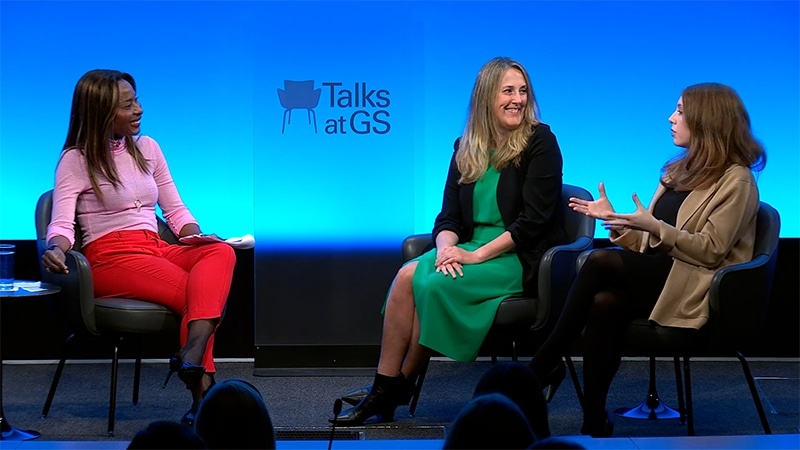
A smaller circle offers another clue to Childers's thinking. She has two older sisters and calls them role models she still turns to for advice. Her grandmother was one of three girls; so was her mother. In her telling, women helping one another was already a familiar family arrangement before it became a business proposition.
That history makes the wish behind Chief easy to understand. A professional community cannot reproduce a family, and a membership cannot guarantee a friendship. It can arrange repeated opportunities to know other people, ask useful questions and hear how someone else handled a problem. Those are modest actions with real demands on attention and trust.
Childers's career is full of jobs that required her to work out how something should run. Chief added a question about how the person running it would keep learning. Now, from the board chair's seat, that question remains part of the company she helped create. Competence can get someone into the room. A good conversation gives them a reason to return.
Continue the conversation
Read, listen and watch Carolyn Childers discuss the work.
- Chief’s website
- Carolyn Childers on LinkedIn
- Carolyn Childers on Twitter/X
- The career conversation with Bessemer
- The Kara Goldin Show interview
- The conversation with Alisa Cohn
- Masters of Scale: building Chief
- Childers and Kaplan at Collision - watch on YouTube
- This Week in Startups - watch on YouTube
- Chief’s 2025 leadership announcement
- Childers’s essays on LinkedIn