The ordinary business spreadsheet is a remarkably effective liar. It presents itself as a document when it is often an apology: one software system cannot speak to another, so a human being has agreed to carry the message. Copy the customer list. Export the orders. Repair the dates. Try not to disturb the commas. Sriram Subramanian built his career by noticing the machinery behind that little ritual.
His company, LinkToAny, works in the space software marketing prefers to crop out of the picture. A new point-of-sale system can be elegant. A restaurant app can be clever. An accounting platform can be indispensable. Yet the merchant still has a business to run on Monday morning, with years of history to move and several other tools expecting fresh data. The sale may happen in a demo. The value appears only when the systems cooperate.
Subramanian did not arrive at this thesis in a flash of founderly weather. He followed it through engineering, product management, night classes, hundreds of merchant conversations, and a long period in which experimentation was the job. The company emerged after the pattern had repeated often enough to become impossible to ignore.
First, teach the systems to recognize one another
His early training was technical and unusually relevant to everything that came later. He studied electronics and telecommunications in Pune, then information networking at Carnegie Mellon, concentrating on distributed systems, networking, and security. At Convergys Labs he found a research role at the intersection of wireless networks and security. Soon afterward, he joined Trustgenix, a very small Silicon Valley startup building enterprise single sign-on when the idea was still novel enough to require explanation.
There was serendipity in the move. Subramanian had already worked with Trustgenix through technical standards groups. His fiancée, whom he met at Carnegie Mellon, took a job in the Bay Area. The startup happened to be in the same ZIP code. The geographic coincidence became a career hinge. He joined the team, and in 2005 Hewlett-Packard acquired Trustgenix.
Trustgenix
PayPal
LinkToAny
The surface changed, but the underlying question stayed familiar: how do separate systems establish trust and exchange useful information without making the user perform clerical diplomacy? At HP, Subramanian worked as a senior research and development engineer. At eBay and PayPal, he moved into product management and worked on high-volume checkout products, including Turbo Checkout and the Express Checkout line.
Checkout gave him a wide window into small-business life. Conversations with merchants across dozens of countries exposed the awkward side of cloud adoption. The tools were arriving faster than the connective tissue. Businesses could purchase modern software and still find themselves trapped in imports, brittle integrations, and expensive implementation projects.
Berkeley added urgency
While working, Subramanian attended the evening and weekend MBA program at UC Berkeley's Haas School of Business. Berkeley supplied more than a credential. Its culture of argument and reinvention made starting something feel less like an eccentric departure and more like unfinished business. He and a group of classmates met on weekends to brainstorm. Those sessions built what he later called an urge and an urgency to act.
Leaving PayPal was still a difficult choice. He came from a family in which professional stability was a recognizable form of success. Entrepreneurship offered a fuzzier report card. He left anyway, moved back to Pune, and began testing ideas around retail applications, payments, point-of-sale systems, and open-source software. During the same broad chapter, he and his family adopted two daughters.
“There were times in the first six months, where we were dealing with legacy systems, and we felt like giving up. But we were agile and nimble.”Sriram Subramanian
The experiments were not ornamental side projects. He worked with the team behind the Reliance Jio point-of-sale effort and helped Snapdeal create an early omnichannel experience for smaller businesses. He examined what happened when retailers added cloud tools to stores and warehouses that already had routines, data, and old systems. The stubborn workarounds supplied the map.
Listen past the requested feature. Find the recurring manual job customers perform because the market's products do not cooperate.
The original ShoppinPal idea involved building reusable apps over a common data layer. If the underlying connections were standardized, a second, third, or fourth application could be created much faster. The retail app was visible. The reusable integration layer beneath it was the more durable asset.
The first name became too small
ShoppinPal began as a retail proposition, and its earliest public descriptions focused on bringing brick-and-mortar merchants into mobile commerce. By 2016 the company had outside backing, including a funding round led by Plug and Play Tech Center and Steelhead Ventures. Its core integration-platform product was ready by 2019. The company increasingly served software providers that needed a portfolio of connections without building and maintaining each one alone.
This changed the commercial logic. An integration was no longer a technical afterthought attached to a sale. It was part of the sale. A platform might attract a restaurant, retailer, or service business, only to discover that one missing connection blocked activation. Even a willing customer has a finite window for enthusiasm. If migration drags on and the promised workflow remains theoretical, the old system begins to look charming through sheer familiarity.
In 2023, ShoppinPal became LINK. The new name admitted what the business had learned. Retail had been the entrance, not the entire building. The company was handling integrations, historical data migrations, and onboarding across restaurant, retail, hospitality, accounting, payments, and other commerce systems. “While the name ShoppinPal reflected our beginnings focused on the retail industry,” Subramanian said at the time, “LINK represents where we are going.”
A good rebrand can be a correction of nouns. This one removed a category boundary while preserving the thesis: business software becomes more useful when joining it to the rest of the operation is faster and less costly.
Plumbing is a leadership problem too
LinkToAny became globally distributed, with teams and offices spanning the United States, India, and Canada. That structure made autonomy practical rather than decorative. Subramanian has argued that people in an early-stage company need the power to do things correctly without being micromanaged. Integrations punish slow internal handoffs; a team that maintains connections across many products cannot route every judgment through one desk.
“Creating a culture of autonomy is very important, especially in early stage settings, for employees to know they have the power and control to do things right and not be micromanaged.”Sriram Subramanian
His public writing also reveals a taste for the overlooked operating detail. He writes about integration marketplaces, historical migrations, restaurant data, onboarding, workplace inclusion, and even office pets. The subjects look scattered until one notices the shared concern: systems work better when the inhabitants can move through them with less friction.
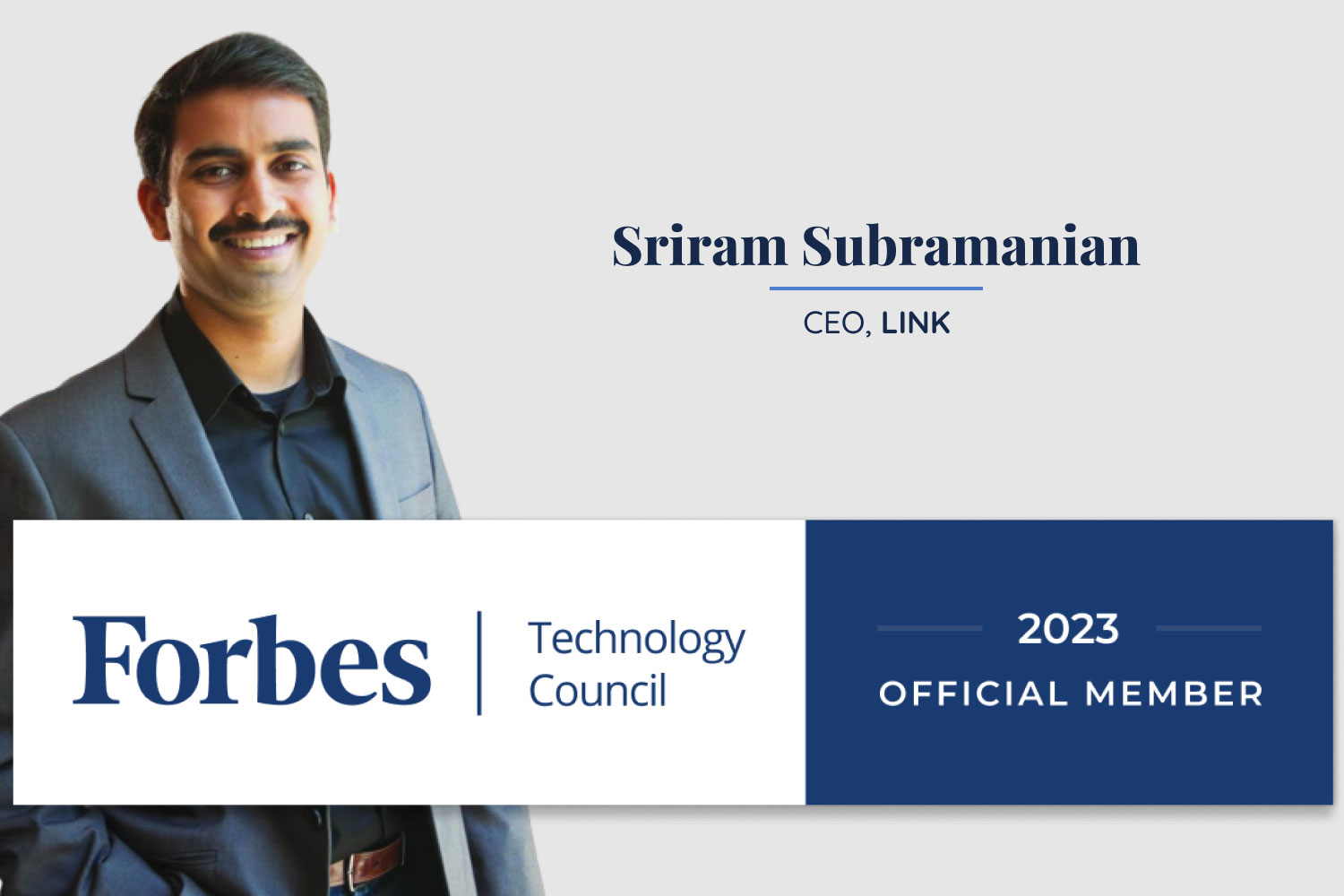
In 2023 he joined the Forbes Technology Council. In early 2024 he published pieces on restaurant software integrations, integration marketplaces for SaaS companies, and the ballooning challenge of data migration. LinkToAny also expanded its data-migration work and made services available through commerce marketplaces such as Lightspeed's. At Money20/20 in 2025, he presented the company as infrastructure for businesses that need to connect, onboard, and scale.
The deal after the deal
Subramanian recently offered a compact parable. A founder spent $30,000 on a trade-show booth, generated attention and leads, then watched conversion stall. The product did not work with the prospects' existing tools, and onboarding took too long. Marketing had opened the door; incompatibility had quietly locked the room behind it.
This is the part many software businesses misclassify. Integration belongs on an engineering roadmap, but its consequences appear in sales, support, customer success, and finance. Data migration sounds like a project until it delays revenue. Onboarding sounds like training until the customer's history will not import. A connector sounds like an API exercise until its absence kills a deal.
The newest chapter adds AI agents to the same old dependency. In restaurant technology, an agent can only act sensibly when menus, orders, customers, and payments arrive completely and on time. A clever model operating over partial data is merely a faster route to confusion. Once again, the fashionable layer depends upon unfashionable plumbing.
Subramanian's story offers a useful theft for founders: inspect the distance between purchase and value. Watch what customers export, retype, reconcile, and wait for. The market may celebrate the application. The business may be hiding in the handoff.
He has spent years making that handoff shorter. The work is rarely cinematic. Databases migrate without applause. Orders sync while nobody watches. A merchant opens a new system on Monday and finds the old business already there. When the plumbing works, it disappears. For the person who built the pipe, invisibility is the compliment.