A menu is a promise made in public. The kitchen may have run out of something. The price may have changed. The promise, laminated and hanging above the counter, carries on regardless. Between the person who knows the truth and the customer reading the sign sits a small publishing problem. Multiply it by a chain of restaurants and it becomes a software business.
Raydiant built around that gap. A player connected to a television, an internet connection, a dashboard: the basic proposition was to make the wall editable from somewhere else. Then the company began adding jobs to the screen. Could it motivate employees? Notice an audience? Respond when a shopper picked up a product? The television acquired quite a demanding résumé.
- The job: create, schedule and update content across physical screens.
- The expansion: employee software, audience analytics and interactive shelves.
- The economics: subscriptions and hardware, with costs multiplying by screen.
- The turn: Displai acquired Raydiant’s assets in May 2025.
01 / The wall A store needs an editor
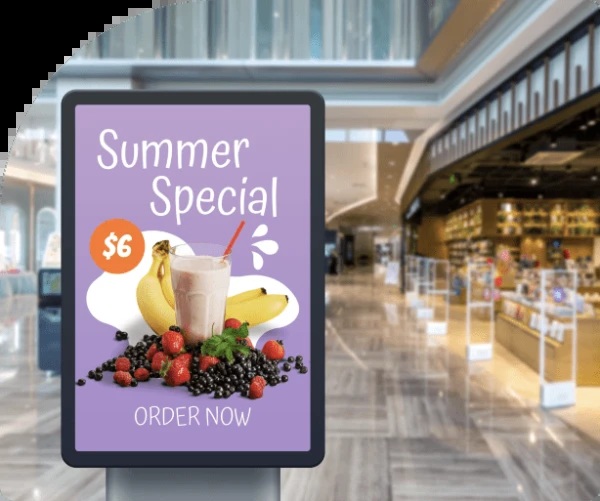
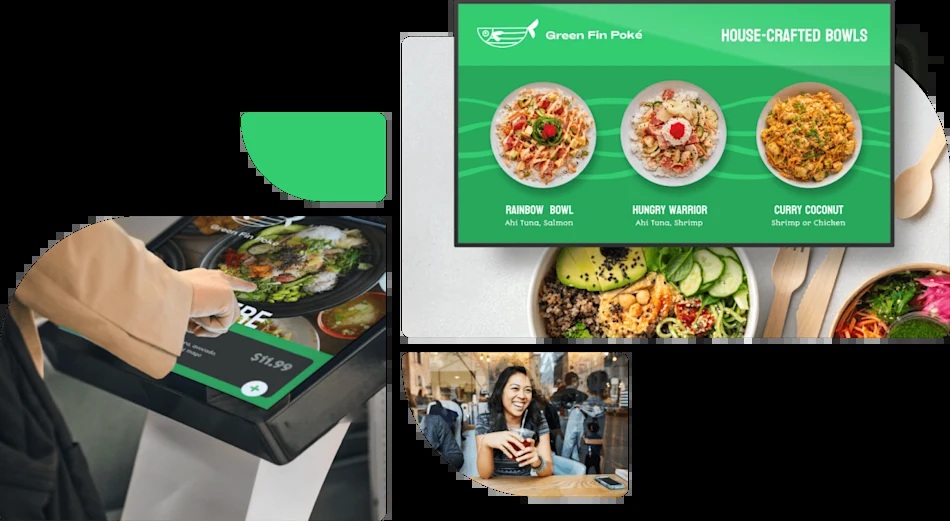
Raydiant’s digital-signage system let an operator publish menus, announcements, promotions and other content through a cloud dashboard. Its ScreenRay player connected to an HDMI-equipped display. The appeal was ordinary and substantial: change the message without visiting every television. A franchise manager could coordinate a campaign; a local operator could stop treating a price correction as a minor expedition.
The customer list crossed categories. Raydiant named First Bank, Dickey’s BBQ, Harvard University, Red Bull, Chick-fil-A and Wahlburgers among its users. That range makes sense when the common requirement is a screen carrying useful information. Banks have announcements. Campuses have notices. Restaurants have prices. None benefits from last month’s message being beautifully displayed.
The more interesting example is smaller. In a company-published case study, True Glory Hair described using 19 Raydiant-enabled screens across five locations, including a social wall. A retailer could bring material from its online presence into the shop where customers were actually choosing products. This was a specific deployment, rather than evidence that every screen improves every sale.
02 / The pitch Fifty conversations, one bigger brief
The company began in 2017 under the name Mira. Founder Tuan Ho had previously co-founded Philo, an internet television business. In 2019, Mira became Raydiant and Bobby Marhamat became chief executive. Ho’s own announcement welcomed the new CEO alongside a $7 million fundraising round. Television remained central, although now the audience was standing in a store.
Marhamat came from point-of-sale provider Revel Systems. In a 2020 interview with the 16:9 podcast, he said he had spoken to 50 digital-signage customers before taking the role. The recurring complaint, in his account, was fragmentation: several tools, without one combined experience. Raydiant’s broader positioning followed that complaint. Customers needed the sign connected to the work around it.
“And digital signage is not sexy to investors.”
Bobby Marhamat · 16:9 interview, 2020
That remark helps explain the language of an “experience platform.” A screen player solves one problem. A platform promises to connect several. There is commercial logic here: integrations can make software harder to replace and give existing customers more to buy. There is also an expanding obligation to make those connections dependable. A bigger pitch comes with a bigger maintenance bill.
03 / The acquisitions Three purchases gave the screen new senses
Hoopla arrived in March 2021. It brought performance management and gamification into Raydiant’s offering: displays could broadcast achievements, recognize wins and share team results. The audience moved from the customer queue to the workplace. The business could now sell to managers concerned with employees as well as marketers concerned with shoppers.
Sightcorp followed, with its acquisition announced in January 2022. Its computer-vision software supplied audience measurements such as viewer counts, attention and dwell time. Raydiant described local processing and faces blurred by default in the DeepSight toolkit. Those were product-design claims about handling camera data, rather than a reason to assume every installation was automatically appropriate.
Perch joined in September 2022. Its lift-and-learn technology connected physical merchandise to digital content: a product interaction could trigger information on a nearby screen. Raydiant integrated the acquisition into its Shop offering. Here the shelf became part of the interface. A customer’s hand could select the subject without touching a menu or typing a search.
By January 2023, Raydiant was describing integrations with POS providers including Square, Toast, NCR and PAR/Brink, plus partner applications for virtual try-on and other uses. A price could originate in the business system and appear on a screen. This is where the platform argument becomes concrete: fewer opportunities for two pieces of software to disagree in front of a customer.
Employee software expanded too. In April 2023, Raydiant introduced task management through its Huddle feed, including recurring tasks and up to 20 subtasks. The glamorous phrase was employee experience. The practical job was ensuring somebody could assign a repeated chore and somebody else could show it was done.
04 / The bill Count screens before counting possibilities
Raydiant sold subscriptions alongside hardware. A historical pricing page lists $59 a month, or $49 a month prepaid annually, plus a $169 hardware fee. On the annual option, one screen means $588 in software and $757 including the player for the first year. Five screens mean $3,785, before televisions, installation or other costs. These are legacy figures; today’s Displai purchase requires current terms.
Screens × ($588 annual software + $169 hardware). Legacy prepaid pricing, not a current quote. Displays and installation excluded.
The financing was on another scale. Raydiant announced a $13 million Series A in January 2021 and a $30 million Series B in February 2022, bringing its stated total at that point to $50 million. The latter announcement named nearly 4,500 customers and more than 100 marketplace partners. It also described spending on acquisitions and hiring as the company moved up-market.
A small operator’s calculation is more prosaic. How much work does the system remove? How often does the message change? Who owns the content? A screen with no editor becomes expensive wallpaper. An ambitious analytics package has little value if nobody has the time or authority to change the promotion after reading the results.
05 / The redirect The software outlived the original deal
In May 2025, Displai Systems acquired Raydiant assets, including its products, technology and customer contracts. Team members also moved to Displai. Industry publication invidis reported that Raydiant had sought a buyer for the whole business without securing one. The transaction was an asset acquisition, a meaningful distinction from the purchase of the entire company.
Displai pledged continuity of service and continued product development. By October 2026, the Raydiant website redirected to Displai, whose site offered Signage, Engage and InSight. The new operation foregrounded restaurants and hospitality while retaining other industry uses. For a customer researching a renewal or a new installation, that redirect is part of the buying decision.
The transition is not evidence that digital signage failed as a product. Nor do earlier funding announcements establish that the broader company was financially sound. Customers, products and corporate outcomes answer different questions. The documented change is ownership of the assets and a sharper stated focus; assigning a single cause to the sale would go beyond the evidence.
06 / The useful lesson Give the screen one job worth doing
Raydiant’s competitive position rested on breadth: content management, integrations, employee tools and measurement around physical displays. Buyers can also choose dedicated signage platforms such as ScreenCloud, Yodeck or OptiSigns, or broader in-store providers such as Spectrio. The useful comparison is the actual workflow, supported hardware and total bill. A large catalogue of features is a poor substitute for a solved problem.
An operator can copy the underlying method without copying the whole platform. Start with one frequent chore, perhaps updating prices across locations. Assign an editor. Connect the authoritative information. Pilot the change on a few screens and measure time saved, mistakes avoided and whether people can read the result. Add interaction or analytics when there is a question those tools can answer.
For measurement, keep the distinctions intact. A camera count is not a sale. A longer look is not necessarily persuasion. If revenue is the goal, compare outcomes against a baseline and account for changed prices, traffic and promotions. Sparse traffic, infrequently changing content or a team already stretched thin can make an elaborate deployment difficult to justify.
The pleasure of Raydiant’s idea is that it begins with something almost embarrassingly simple: the wall should know what the business knows. Its history shows how many products can grow from that sentence. The operator still has to choose which of them earns a place beside the menu.