There is a good chance Evoke Creative has entered your day without introducing itself. You tap through a McDonald's order, check into a Premier Inn or look up a sold-out trainer in a JD Sports store. The logo on the screen belongs to the brand you came to see. The company from Bromborough, on the Wirral, is backstage - shaping the metal, writing the interface, connecting the payment terminal and watching the finished machine from the cloud.
That anonymity is the point. Evoke is a business-to-business maker of self-service kiosks, digital signs, video walls, ticket machines, smart lockers and the software that runs them. It says it now ships more than 14,000 kiosks every year, completes over 1,000 installations and supports customers in more than 120 countries. The company has passed two decades old without becoming a household name while making hardware for household names.
It sells the part of the experience you are not meant to notice
A kiosk seems like a screen bolted to a stand. An enterprise kiosk is closer to a small branch office with strangers prodding it all day. It may need a card reader, receipt printer, scanner, camera, RFID reader, accessibility features and a network connection. It must speak to stock, loyalty, booking or kitchen systems. It needs to survive spilled drinks, impatient fingers and a marketing department changing its mind on Friday afternoon.
Evoke's pitch is that the seams matter more than the screen. Its team covers research, industrial design, prototyping, manufacture, interface software, systems integration, rollout and aftercare. Evoke Cloud and Evoke OS let operators update content and monitor devices remotely. Standard models range from the self-assembly EV Flyte to the modular EV Flow, 27-inch EV Serve and two-screen EV Duo. Bespoke builds absorb the odd requirements that make large brands large brands.
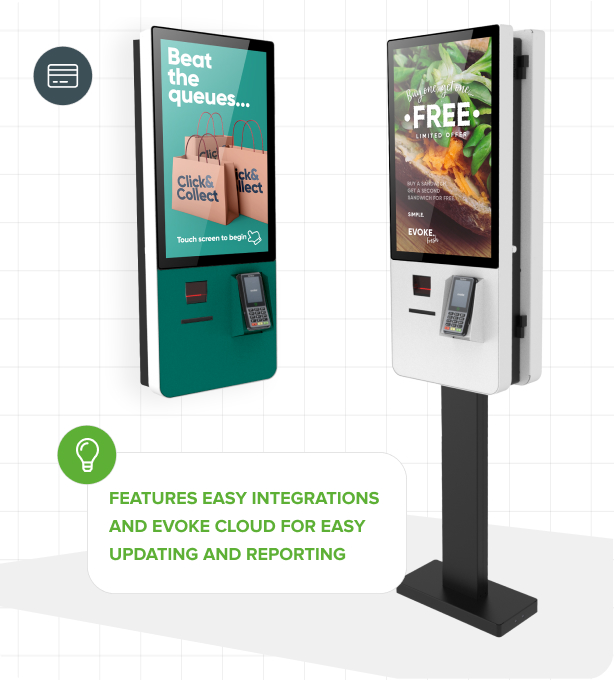
That breadth separates Evoke from a catalogue vendor and from the alternative many buyers assemble themselves: one hardware supplier, one app agency, a payment specialist, an installer and a maintenance contractor. The all-in-one model does not make a rollout simple. It gives one team responsibility for the complexity.
“The key to a great customer experience on a kiosk is making the hardware and software blend seamlessly together.”Dean Ward, co-founder, on the Gatwick rail project
The best case studies begin with a small annoyance
Tesco's electrical click-and-collect customers once had to reach a service desk, often at the back of a large store, and sometimes find it unattended. Evoke's terminal moved the moment of arrival to the entrance. A customer scans the barcode from an email; a staff member gets an alert on a handheld device and brings the order forward. The same relationship later produced drive-up grocery collection points and parking-validation kiosks connected to number-plate recognition.
For the fashion retailer Size?, the irritation was an item unavailable in the right size during a busy launch. Ordering kiosks and “endless aisle” features kept the sale alive. Evoke made more than 300 devices and even put one on a lamp-post-style base. That is a small, charming clue to the company's method: technology should look as though it belongs in the shop, not as though IT left it there overnight.
Bespoke ordering hardware, designed for continuous restaurant use and brand consistency.
Automated check-in and concierge work intended to shorten arrival time and release front-desk staff.
Barcode check-in, staff alerts and later an ANPR-linked parking workflow.
A Europe-wide self-service deployment reported at 980 locations in 2025.
Hospitality has become the clearest new growth lane. Public reporting puts Evoke's automated check-in and concierge deployment for Premier Inn at £4 million. Subway's Europe-wide programme had reached 980 sites by July 2025, up from the 300 locations Evoke had described weeks earlier. In rail, Evoke and payments company Worldline developed a ticket machine for a trial by Govia Thameslink Railway at Gatwick Airport. Its 64 inches of screen space handled ticket purchase, travel information and remotely controlled content.
The money arrived before the tidy growth chart
Evoke Creative Limited was incorporated in 2003, first as Raffo Design. Co-founders Dean Ward, Neil Clark and Graham Boyd came from a love of product design. The business took its current legal name in 2006. Its centre of gravity is still physical: a purpose-built, roughly 50,000-square-foot UK base that combines office, showroom, warehouse and production lines. There is also a Greenville, South Carolina, office for North America.
Growth capital supplied the next gear. BGF invested £6 million in November 2018 to expand production and international sales. A further £3 million injection was reported following the follow-on deal announced in December 2023. That announcement came with a three-year hotel contract worth £5.6 million and restaurant wins connected to two multinational groups with almost 70,000 locations between them. Neil Clark stepped away from his operating role, Peter Edwards became the chief executive and Ward continued as chief product officer.
The line was not perfectly smooth. Regional business reporting said Evoke made a £1.6 million pre-tax loss in the year before its record result, wider than £683,000 previously. The company attributed the pressure to higher component costs and new senior hires. That is the less photogenic side of vertically integrated hardware: a global supply shock reaches the bill of materials before it reaches a touchscreen.
By the year ended March 2024, annual revenue had risen 20 per cent to a record £34 million. Evoke did not publish a profit figure alongside that update, so the clean conclusion is sales growth, not a victory lap. Betting and gaming, a newer vertical, was contributing more than £2 million in annual revenue. The broader mix matters because Evoke's traditional retail and hospitality customers were precisely the sectors hit hardest during the pandemic.
In April 2026, BGF sold Evoke to Steliau Technology, an Astorg-backed European electronic-solutions group. Companies House records Steliau's UK vehicle, Inofab UK Limited, replacing BGF and Ward as the company with significant control. Evoke continues as an independent brand, now with a larger European parent whose catalogue spans displays, embedded computing, connectivity and manufacturing support. The fit is industrial, not cosmetic.
The screen in your pocket changed the plan
In August 2021, Evoke bought Liverpool app studio Apposing. Hardware could manage the in-store moment, but the customer journey had moved onto phones before arrival and remained there afterwards. Apposing added mobile-app and user-interface specialists who had worked with Footasylum, Nando's, McDonald's and Liverpool FC. Evoke called the combination “in-store and in-pocket.”
The acquisition is the clearest answer to what changed the company's mind about its own boundaries. A kiosk maker could no longer treat mobile as somebody else's screen. Apposing initially remained a separate unit, while the teams explored links between phones, signs, kiosks and video walls. It was not a pivot away from manufacturing; it was an attempt to close the loop around it.
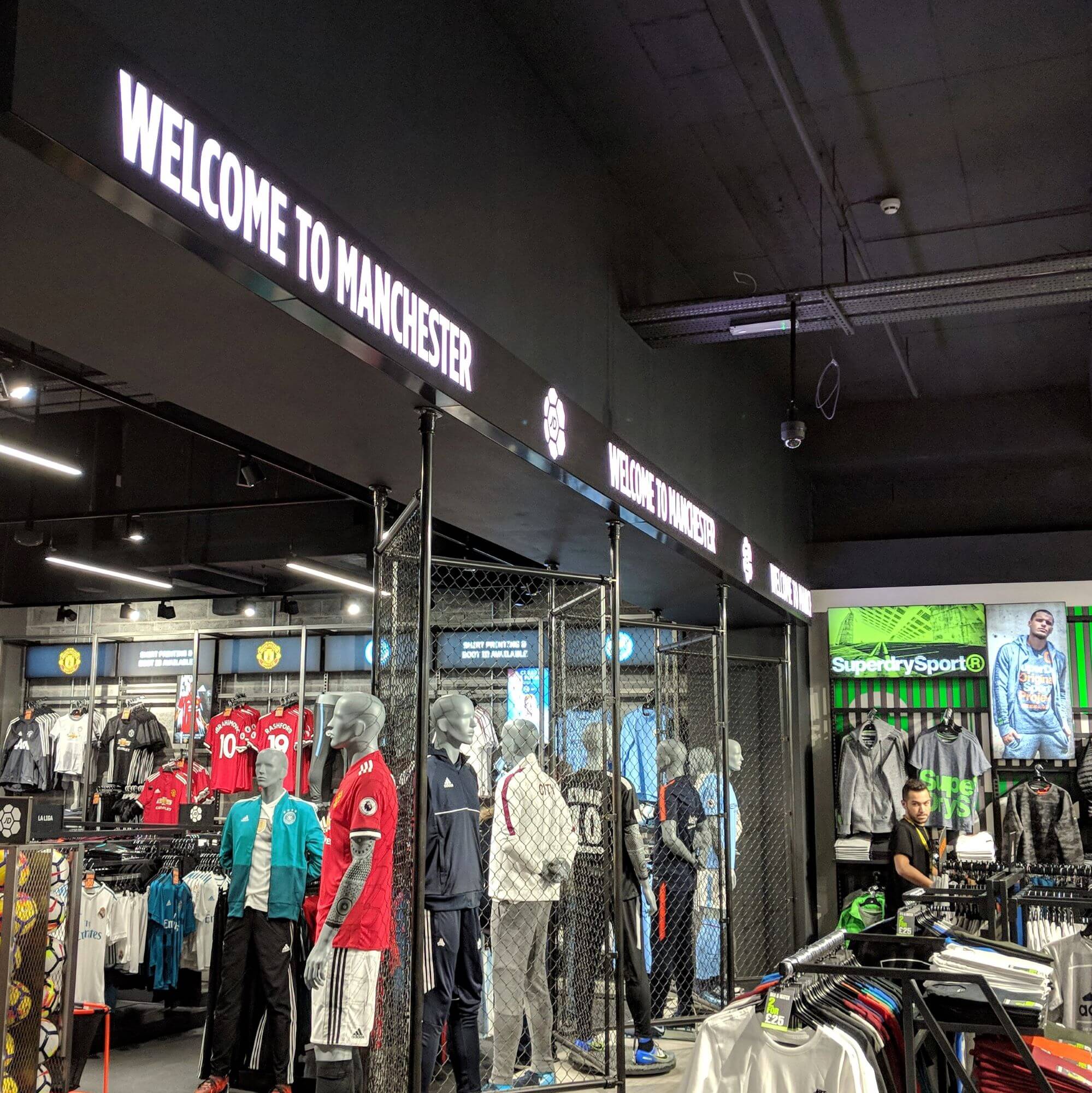
This is also where Evoke sits in the market. It is larger and more operational than a design studio, more customised than an off-the-shelf equipment vendor, and more hardware-literate than a software agency. Its customers are enterprises with enough locations to make remote management valuable, enough transaction volume to make queue time expensive, and enough brand equity to reject a generic grey cabinet.
The useful trick is learning before the forklift arrives
Evoke's own deployment advice is refreshingly suspicious of the easy sell. The first failure is often software compatibility, not sheet metal. New kiosk software collides with a booking platform, payment service or legacy back end. A poorly placed terminal interrupts the lobby it was meant to improve. Staff do not know who owns an alert. Customers ignore the machine. Accessibility arrives as a late compliance task rather than a design constraint.
The copyable part of the playbook is a disciplined pilot. Put different formats in different environments. Watch real people attempt the journey. Measure completion time, abandonment, upsell, staff time and device uptime. Fix the data path to the back office. Document installation and support while the sample is small. Only then turn a promising object into an estate.
- Start with a queue, abandoned sale or repetitive staff task that can be counted.
- Give operations, accessibility, payments and IT a seat before the cabinet is signed off.
- Pilot in contrasting sites, not only the tidy flagship chosen for the launch photograph.
- Treat telemetry, remote updates and field support as product features.
- Scale when adoption and economics are visible, not when the hardware looks finished.
The approach is a poor fit where transaction volume is low, the process changes every week or a human conversation is the service. It also falls apart when networks are unreliable, back-end owners will not integrate, accessibility is deferred, or nobody is accountable after installation. A kiosk cannot repair a bad workflow; it merely gives the bad workflow a bright screen.
A kiosk only looks simple from the customer side. Evoke built its business in the messy half.
From a product-design habit to public infrastructure
There is still a workshop sensibility underneath the enterprise contracts. The EV Flyte, Evoke's first self-assembly kiosk, can arrive with a 15- or 22-inch screen and be mounted on a wall, table or floor. Customers choose add-ons and can change the hardware later. It is a useful counterweight to the bespoke programme: not every restaurant needs a sculptural prototype and an army of installers.
Culture appears to follow the same mix of play and production. Evoke has run Innovation Days and university internship schemes. Retired co-founder Graham Boyd painted crash-test-dummy murals around the headquarters, showing little green-shirted figures in meetings and on the factory floor. The joke works because the work is physical. Ideas here eventually have to stand up in a railway station.

The legal starting point for the company that would become Evoke.
Long-running relationships put Evoke into grocery collection and restaurant ordering.
Capital goes towards production capacity and international growth.
Mobile product design moves into the group.
Follow-on funding meets larger contracts and a broader market.
BGF exits and the kiosk maker becomes an independent brand within a larger European electronics group.
The next test is whether Evoke can keep its craft-minded differentiation as volume rises. Fourteen thousand kiosks a year rewards repeatable modules; McDonald's, JD Sports and hotel groups still expect their own experience. The company must standardise the invisible parts while customising what the customer sees. That tension is not a flaw in the model. It is the model.