The most revealing screen in a hotel room is often the one nobody talks about at checkout. It boots slowly. The channel guide feels like archaeology. Netflix exists, but not here - or it does, if the guest can decipher a casting ritual and trust that the next occupant will not inherit the login. PureHD built a company around that small, persistent irritation. Its real wager was that the television would not disappear from the guest room. It would absorb more jobs.
Founded by Thomas Pullen in 2009, the Massachusetts company designs, installs and supports video systems for hotels across the United States and Canada. The original center of gravity was digital, high-definition free-to-guest television - the live news, sports and weather a property pays to make available without charging each guest. Today the pitch includes streaming apps, casting, interactive guides, digital signage, property marketing, folio review, checkout and service requests. A rectangle once judged by picture quality is becoming a hotel operating surface.
PureHD reports an installed base of more than 180,000 rooms at more than 750 properties across more than 125 brands. Its website displays names ranging from Marriott, Hyatt and IHG to Radisson, Wyndham, Kimpton and Virgin Hotels. This is not a consumer electronics story. Hotel owners, operators, management companies and brand technology teams are the buyers. The guests merely deliver the verdict, usually with a remote in one hand and a phone in the other.
The old system failed in the living room first
Hotel video did not collapse because the television stopped working. It failed because the guest's expectations escaped the building. At home, people opened Netflix, Disney+, YouTube or Max and resumed exactly where they had left off. In a hotel, a fixed channel lineup and yesterday's video-on-demand menu looked increasingly stingy. The room might be premium; the screen felt borrowed from 2006.
That behavioral shift changed PureHD's mind about what it needed to deliver. The company had years of experience distributing satellite and cable video through commercial headends. But preserving a linear-TV business would not answer the bring-your-own-content problem. By 2022, its PureSTREAM platform for Radisson used Google TV to mix DISH channels, Chromecast and access to apps. In 2023, a rebrand under incoming chief marketing officer Craig Snelgrove made the strategy explicit: entertainment should follow current consumer behavior across smart TVs, Android set-back boxes, browsers, Wi-Fi, coax and wired IP.
“We are focused on utilizing streaming apps rather than casting to provide BYOC, ensuring a secure and consistent experience for every guest.”Thomas Pullen, founder and CEO
The distinction matters. Casting asks a phone, hotel network and television to cooperate. Native apps put the experience on the largest screen with the remote guests already understand. PureHD supports both, but Pullen's preference for apps reveals the company's product instinct: make the system feel predictable across rooms, and make credentials disappear safely when the stay ends.
What PureHD actually sells
The cleanest way to understand PureHD is as an integrator with a managed-service brain. It takes programming, headend hardware, commercial televisions, networks, cloud software and hotel systems that come from different vendors, then makes the whole stack behave like one product. Design and installation get the system into the building. Monitoring, remote recovery, maintenance and 24/7 U.S.-based support keep it there.
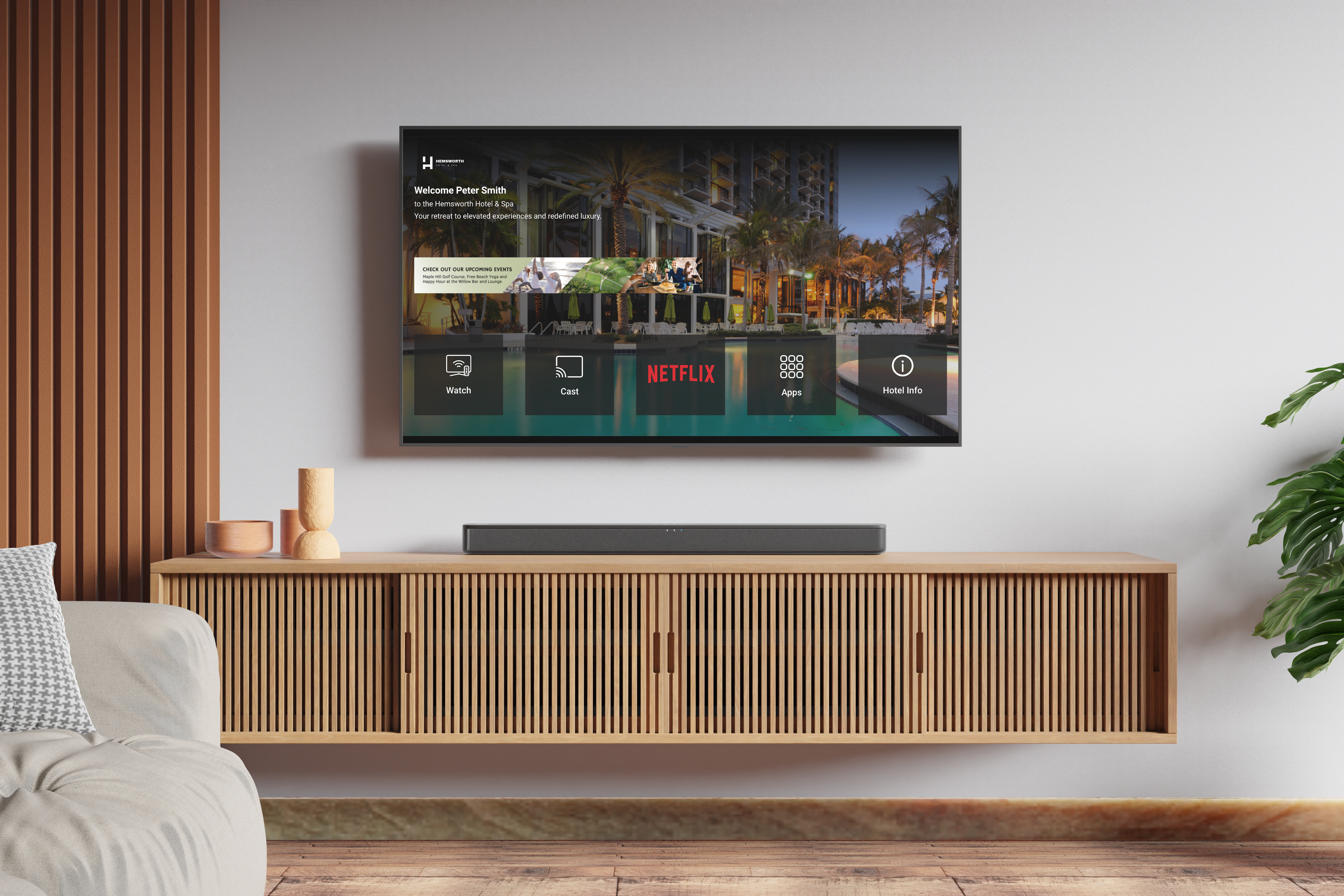
OnStream by DISH is the polished front end. It combines live television, streaming apps, native casting and universal search with property information. A hotel can add welcome messages, loyalty details, dining or spa promotions, QR codes, checkout and housekeeping requests when the required back-end integrations are in place. The television becomes both entertainment and a measurable distribution channel for the property.
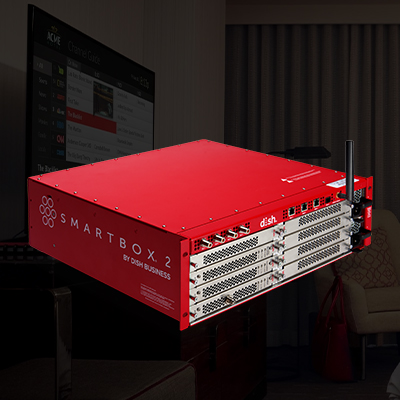
SMARTBOX2 handles the less glamorous part. The headend can deliver as many as 192 HD channels across a property and output video over coax, Ethernet or fiber. PureHD says the current unit takes 40 percent less space and operates 50 percent more efficiently than the legacy SMARTBOX. More important for an owner staring at a renovation budget, DOCSIS can carry newer services over suitable existing coax. The wall does not need to be opened simply because the guest wants Peacock.
The portfolio also includes LG Pro:Centric integrations and, since a 2025 reseller agreement, Uniguest Hotel Hub. The latter widens the canvas beyond a room: interactive TV, IPTV, casting, signage and wayfinding can be managed through one cloud-oriented suite. PureHD's expertise is less about owning every component than knowing which pieces can survive hotel operations, brand standards and the occasional guest determined to press every button.
The bill is custom; the cost argument is not
PureHD does not publish a menu price. That is sensible, if inconvenient. A 90-room roadside hotel with usable coax is not the same project as a new 600-room tower with fiber, multiple outlets, brand integrations and strict service levels. Quotes depend on rooms, televisions or set-back boxes, the channel package, network readiness, headend equipment, property-system connections, installation and ongoing support.
The company's sales argument therefore moves from sticker price to total cost of ownership. Avoid a rewire where possible. Consolidate television, streaming and support. Restore channels remotely before a technician rolls a truck. Let a management company deploy a common interface across several flags. Give the property ways to promote breakfast, late checkout or the spa on a screen it already owns.
SMARTBOX2 versus the legacy system
Company-reported comparison. “Efficiency” is presented by PureHD without a public methodology; treat it as a product claim, not an audited benchmark.
The business model follows that logic. PureHD earns from project design and installation, partner hardware or platform resale, programming and integrations, then managed maintenance and service. Financing records tracked by CB Insights show a management buyout and mezzanine financing in March 2022, with Massachusetts Capital Resource Company attached to the mezzanine round. No amount or valuation was disclosed. This looks less like venture-funded blitzscaling and more like a private operator building recurring relationships around installed infrastructure.
The moat is a phone answered at 2 a.m.
A streaming interface is easy to admire in a demo. A system that works in room 814 during a playoff game is harder. PureHD's differentiation is operational: a 24/7 video operations center, constant channel monitoring, remote power controls, software updates and field technicians. The company advertises channel restoration in under five minutes. That promise converts a technical feature into the metric a general manager actually feels - fewer complaints and fewer emergency visits.
“Switching to PureHD was the smartest decision we made. Not only were there financial savings, but the reliability improved.”Seth Wasserman, Menin Hospitality
Partnerships multiply that service footprint. Cloud5 began offering PureHD video alongside hotel internet and voice in 2023. Ovation Networks followed in 2024, pairing hospitality Wi-Fi with entertainment and free-to-guest TV, particularly for IHG properties. Uniguest arrived in 2025 with a broader engagement platform. DISH supplies foundational programming and products; PureHD supplies the hotel-specific integration and care. It is a channel strategy disguised as a complete solution.

Pullen's résumé explains the obsession. Before PureHD, he led North American sales at Guest-Tek and worked on hotel IP video at General Dynamics Interactive and NXTV. He published a paper about intelligent hospitality set-top boxes in 2005. PureHD did not stumble into a niche; its founder had spent years watching expensive hotel video systems meet unforgiving daily use.
What an operator can copy
The transferable lesson is not “sell TVs to hotels.” It is to build around the customer's sunk cost. PureHD supports coax, Ethernet and fiber because hotel buildings rarely arrive as blank diagrams. Start with the installed reality. Remove the nastiest migration expense. Add remote observability before adding flashy features. Then bundle enough responsibility that the buyer has one number to call.
Copy this
Sell the retrofit, instrument uptime, partner for missing layers, and connect the product to revenue or labor savings the buyer can measure.
Skip this when
The property only needs basic linear TV, the network cannot support streaming, the room count cannot absorb integration costs, or staff will not maintain the content.
The approach also has limits. Native streaming depends on compatible televisions or set-back boxes and sufficient network capacity. Casting can be temperamental when network isolation, discovery and device handoff are poorly configured. Property-management integrations add value only when the hotel has clean data and someone willing to keep offers current. A small independent property may be better served by a simpler commercial TV package. And a hotel with bad Wi-Fi cannot software-demo its way out of physics.
Competition comes from GuestTek, Allbridge, SONIFI, WorldVue, Airwave and direct platform or commercial programming options. Large operators can assemble separate vendors for Wi-Fi, IPTV, casting, signage and support. PureHD's answer is coordination: one integrator fluent in the old cables, the new apps and the brand checklist between them.
Where the market is going
The television is unlikely to replace a good front desk. It may replace the queue. A guest can review a folio, request towels or scan a dining QR code without downloading another hotel app. The property gets a controllable canvas for information and commerce. Streaming makes the screen personally useful; hotel integrations make it operationally useful.
That is the larger PureHD story. The company began when “100 percent digital, 100 percent high-definition” sounded like a category break. Seventeen years later, HD is table stakes. The opportunity moved upward into identity, apps, cloud control, digital signage and service. PureHD followed it without abandoning the racks, cables and support shifts that make the new experience possible.
The hotel TV did not win by staying a television. It won by becoming the familiar screen through which a temporary room explains itself. PureHD's job is to make that transformation boring in operation - and just useful enough that a guest notices only when it is missing.