Consider the menu board at a drive-thru. To the hungry driver, it is a list of possibilities. To the restaurant, it is a small operational wager: the prices must be right, the breakfast menu must disappear on time, and the screen must survive the weather. Multiply that wager across a chain and the interesting business moves behind the glass.
That is where STRATACACHE works. Founded in 1999 by Chris Riegel, the Dayton company supplies the software, displays, content delivery and support that let enterprises run networks of screens. Its proposition is practical: make the message changeable, keep the equipment working, and give the operator something useful to measure.
- It combines signage software, hardware and ongoing service.
- Retail media adds advertising sales and shopper measurement.
- Its Oregon manufacturing bet carries very different costs.
01 A menu board is an operating system
The product catalogue reads like a map of things that can go wrong. ActiVia creates, schedules and monitors visual content. OmniCast distributes large files across different kinds of networks. SuperLumin caches content to ease network demand. Outdoor displays add enclosures, media players and remote monitoring. Each product addresses a dependency between an approved message and a working screen.
A restaurant operator can schedule promotions across locations; a retailer can update product messaging without replacing printed signs. Headquarters can coordinate the campaign while local rules determine what appears where. The work is less glamorous than the advertising it carries, but a wrong price repeated across a network is a persuasive argument for control.
In that announcement, STRATACACHE said its technology served seven of the ten largest global quick-service restaurant brands. It also described outdoor platforms designed for more than ten years of field service. That is a company specification, rather than a demonstrated lifespan for every unit. Still, it reveals the sales pitch: buy equipment that can be maintained, then keep maintaining it.
This places STRATACACHE between enterprise software, commercial display hardware and systems integration. A buyer can assemble those pieces separately. STRATACACHE offers to coordinate them. Its 2022 NCR partnership added another connection: restaurant commerce software, customer information and field service alongside digital menus.
02 An aisle becomes advertising inventory
Inside a supermarket, the screen acquires a second job. It can help sell the merchandise, and its airtime can itself be sold. A brand pays to reach shoppers near a purchase decision. The retailer becomes a media owner with an audience that is already holding a basket.
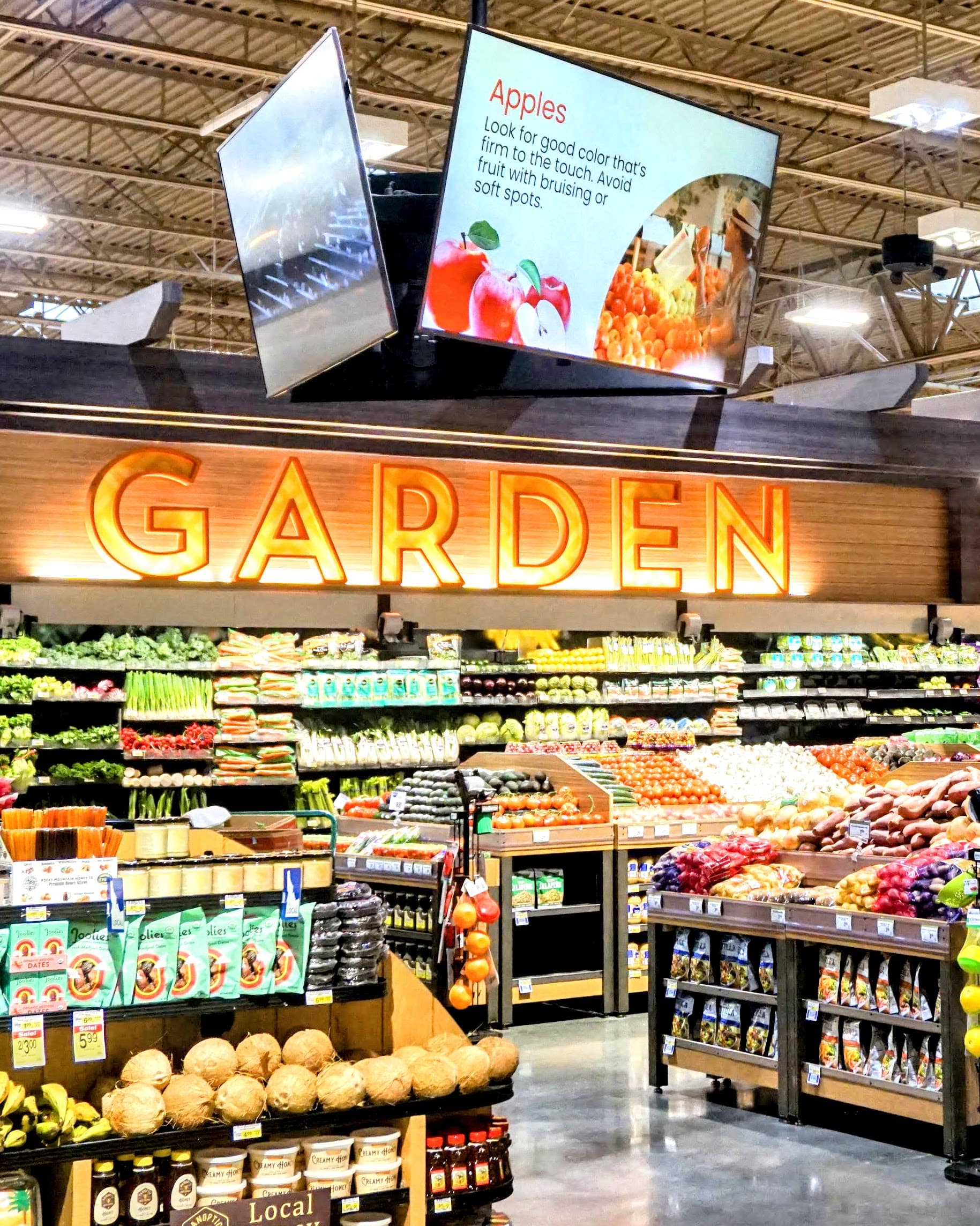
In January 2026, Iceland and The Food Warehouse announced a collaboration covering signage, content software and sensors across 766 locations. Walkbase, STRATACACHE’s analytics business, supplies camera-free measurement. PRN, its media-sales operation, helps sell the advertising. The offer stretches from installing the screen to finding a buyer for the time on it.
The announcement reported a condiment campaign with a 10% sales increase during its activation period. Treat that as a reported campaign result, rather than a promise for another store. Promotions, placement and underlying demand all matter when interpreting a change at the checkout.
“it’s not enough to simply run ads in-store, you have to prove impressions and conversions.”Chris Riegel · January 2026
Albertsons Media Collective offers another example. STRATACACHE’s January recap described a network launch with Mondelēz International and a planned expansion to approximately 800 stores. The distinction between a pilot, a rollout target and an operating estate matters. A plan becomes evidence only as the locations come online.
A played ad, a measured audience and an incremental sale are different things.
03 The cost of owning more of the stack
The company’s commercial model combines software, hardware, integration and continuing services. For a customer, the useful cost calculation includes installation, connectivity, creative production, replacements and support. Our reading of the model: a cheaper screen can still produce an expensive network if those obligations are poorly handled.
STRATACACHE’s own costs become more tangible in Eugene, Oregon, where it is developing a former semiconductor facility for MicroLED and photonics work. Oregon’s March 2026 progress report identifies a $19 million state CHIPS grant. That is public project support, with conditions and disbursements, rather than venture capital invested in the whole company.
An earlier state report recorded approximately $6 million of company spending during its reporting period, with no Oregon CHIPS award funds spent in that period. The March report described research hiring, tool acquisition and preparation for a pilot line. It also said no tools had entered service during the period covered. The reporting date does not turn preparation into production.
The manufacturing ambition is understandable: gain more control over the technology inside the display. Execution introduces buildings, specialized equipment and a production timetable. Here, the bottleneck appears before a finished screen reaches a customer.
04 The ownership map changed
Acquisitions helped STRATACACHE broaden its offer. Divestiture now belongs in the story too. On June 1, 2026, Vertiseit completed its purchase of Scala’s business for approximately SEK 265 million. Scala had been part of STRATACACHE since 2016. In September, Vertiseit announced that Dise and Scala would come together under the Scala name.

This changes the competitive picture. Scala is now an external alternative, and older group-wide deployment totals describe a different portfolio. Buyers comparing an integrated supplier with a separate CMS and integrator should start by tracing who owns, develops and supports each component. Yesterday’s company diagram can send today’s support request to the wrong door.
05 Start with one decision
The useful lesson for an operator is small enough to copy. Pick one decision to improve: a menu change, a promotion or a queue. Define the outcome, establish a baseline and test before expanding. Include the person who owns store operations, because a campaign still needs working equipment and usable content.
This approach depends on sufficient traffic, reliable operations and a way to judge results. A quiet shop with static information may have little reason to absorb a managed network’s complexity. A busy chain has a different calculation. STRATACACHE’s business begins where updating the screen becomes everyone’s problem.