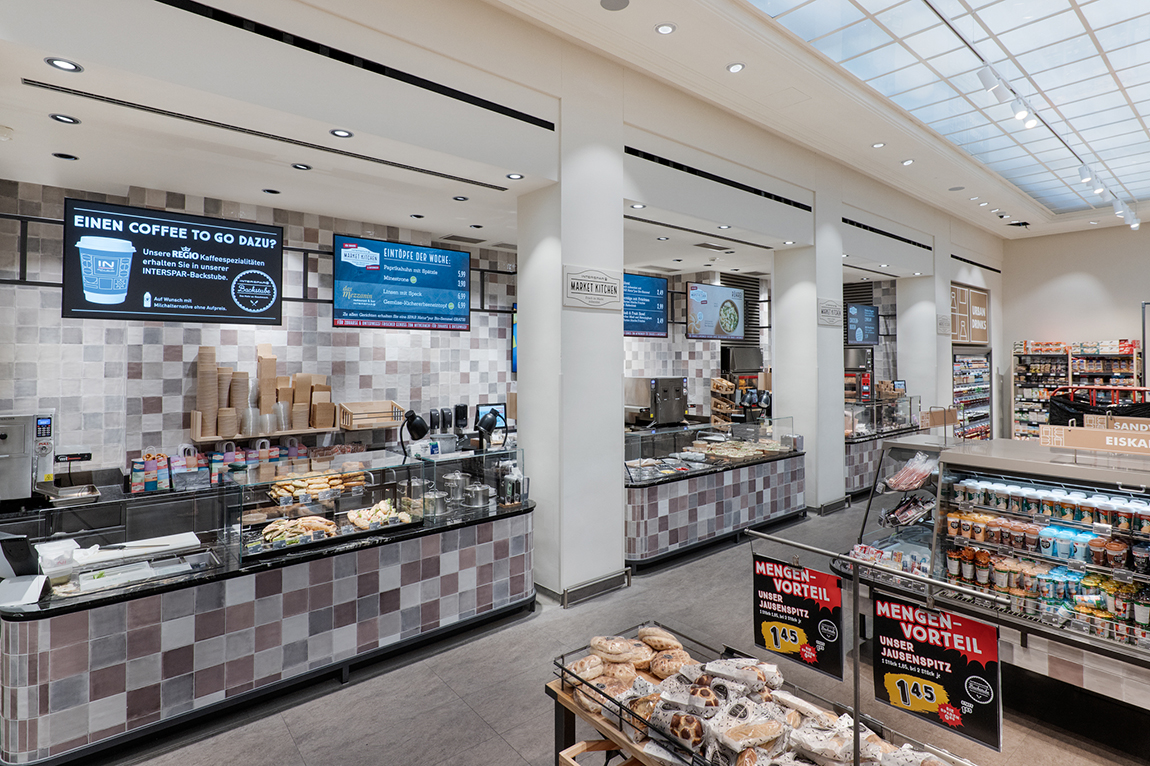
At INTERSPAR’s Schottentor store in Vienna, lunch once depended on a small act of clerical heroism. Someone had to replace the menu posters. The food changed throughout the day; the printed information needed to keep up. During busy periods, that was another task competing with customers, counters and actual cooking.
ZetaDisplay’s Austrian team, then known as Peakmedia, supplied eight LG displays above the Market Kitchen. Menus change on a schedule. Staff can prepare seasonal promotions using templates. A live bakery feed lets shoppers look over the baker’s shoulder. The appetite is human; the timetable is software.
- One partner for the whole job: software, screens, content, installation and ongoing operation.
- A new commercial purpose: retailers can use signage networks to sell advertising near the purchase decision.
- The question to keep asking: did a campaign create additional demand, or merely appear near an existing buyer?
Eight screens, one less chore
This is a useful way into ZetaDisplay because it begins with a modest problem. Digital signage means changing information on networked screens. Its value can be as ordinary as showing the lunch menu at lunchtime. The Vienna case also records special mounting requirements in a protected historic building. Even a cloud product sometimes needs permission to touch the wall.
Founded in Sweden in 2003 by Mats Johansson, Martin Gullberg and Mikael Öberg, the company now reports more than 125,000 active installations across over 50 countries. Its customers include shops, restaurant operators, transport organisations and workplaces. The common difficulty is coordinating communication across locations, equipment and teams.
Engage Suite is the software at the centre: a cloud content management system, an administration panel, a content creator and more than 50 apps. Users schedule material, manage permissions and connect business systems through APIs. A central team can govern the network while local staff use approved templates. Consistency becomes an operating arrangement rather than a request.
The shop floor gets a second business
In-store retail media adds another purpose. A retailer already has an audience near products. Screens can carry paid messages from brands, giving the store an advertising business alongside its trading business. The opportunity is attractive. It also introduces questions about inventory, advertiser approvals and measurement that an electronic poster need never answer.
Coop Norway offers a concrete example. After a pilot across 32 Obs hypermarkets, its May 2026 announcement described expansion focused on Extra stores. Coop attributed the move to pilot results and growing advertiser demand. Its approximately 1,200-store overall estate is context, not a claim that every location already has the new network.
“Advertisers are eager to be closer to the purchase moment in a relevant context”
Christian Skaarud / Coop Norway / May 2026
September brought a SPAR announcement: hundreds of new displays, repositioning of existing ones, and Engage Suite across SPAR Slovenia’s stores. A pilot had begun, with rollout continuing through year-end. SPAR would retain approval over participating advertisers. Moving screens is the telling detail. Better software cannot make a badly placed message conveniently visible.
Between those announcements came July’s acquisition of Berlin-based retailmediatools. Its API-first platform lets retailers operate their own media businesses while retaining their data and advertiser relationships. Founder Magnus Aufschild described the problem plainly: “Retailers have struggled with fragmented technology stacks.” ZetaDisplay is connecting campaign operations with the physical network that delivers them.
- 01PlanCampaign + approvals
- 02PublishEngage Suite
- 03DisplayStore touchpoints
- 04MeasureExposure + reporting
Someone still has to keep it running
The business model mixes deployment projects with recurring software and services. The 2025 yearbook reports SEK 656.0 million in net sales and SEK 258.2 million in recurring revenue. That recurring category should not be mistaken for software licences alone. Hardware, creative work, installation and maintenance remain consequential parts of the offer.
The financing is substantial too. ZetaDisplay issued a SEK 500 million secured bond in April 2025, carrying three-month STIBOR plus 6.50%. The retailmediatools acquisition announcement identifies refinancing proceeds as its funding source. For a buyer considering signage, the practical budget needs equipment, installation, content and ongoing support, as well as the software.
Its full-service position puts ZetaDisplay alongside integrators such as Mood Media and M-Cube. Owning Engage Suite lets it combine platform development with delivery responsibility. That combination matters when a problem crosses boundaries: the content looks right in the editor but the player, firmware or display behaves differently.
The Vy rail project makes those boundaries physical. Announced in April 2026, it covers approximately 1,400 displays across 135 trains, with completion expected by year-end. Kuori is collaborating on custom 32-inch screens built for railway conditions. Passenger information shares the network with commercial content; GPS data can make advertisements relevant to location.

Test manager Katjana Brandt’s team describes manual and automated checks across software and hardware. The company says consolidating its software portfolio required a coordinated testing function. Its 2023 financial report records another pressure: reduced hardware investment and delayed projects hurt non-recurring business. Dependable operations and recurring contracts have obvious appeal when customers postpone installations.
Count the audience. Question the result.
The most useful caution comes from ZetaDisplay itself. Its measurement guide distinguishes presence around a screen from an opportunity to see content. Neither confirms attention. A September 2026 commentary goes further: optimising advertising returns may favour people already likely to buy, producing a pleasing metric without additional sales.
Readers can copy the sequence visible in these projects: solve an operational problem, pilot a bounded network, examine placement, then expand with clear commercial responsibilities. Advertising needs buyers and credible evidence. A screen hidden from shoppers, a campaign without demand, or a measurement system that confuses proximity with persuasion weakens the proposition. The lunch menu still has to be right.