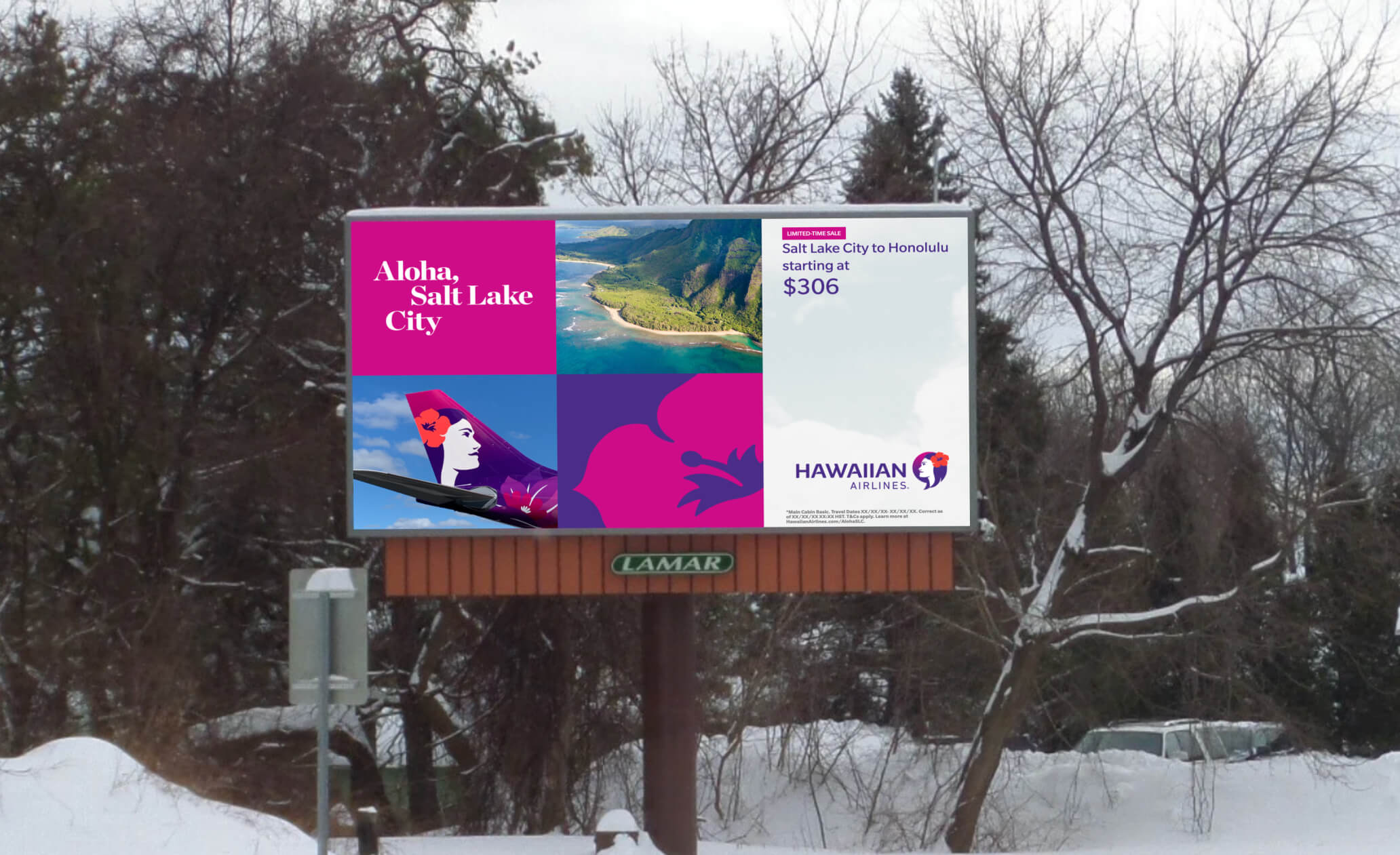
Snow makes a beach look better. Hawaiian Airlines understood this when it promoted its Salt Lake City-to-Honolulu route through Vistar Media. The campaign used local weather to trigger digital outdoor ads and live flight prices to give the daydream a number. The billboard had acquired a sense of occasion.
That is an appealing trick. The more interesting business is everything required to make it happen: find available screens, decide when to buy them, deliver the right creative and establish whether the advertisement did anything useful. Vistar sells the software and marketplace that connect those jobs. Much of its work happens where the pedestrian cannot see it.
- For buyers: plan, purchase and measure outdoor campaigns across screen networks.
- For owners: sell available ad space and coordinate direct and programmatic bookings.
- For operators: keep content and devices working through Cortex.
- The wager: a message gains value when place, time and circumstances agree.
A forecast becomes a media plan
The airline campaign placed ads around Salt Lake City, including locations near the airport, and used Acxiom’s Leisure Traveler audience segment. Through Vistar’s partnership with xCheck, fares could change within the creative. Weather supplied the cue; software coordinated the response.
Vistar’s published brand study reported a 2% lift in awareness, 32% in consideration and 16% in purchase intent. These are measures of people’s responses to the brand. They should not be read as equivalent increases in ticket sales. The useful result is narrower: this combination of context, audience selection and creative improved the reported brand measures.
Relative lift reported in Vistar’s case study. Bars share a scale; they represent different survey measures.
For a marketer, the transferable idea is to decide which circumstance makes the offer useful before choosing the media. A holiday offer has an obvious relationship with unpleasant weather. Another product may have a stronger relationship with a particular place or hour. The targeting rule should follow that reasoning, rather than become a decorative feature on a media plan.
The first borrowed idea needed rebuilding
Michael Provenzano and Mark Chadwick arrived with experience from Invite Media, the advertising technology business Google bought in 2010. Provenzano had been a co-founder; Chadwick its chief architect. Alongside Jeremy Ozen, they brought programmatic buying into outdoor media. Vistar dates its founding to 2012.
Their early attempt to reuse an online ad server ran into the physical world. In a 2012 interview, Provenzano described devices with intermittent internet connections and particular bandwidth requirements. A system designed for online advertising needed different engineering when the destination was a screen in a public place.
“We figured out we have to build a unique ad serving solution.”
Michael Provenzano / AdExchanger, 2012
The founders’ experience helped them identify the opportunity, but the operating conditions changed the product. This is a useful detail for anyone importing a familiar business model into an unfamiliar industry: the screen may look like another display, while the infrastructure makes it a different job.

One spot, several businesses
Vistar serves two sets of customers whose interests meet at an available ad spot. Brands and agencies want useful reach, manageable execution and evidence of results. Media owners want buyers for their inventory while retaining control over prices and content. Retailers can also use the technology to operate and monetize in-store screens.
The demand-side platform, or DSP, gives buyers tools for planning, activation and reporting. The supply-side platform, or SSP, connects owners to demand through transactions such as open auctions and private marketplaces. The ad server coordinates bookings, including predictable loops and flexible scheduling. Cortex handles content and fleet operations. Each product addresses a different source of friction.
A simplified view of the work. Owners can use individual tools and existing integrations.
There is also mediation: Vistar’s ad server can bring multiple SSPs into a unified auction for an available spot. For an operator juggling demand sources, that replaces separate technical connections and scattered reporting with a more consolidated workflow. More bidding competition can help yield; it does not manufacture advertisers where demand is absent.
The commercial model combines advertising transactions with software and services. At launch, the founders described buyer ad-serving fees and publisher revenue sharing. Today, Vistar’s ad-platform glossary specifies CPM pricing: cost per thousand impressions. Owners can set a minimum acceptable CPM. The price floor matters because an automated sale is still a negotiation about value.
The burger is the easy part
Cortex makes the unglamorous work visible. Its tools include remote deployment, troubleshooting, performance alerts and device monitoring. A screen network needs people to know whether a player is healthy and what it is showing, without driving to every location. Software saves work when those answers can be found in one interface.

In April 2024, Vistar announced that Lamar Advertising had selected Cortex for its national digital billboard network. The reported migration covered nearly 5,000 displays, took less than six weeks and caused zero downtime. It followed work on Lamar’s Denver Transit network in 2023. Those are rollout claims from the announcement, rather than a promise about every deployment.
Less than six weeks to migrate.
Zero downtime reported.
For a media owner, this is a different purchasing argument from better targeting. The question becomes whether an operating platform can remove repetitive work and make a distributed network easier to maintain. Vistar’s expertise spans both the advertising transaction and the machinery that must carry it out.
Even the paper needed software
Digital outdoor advertising is only part of the market. In April 2024, Vistar acquired Adstruc’s traditional outdoor planning and buying software from PJX Media. By September it was available across the U.S. marketplace, with inventory connections to more than 1,500 media owners, according to Vistar’s launch announcement.
Adstruc helps agencies manage proposals, vendor communication and campaign knowledge. Media owners can use it free. A static billboard still requires a buyer, a proposal and a negotiation; removing routine administrative work can be valuable even when the advertisement itself never changes.
That breadth distinguishes Vistar’s position, though it has company. Broadsign provides overlapping inventory, programmatic and network tools. Perion DOOH, formerly Hivestack, also offers a DSP, SSP and ad server. Choosing among them means examining inventory access, integrations, local support and the work a team actually needs to perform.
Recovery, then a much larger buyer
Vistar reported more than $100 million in platform billings in 2019. Billings describe money moving through the platform and should not be mistaken for Vistar’s own revenue. The pandemic then hit outdoor advertising. Provenzano’s 2021 funding account described helping advertisers make decisions where conditions made sense and helping media owners through the disruption.
The reason to accelerate again was concrete: platform spend had surpassed pre-pandemic levels. Lamar’s $30 million Series B supplied capital for expansion and product development. A company selling attention in public places had to watch whether the market was actually returning before resuming its growth plans.
T-Mobile announced an approximately $600 million cash acquisition in January 2025 and completed it on February 3. Its annual report records $621 million in cash transferred. At announcement, T-Mobile described Vistar’s reach as more than 1.1 million digital screens, over 370 media owners and more than 3,000 advertiser partners. That is access through a network, rather than ownership of all those screens.
Vistar now sits within T-Mobile Advertising Solutions. In September 2026, it expanded its Japan operations with a dedicated local team led by Country Manager Yosuke Maekawa. The move illustrates an ordinary requirement of a global marketplace: software still needs local inventory relationships and people who understand the market.
What a useful campaign asks first
Vistar offers managed execution, self-service DSP access and co-managed campaigns. Buyers can also reach its SSP through other DSPs. An agency can choose a route that matches its staff and existing tools; a screen owner can begin with the operational or selling problem that costs the most time.
My reading of the examples is that three decisions belong before activation: define the useful moment, select a plausible audience and agree on the outcome to measure. A consideration study answers a different question from a store-visit study. A well-chosen screen answers a different question from a cheap impression.
The weather idea is strongest when the offer changes meaning with the conditions and there is suitable inventory to reach the audience. It is less useful when the trigger has little relationship to buying, the creative is hard to read or the measurement cannot distinguish campaign effects. Network health and permission to use the relevant data also remain practical requirements.

Vistar’s own careers material emphasizes autonomy and development. One engineer’s testimonial mentions officiating a colleague’s wedding, an unusually specific piece of workplace affection. It is a company-selected account, but a welcome reminder that the people maintaining the auctions have lives beyond the auction.
Out on the street, none of this needs to announce itself. Someone notices a fare to Honolulu while the trees are bare. The offer makes sense at that moment. Vistar’s business is arranging the conditions under which that small encounter can happen, then giving buyers and owners a workable way to repeat it.