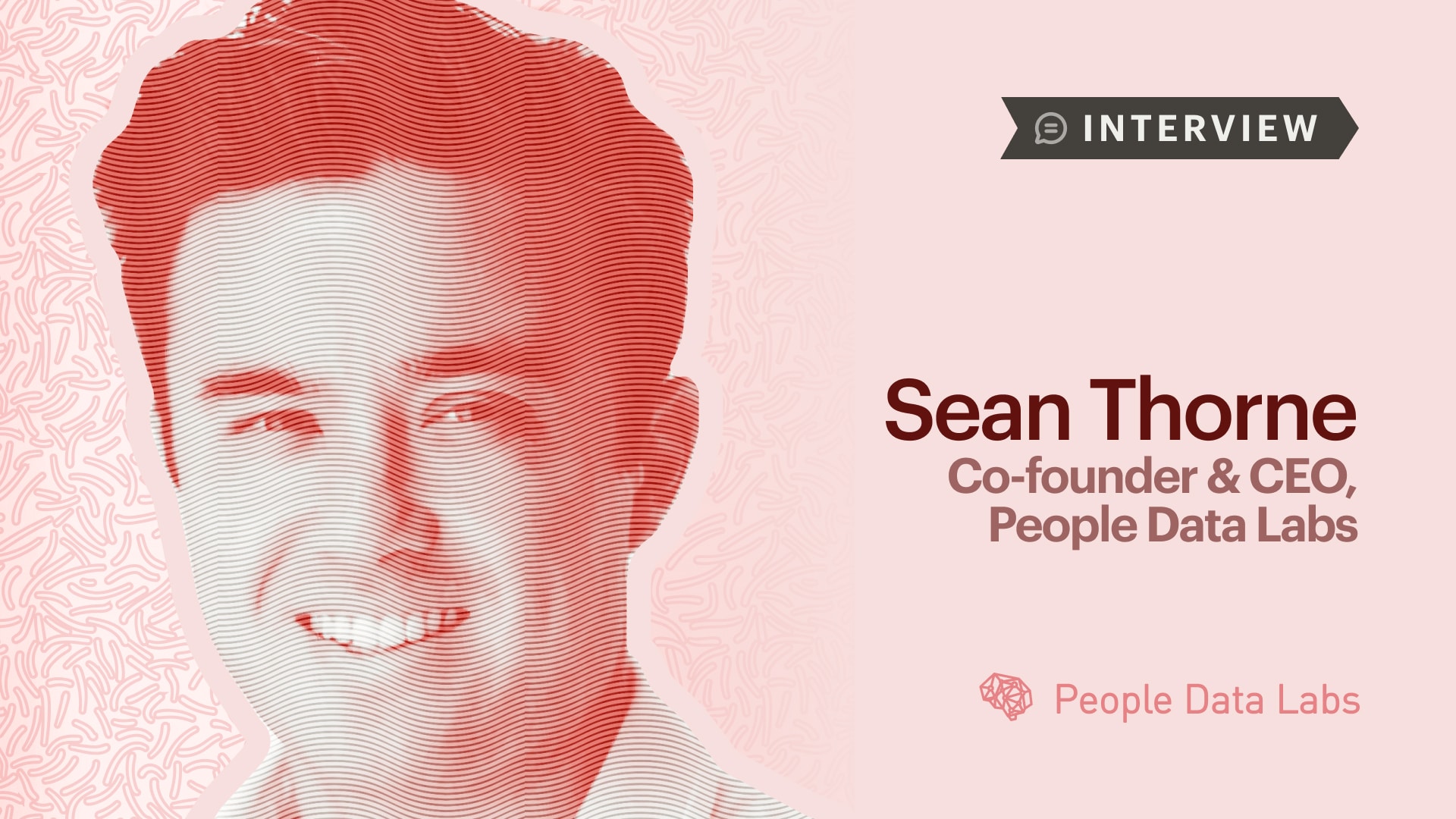
Sean Thorne had a paying customer before he had a company bank account. The product had taken two weeks to build. By week three, somebody wanted to buy it. There was just the small administrative matter of where to put the money. He bought time by giving the customer sixty days to pay for a $100 software subscription. Entrepreneurship, on this occasion, involved making the invoice slower than the business.
It is a useful place to begin with Thorne, a co-founder of People Data Labs and now a founder of AgentScore. The first sale was an early TalentIQ sale, before the business became PDL. He later recalled reaching $500,000 in annual recurring revenue in month ten. His customer had supplied the first encouraging answer to a question that would follow him through several ventures: will anyone care enough about this problem to pay?
The polished version of a founder’s life tends to arrive with the paperwork already completed. Thorne’s account has the loose ends still showing. A product goes out. A buyer appears. The founders hurry to catch up. Today, after building a business that supplies data to other companies’ products, he is pursuing another unfamiliar customer: an AI agent acting on somebody’s behalf.
01The campus was the market
Before enterprise data, there was Eugene. In July 2013, Thorne was a University of Oregon junior studying economics with a business minor. Hallspot, his college-focused social service, had raised $150,000 from an angel investor. His presentation at the Willamette Angel Conference had also won $6,300 in cash and prizes. Around 4,800 Oregon students had preregistered. The intended expansion started with Oregon State and the Pac-12.
Nathan Lillegard, the university’s entrepreneurship program director, was among his advisers. Thorne had approached him when the team numbered four. By that summer, the university described a staff of fifteen and an office in downtown Eugene. The enterprise was taking shape within walking distance of the audience it wanted to reach. A campus offered a defined place to test whether people would use the thing.
Thorne traced the idea to a marketing class in November 2012. Facebook and Twitter offered plenty of content, but little that helped him understand what was happening around his own university. He wanted an online space built around campus life. It was an appropriately student-sized irritation: the internet could show him the world, yet seemed oddly unhelpful about the next few blocks.
Hallspot began as a social network. When it added deals, the numbers pointed elsewhere. Thorne and co-founder Adam Tirella shifted their attention toward offers from businesses students actually visited. His parents supported his decision to leave college after the first funding round. In his telling, they were the ones asking why he was still enrolled. The family discussion evidently required less persuasion than the average investor meeting.
02A customer asked for the machinery
In 2015, Thorne and Henry Nevue founded the business that became People Data Labs. Its early name, TalentIQ, reflected its recruiting focus. They had seen a recruiter struggle with the work of identifying candidates and keeping their details current. Those details could become stale across a whole database, even when the software surrounding them worked perfectly well.
Thorne took sales; Nevue built the product. Selling enterprise software introduced a different kind of education. One prospective bank account involved conversations with thirty-seven people and months of free access, without a discussion of pricing. Enthusiasm could keep an opportunity alive for a remarkably long time. A signature required something more definite.
After hearing sales coach Whitney Sales speak, Thorne sought her help. An applicant-tracking company’s chief executive asked for access to the underlying data through an API, a connection software can use directly. The request helped clarify what customers wanted. PDL moved from a platform people logged into toward data that could update the systems they already used.
That distinction made the buyer easier to identify. A company building a recruiting tool or managing a customer database could integrate PDL’s data into its own product. The software vendor kept its relationship with the user. PDL supplied an ingredient. For Thorne, the lesson arrived through an actual customer request, which has the advantage of being harder to romanticize than a whiteboard.
03The useful friend in the next office
Thorne’s approach to allies could be disarmingly plain. At the seed stage, he contacted Auren Hoffman on LinkedIn and visited the SafeGraph office. Hoffman was building a data company too. Thorne wanted to know him. He says he did not even realize Hoffman was a venture capitalist when he made the approach.
Hoffman’s Flex Capital later participated in PDL’s Series B. Thorne valued investors who were still operating companies, dealing with current problems rather than remembering earlier ones. He wanted people he could call when something went wrong without first composing a flattering account of events. “Building a company is very hard, so having allies is key,” he said.
The appeal is understandable. A founder who has just encountered a difficult customer, an awkward hire or a disappointing month may need practical advice before a strategic lecture. Thorne’s description of his cap table gives the relationships a workaday purpose. An investor can supply money and still be chosen for the quality of a conversation.
04$45 million for the people building behind the scenes
PDL announced a $45 million Series B in November 2021, led by Craft Ventures with Flex Capital participating. At the time, the company reported eighty employees and plans to double its headcount, emphasizing engineering and product. Jeff Fluhr joined the board; Hoffman continued as an adviser. The funding was intended to expand work in areas including financial technology and investment research.
The company described three billion B2B data records and 18.6 million companies in that announcement. Those are historical figures, a snapshot of the business at the funding round. They make the scale legible, but the product’s purpose is easier to understand one record at a time: a team needs information about a person or business, and wants that information to arrive in a usable form.
Flex Capital participated80 employees at announcement · hiring expansion planned
PDL’s published data-building process describes sourcing, reconciliation and recurring releases. It combines partner data with public information and invests engineering work in keeping the resulting dataset current. This is the continuing labor behind an answer that appears quickly on a screen. A career changes; a record needs to change with it.
Thorne’s taste in hiring followed the same practical bent. When discussing an early marketing hire, he recommended someone nearer to an engineer than a traditional marketer. PDL wanted a person who could handle the analytical and technical work before making a campaign look finished. The recommendation suits a business whose buyers want to inspect what a product can actually do.
05Knowing when to give someone else the keys
Eventually, Thorne and Nevue stepped away from their daily leadership roles. Ben Eisenberg, a colleague of more than seven years, became CEO. The founders described him as a third founder in all but the original paperwork, someone who understood the customers and had worked across the business. Thorne remained involved through the board.
Their explanation centered on fit. They considered their own abilities especially suited to the “zero-to-one” stage. They wanted Eisenberg to lead the next stretch, including an ambition to reach $100 million in annual recurring revenue. That number was a destination they set for the company, rather than a result they announced.
There is an unshowy piece of judgment in that decision. Starting a company earns a founder authority over it; the work can later demand abilities someone else has spent years developing. Thorne’s account gives Eisenberg credit for that accumulated knowledge. The handoff also allowed Thorne to seek the uncertainty he had enjoyed at the beginning, while retaining a stake in what the team had built.
“Keep building”
The closing words of Sean and Henry’s handoff letter
06The next customer may arrive as software
At AgentScore, Thorne is again working on infrastructure. The company presents its work around identity, payments and compliance for AI agents. One demonstration involves Martin Estate, a Napa Valley winery accepting orders from software acting for a buyer. A bottle still has to reach a real address. The recipient’s age, the shipping destination and the payment still matter. Automation inherits the practical obligations of the transaction.
The winery case separates those jobs: AgentScore handles identity checks and payment infrastructure, while the merchant handles product-specific shipping rules and fulfillment. It is a useful example precisely because it ends in something physical. An agent’s plan must survive contact with a shop, a payment and a delivery. Cabernet makes an unexpectedly strict software test.
Thorne is changing how he works, too. In recent posts, he described opening pull requests, changing website copy and updating documentation himself, after years of passing requests to other people. AgentScore’s internal Hivemind gives staff and AI tools a shared, version-controlled body of company knowledge. Its published account describes agents drafting work for human approval.
In October 2026, his public profile carried an update saying a new product had reached six figures in annual recurring revenue in August and doubled ARR in September. These are his reported milestones. Alongside them, he was still talking about refining the customer profile and identifying repeatable uses. The uncertainty remains visible, even in the encouraging numbers.
The resemblance to that early TalentIQ sale is hard to miss: put a product in front of someone, find out whether it helps, then learn from the answer. Thorne has returned with more experience and a new set of tools. The administrative details are different. The pleasure he describes still comes from seeing a small team make something that another person wants to buy.