Imagine a sales agent with perfect manners and a rotten address book. It writes a polished note about a company’s expansion, except the company has not expanded. It sends the note to a vice president who left six months ago. The failure is dressed in good prose, which makes it unusually easy to miss. Explorium has built its current business around that less theatrical part of artificial intelligence: the facts an agent checks before it acts.
The short version
- Explorium combines outside business data - company records, people, technology, events and intent - for sales and marketing workflows.
- Its first product helped data scientists discover useful external signals for predictive models. AgentSource, launched in 2025, gives AI agents that context through APIs and MCP.
- Melio reported a 15% improvement in main funnel conversion using Explorium-enhanced lead scoring. The result belongs to that customer case, not every deployment.
- Published packages begin at $29.99 for 500 credits; the cost of a workflow depends on which records and fallback sources it uses.
The first question was: what is missing?
Founded in Tel Aviv in 2017 by Maor Shlomo, Or Tamir and Omer Har, Explorium originally addressed a problem familiar to data scientists. A company could have a tidy database of its own customers and still miss the conditions around them: where a business operated, whether it was hiring, what technology it used, or what else had changed in its market. The early platform searched outside sources, joined useful information to internal records and turned those discoveries into features for predictive models.
That was a different buyer and a different vocabulary from today’s AI sales agent. But the basic job has survived the fashion cycle. Someone has to identify the right outside fact, resolve it to the right company or person, and deliver it in a form a machine can use. In 2020, co-founder Shlomo described the ambition as doing for machine-learning data what search engines did for the web. The line is grand; the work beneath it is painstaking.

A better lead is a smaller haystack
The clearest older example comes from Melio, the business-payments company. As inbound interest grew, its team needed to sort businesses that fit its product from those that merely filled a form. Explorium’s case study says the teams combined internal information with external enrichment to broaden the criteria in their lead-scoring models. Melio reported a 15% lift in main funnel conversion and a threefold improvement in operational efficiency. These are customer-reported results from one implementation, useful because they describe a decision that changed: which leads deserved attention first.
Other named users show the range. Taboola describes Explorium’s catalog as a consolidated source for its algorithm. PepsiCo’s commercial data science team has spoken about comparing the many available data points with the problem at hand. Bluevine used it in model development. These are analytics and decision-making stories. The newer pitch asks what happens when the decision-maker is software that may take the next step without waiting for a person.
The agent does not need another dashboard
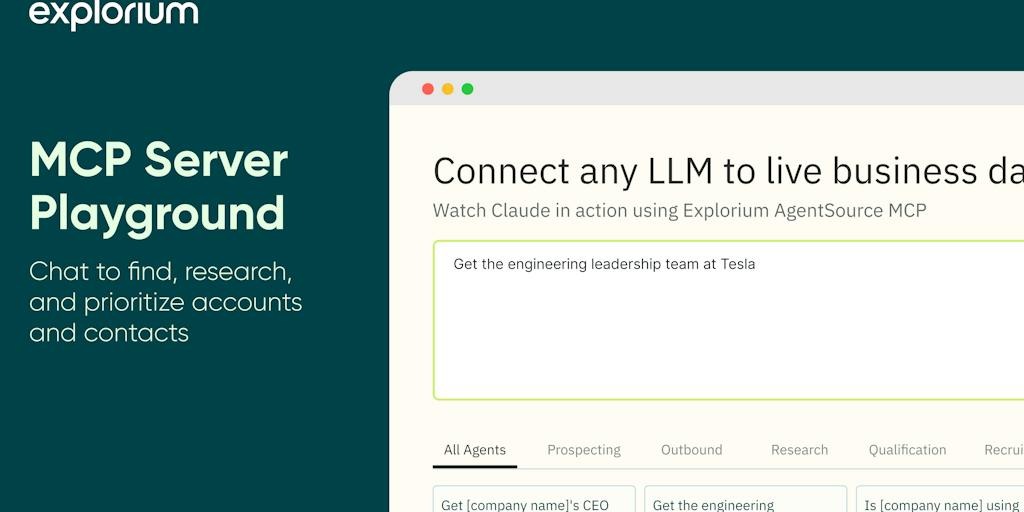
In March 2025, Explorium introduced AgentSource, a collection of interfaces for finding accounts and people, matching identities, enriching records and detecting events. Its MCP server lets compatible AI tools call those functions directly. A prospecting agent can ask for companies that fit a size and technology profile, look for a recent change, identify a relevant contact and retrieve contact details. That is a more specific proposition than “AI-powered sales”: it is the data supply under the agent’s workflow.
What the workflow actually needs
The distinction from a typical list seller is in the packaging. Explorium combines multiple outside sources into structured records and exposes the data through one API and MCP connection. Its Bombora integration places topic-level purchase intent alongside firmographic, contact and technology information. Its Outreach integration feeds an AI Prospecting Agent with enrichment and live market signals. A team could assemble a similar stack from data vendors, a warehouse and integration code; Explorium sells the convenience of having much of that joining done before the agent asks.
The revealing list of repairs
Product revisions often tell the truth more plainly than launch announcements. AgentSource v2, released in beta in September 2026, adds asynchronous jobs for up to 10,000 records, with a runtime allowance of up to 24 hours. It also adds fallback to verified outside providers when Explorium’s primary contact source comes up empty, up to ten separate webhooks per tenant, custom research against a specified output schema and one unified /v2 API surface.
Those changes answer visible problems in v1: synchronous calls could time out on large batches; one webhook was too narrow for several downstream systems; contact filters and bulk routes were inconsistent; a missing phone number was a dead end. Explorium has said v1 will remain live alongside v2 for six months. That migration runway matters to a builder whose agent is already in production. The practical lesson is transferable: before praising an AI agent’s writing, test the failed match, the empty contact field, the ten-thousandth record and the webhook that arrives late.
“Explorium’s vast external data catalog provides a single, consolidated source for all our data needs.”Mor Nitzan, analytics team lead, Taboola
The bill follows the data
Explorium is a business-data software supplier, with usage packages rather than a single public seat price. Its published pricing offers a free 100-credit trial, a $29.99 Lite package with 500 credits, a $149.99 Starter package with 5,000 credits and larger tiers up to custom enterprise terms. Paid credits expire after 12 months. A basic generated record or event costs one credit; enrichment costs vary. In v2, for example, an externally sourced phone number in the contact fallback costs 15 credits, compared with five for an Explorium phone number. A cheap entry package can therefore be an honest experiment, but it is not the cost of a full production campaign.
Published entry points
Package prices and credit rules as listed by Explorium in September 2026. Paid credits expire after 12 months.
The company has had the capital to make a long bet. It announced a $31 million Series B in 2020 and a $75 million Series C in 2021, bringing its announced total above $127 million at the time. Its market now includes sales-data providers such as Apollo and ZoomInfo, workflow tools such as Clay, and teams that join several vendors themselves. Explorium’s case is strongest when a builder needs several kinds of data in one machine-readable flow. A team with a small, stable prospect list and good in-house records may have less reason to pay for that breadth.
What to borrow from the unglamorous part
There is a useful discipline in Explorium’s shift from model features to agent context. Start with the decision that needs improving, as Melio did with lead priority. List the outside facts that could alter that decision. Measure match quality and freshness on a sample you know well. Then price the whole path - including blank fields and fallback records - before letting an agent act at scale. The clever email comes last. The address book gets inspected first.