The most expensive name in a sales database may be the person who no longer works there. Somebody researched that contact, somebody bought the record, and somebody is now composing a thoughtful introduction to an abandoned inbox. InFynd has built its proposition around this small, stubborn absurdity: the campaign can only be as useful as the information underneath it.
The Bracknell-based business supplies company and professional contact data to sales, marketing and recruitment teams. It also builds bespoke lists, fills gaps in existing records, cleans customer relationship management systems and runs outreach campaigns. That combination puts it in an interesting position between a software subscription and a service team that does the preparation a busy commercial department keeps postponing.
Its public face is getting bigger. The current InFynd Group homepage presents three offerings: global B2B and healthcare intelligence, sales and marketing agents through 27x.ai, and continuous risk intelligence. The common ambition is to carry information further into the working day, from finding a business to contacting it or monitoring what changes.
A very large database, a very small target
InFynd’s global-data page advertises more than 240 million contacts across 12 million companies. Those are the company’s coverage claims. For an actual buyer, however, the relevant number will usually be much smaller: the people with the appropriate responsibility, at suitable companies, in a territory the sales team can serve.
The platform offers filters for role, industry, company size and location, alongside information about the technologies a business uses and signals intended to indicate buying interest. Users can build a prospect list, enrich existing records and export the resulting audience. Salesforce, HubSpot and Zoho appear among its advertised destinations for connected data.
Consider a hypothetical software seller looking for technology leaders at medium-sized businesses in one region. A general directory supplies names. A usable brief adds company size, job seniority, required contact fields and exclusions. InFynd’s custom-data service is designed around those details, including fields mapped to the customer’s own CRM. That is where its offer becomes more specific than access to a search box.
Advertised coverage on InFynd’s global-data page. Database size is not a measure of campaign performance.
Custom delivery can take the form of a file, an API feed or a CRM connection. The company also advertises ongoing validation and refreshes. The practical attraction is continuity: a list can be built for a particular campaign, then maintained for the next one, rather than treated as a spreadsheet that becomes somebody else’s problem after purchase.
The first thing to fail was the address book
InFynd’s published case study of an unnamed UK job board provides a concrete illustration. The client’s ageing employer records contained obsolete job titles, invalid emails and missing decision-makers. Its internal team also struggled to build lists for additional sectors. The failing component was the information supporting employer acquisition.
The intervention combined custom contacts, a CRM cleanup, enrichment and managed email campaigns. InFynd describes a staged rollout: audience definition and audit first, data delivery next, then campaign testing and activation. It reports that email bounce rates fell from 18% to under 3%, with 45% more new employer pipeline conversations within eight weeks.
Fewer emails hitting a wall
These are vendor-reported results from one combined engagement. Because several things changed together, the figures cannot establish how much improvement came from cleaning, targeting or messaging alone. They do make the sequence understandable: repair the records before asking the campaign to perform.
For a reader copying the approach, that order matters more than the headline percentage. Define the audience, inspect the existing database, repair the gaps and test a segment before expanding. Measure useful conversations as well as delivery. A message arriving successfully is the beginning of the commercial test.
The cleanup can be the product
InFynd’s CRM health check makes the maintenance work explicit. It describes duplicate detection, missing-field completion, checks on email and phone information, and reviews of record ownership. It also offers to examine field structure and scoring rules. That puts attention on how information behaves inside a sales system, beyond whether an individual email address is valid.
The enrichment service adds company characteristics, professional details and technology information. In practical terms, a sparse record can acquire a current job title, a company size band or the context needed to route it to the appropriate salesperson. The integration service then addresses field mapping and synchronization between systems.
This is a useful distinction for buyers. A team short of prospects needs discovery. A team already sitting on thousands of neglected accounts may need restoration. Purchasing another list will not, by itself, settle who owns an account, eliminate duplicate records or make the reporting consistent. InFynd sells work on those operational problems as well.
“Great things take time”
InFynd’s fourth-anniversary newsletter, November 2024
Doctors have job descriptions, too
Healthcare gives the company’s segmentation argument a sharper edge. Its dedicated platform advertises more than 3.1 million professional contacts and over 100 specialties. Users can browse prepared lists or build audiences using specialty, role, management level, hospital type and geography. The offer is aimed at businesses trying to reach healthcare professionals and decision-makers.
A dental practice owner, a hospital procurement contact and a clinician may all sit within a broad healthcare market, but the commercial question addressed to each is different. InFynd’s published categories include dentistry, cardiology, pharmacy, radiology and nursing. Its interface promises to let the buyer work through that specificity before exporting records.
The company describes a data process that combines public registries and professional directories with machine-assisted cross-checking and manual verification. Human review remains part of the advertised method. For buyers, a sensible evaluation is whether the supplier can produce the relevant role within the relevant institution, with enough current detail to support the intended approach.
A quote for the assignment
InFynd’s current official pricing page asks customers to describe their requirements and request a tailored quote. It advertises no onboarding or platform-access charges, and says support and data maintenance are included without separate charges. Its terms describe paid service plans and a limited licence for internal business use.
Software directories still carry entry prices around £49, but those listings should not be mistaken for a current quotation covering a custom project. The product being scoped may include list construction, CRM work, integration or managed campaigns. The useful comparison is the price for the same assignment, with the same fields, delivery method and service expectations.
InFynd’s emphasis on customization is commercially revealing. It asks the buyer to define the job before the bill. That can suit an unusual audience or an untidy database requiring human attention. A buyer seeking a tightly standardized, instantly priced purchase may prefer a simpler transaction. Scope is part of the buying process here.
People behind the records
The company identifies 2020 as its founding year. Its legal operator, ProminentContact Ltd, was incorporated in August 2019. InFynd’s fourth-anniversary newsletter names Harish Praveen as CEO and Vino Shan as founder; other public material also identifies Praveen as a founder. LDC included him in its 2025 Ones to Watch business-leader selection.

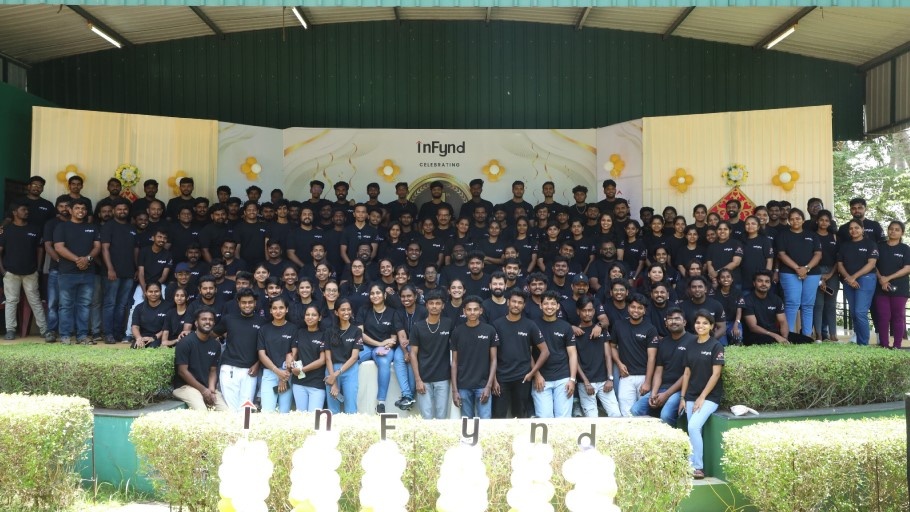
The anniversary account offers a small, unusually tangible look at the organization. Employees performed music and dance, played games and received awards with names including Everyday Champion and Laser Focus. LinkedIn places the business in the 51-200 employee band and lists locations in Bracknell and Coimbatore.
These celebrations offer a glimpse of company life rather than a complete account of working there. Still, the photographs supply a useful corrective to the frictionless language of data platforms. Behind the search fields are people whose work includes checking, researching, supporting customers and keeping records useful.
From finding the contact to doing the work
InFynd names Sony, Experian, Deliveroo, CV-Library, Britannia and Silvey Fleet among businesses it serves. Its current site claims more than 1,000 companies. These are company representations, but they show the breadth of the intended audience: recruitment platforms and commercial teams across several industries, rather than one narrow software niche.
Apollo.io and ZoomInfo are recognizable alternatives in the sales-intelligence market. InFynd’s distinction is the combination it emphasizes: tailored datasets, human verification, data maintenance and managed execution. Buyers can also assemble those functions internally or through separate suppliers. The decision turns on which work a team wants to own and which it wants delivered.
The group’s newer presentation extends that logic. It points to 27x.ai for sales and marketing agents and to Sentinel for continuous business monitoring. Sentinel describes watching companies, suppliers, regulations and news for changes. The homepage suggests a broader ambition to supply both the information and the work that follows from it.
That ambition has a practical limit. Better contact details cannot create a need for the product being sold. Automated follow-up cannot rescue an irrelevant offer. InFynd makes the most sense where a team understands its market but loses time to incomplete records, scattered systems or the labor of preparing outreach. Its value has to be judged in that daily work: fewer dead ends, more relevant people and a database someone can use with confidence.
Explore InFynd
Try the company website, explore healthcare intelligence, read the company blog or watch the InFynd 2.0 product preview.