Consider the smallest unit of business development: one person trying to reach another. Before the pitch comes a less glamorous task. Find the company. Find someone there. Find an address that works. Then decide what to say. Compilerx has built a business around shortening that sequence. Its product begins with company and contact data; its Chrome extension carries the work into the first draft of an email. The interesting thing is the distance between those two jobs.
- Search companies and domains, upload target accounts, and build contact lists.
- Use contact credits: the advertised entry plan is $49 with 3,000 credits a month.
- Add email verification and AI-assisted drafting, then check the results yourself.
A domain is a surprisingly useful starting point
Compilerx asks for something a salesperson may already have: a company name or website domain. From there, it offers professional contact details and company information. A user can upload target companies in bulk, search by industry, and sort contacts according to the availability of phone numbers or social profiles. The point is to turn an account list into people someone can actually approach.
That makes its intended customer fairly concrete. The published plans name startups, sales agents, business developers, marketers, entrepreneurs, and agencies. Picture a small agency with a defined list of prospective clients. Its immediate problem is getting from those businesses to relevant employees. Compilerx offers a way to do that research in batches, with list creation and downloads carrying the results onward.
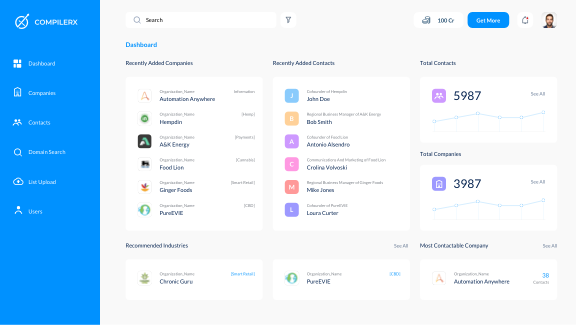
The homepage advertises more than 70 million B2B contacts with email addresses and more than 11 million global company profiles. Those are Compilerx’s figures. For a buyer, the useful test is narrower: whether the database covers the particular companies and roles that matter. A very large directory can still be a poor fit for a very particular market.
There are two ways into that task. A domain search starts with an account already selected; an industry search helps define a broader pool. For example, an agency pursuing a particular group of software companies could begin with its own list, while a business developer exploring a new sector could start with industry categories. These are different research questions. Compilerx puts both entry points in the same product, rather than asking every user to begin with a blank spreadsheet.
The attraction compared with doing each step manually is the concentration of work in one place. A researcher can otherwise spend time moving between a company website, professional profiles, a spreadsheet, and a writing tool. Compilerx’s proposition is to reduce that movement. Whether it improves the result depends on the audience and the quality of the records returned. A team with a tiny, carefully researched account list may gain less from bulk discovery than one repeating the process across many companies.
The man behind the list
The company identifies Joseph Ricard as the person behind Compilerx. He also founded Klizo Solutions, the development business named in Compilerx’s privacy policy and in its Chrome extension listing. The connection helps explain the product’s practical character: company research, bulk uploads, email checks, and drafting sit alongside one another as pieces of an outreach job.

Klizo was publicly discussing Compilerx as one of its SaaS products in February 2023. By June, its articles were describing both company-data research and AI-generated cold-email content. That pairing matters. A contact database answers whom to approach. A writing assistant helps with what to say. Putting them closer together makes the handoff shorter, even though the sender still has to supply a worthwhile reason for the conversation.
One credit. One contact.
Compilerx’s business model has an unusually legible unit. Its FAQ states that one credit corresponds to one contact. The homepage advertises a free trial lasting 14 days with 500 credits. Essentials is listed at $49 with 3,000 credits a month; Professional at $99 with 5,000. Larger companies and agencies are directed toward a custom Enterprise plan.
Monthly allowance
About $16.33 per 1,000 contacts if all credits are used.
Advertised website plans, checked October 23, 2026. Credits measure contacts, not replies or sales.At full use, the Essentials allowance works out to about 1.63 cents per contact. That calculation is simple; getting value is less so. A contact who sits outside the target market consumes attention as well as a credit. The sensible starting point is a sample of known accounts, with a clear idea of which roles would make the data useful.
The pricing cards also advertise bulk downloads and bulk company searches on the paid plans. Professional lists credit rollover. These details favor a buyer who already knows the shape of the research task. Collecting more records is easy to count. Deciding which records deserve action requires a definition of the customer.
The email still has to earn its place
CompilerX-GPT extends the idea into the browser. Its Chrome Web Store description presents an AI assistant for personalized emails and sales prospecting, with Klizo Solutions listed as developer. The listing records version 1.1.10 and an update in June 2024. Its role in the product is straightforward: help convert prospect research into a message without beginning every draft from a blank page.
“1 credit = 1 contact.”
Compilerx’s FAQ
The separate Email Verifier tackles another part of the sequence. Compilerx describes checks of address format, domain information, mail-server responses, and its professional-email database. Those are useful distinctions because an email can look plausible and still fail at delivery. An address that passes a check can also belong to someone who has no reason to buy.
Compilerx’s own privacy policy encourages users to cross-check records before important decisions. That is a useful operating principle for this product. Start with relevant companies, verify the person and role, review the generated message, and try a small batch. Track useful replies alongside delivery. If the sample misses the intended audience, increasing the volume merely makes the mismatch travel faster.
A second life for the same data
One revealing detail appears outside Compilerx’s marketing pages. AI Headhunter’s terms, dated May 2025, name CompilerX.com among enrichment providers used to append professional contact information for active recruiter accounts. Its privacy policy likewise identifies Compilerx as an enrichment partner. The same underlying task appears in a different setting: connect an existing record with information that makes the next step possible.
That places Compilerx in the market for B2B data and prospecting tools, with a browser-based writing assistant attached. Its appeal is a compact sequence: research, select, check, draft. Buyers can judge that sequence against their own workflow. The lesson worth copying is to make each handoff deliberate. Find a relevant person, establish why the conversation should happen, and give that person something worth opening.