Taylor Sterling's job is to make a complicated company fit inside a clear sentence. It sounds almost quaint. It is also one of the harder assignments in business. Products multiply. Audiences diverge. Every team arrives with a cherished noun. Before long, a homepage reads like the contents of a crowded garage: everything may be useful, but nobody can find the bicycle.
At Medbridge, where Sterling has served as Chief Marketing Officer since July 2022, the nouns are especially numerous. The company sells professional education, patient engagement, and digital-care software to organizations and individual practitioners. Marketing has to speak to institutions and people, to buyers and users, and to a market that rewards precision. Sterling's answer is not volume. It is architecture.
Her official biography says she is passionate about building teams and brands through crisp, differentiated narratives, then designing data-driven lead engines built for scale. Read slowly, the sentence contains a whole operating philosophy. First decide what the company means. Then build the human system that can say it consistently. Then make the commercial machinery repeatable. The story goes in front, but the plumbing matters.
A balance sheet for attention
Sterling studied finance at Santa Clara University from 1995 to 1999. She also co-captained the women's golf team, an early pairing of individual accountability and collective scorekeeping. Finance is not the obvious prelude to a marketing career, which is precisely why it is interesting. A balance sheet has no patience for decorative ambiguity. Eventually, the columns must meet.
The same discipline appears in serious marketing. A campaign can be elegant and still fail to create demand. A beautiful promise can become expensive if the product cannot keep it. Sterling's public record suggests an executive comfortable living between the sentence and the spreadsheet. Her preferred language combines brand awareness and customer experience with data, leads, scale, and results. She does not treat creativity and measurement as rival political parties.
Her career moved through Active Network, agency Babcock & Jenkins, BMC Software, and Cyan, Inc. At Cyan, public career summaries credit her with a major rebranding initiative. At Aurea Software, she rose to senior vice president of brand and customer marketing and built teams around end-to-end go-to-market work. The companies changed, but the assignment kept rhyming: take a layered technology business and give customers a clean door through which to enter.
The translation loop
- 01 / ListenStart with the customer's world, not the org chart.
- 02 / EditChoose the differentiated promise worth remembering.
- 03 / BuildGive teams structure to repeat the story well.
- 04 / MeasureTurn attention into a lead engine that can scale.
Learning the scale of a sentence
Aurea offered a concentrated lesson in portfolio storytelling. In a 2020 post, Sterling explained the company's subscription library by reaching for Netflix: one fee, a broad collection of enterprise software. The analogy did useful work. It replaced a thicket of product names with a familiar motion - subscribe once, discover more value over time. Marketing people talk endlessly about simplification. The craft lies in knowing what may safely be removed.
She next served as Director of Customer Marketing for Google Workspace. There, the canvas grew global. Customer marketing at that scale is less like broadcasting and more like translating in a railway station: different industries, regions, and use cases, all moving at once. A 2021 Google Cloud program placed Sterling among women across the organization reflecting on Women's Equality Day. Her contribution focused on opportunity, knowledge, and the women whose earlier work made present possibilities real.
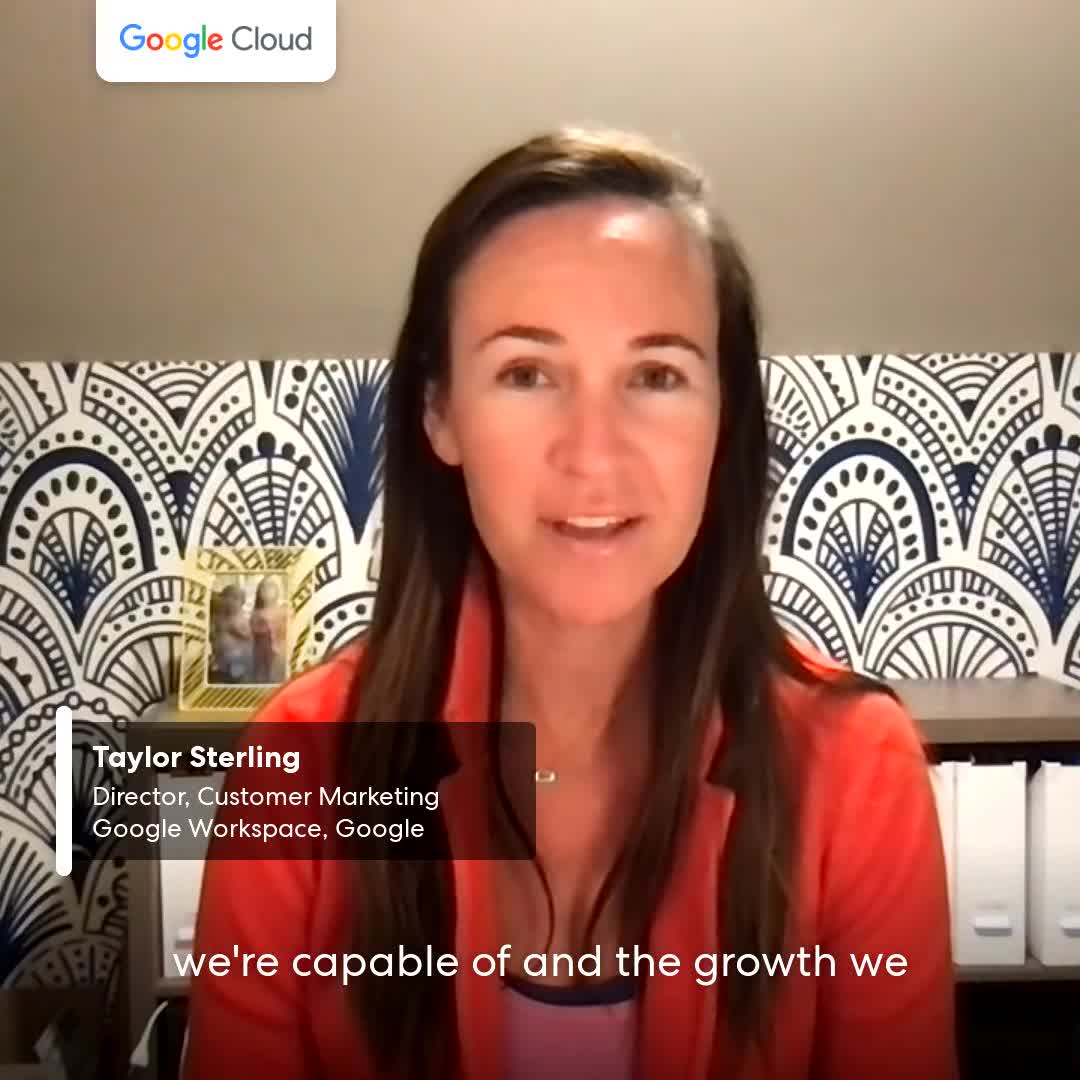
“I'm proud to be part of a company that shines a light on all the opportunities available to us.”Taylor Sterling, Google Cloud, 2021
It is a brief clip, but it reveals a theme that fits the later career: create the conditions in which other people can expand their range. Medbridge's current biography describes Sterling as bringing energy, vision, and structure to teams. A recommendation on her LinkedIn profile makes the same point more personally, praising her ability to maintain professionalism while lifting the energy of people around her during intense work. Structure without energy becomes bureaucracy. Energy without structure becomes a workshop full of sticky notes. The trick is the conjunction.
The rebrand behind the rebrand
Sterling arrived at Medbridge in 2022 as the company was broadening its leadership team and product ambitions. Two years later, the visible result arrived: a new identity, a rebuilt website, and upgrades across the product ecosystem. Corporate rebrands are often narrated as acts of spontaneous revelation. The people doing them know better. They are long negotiations about what a company has become, what it intends to become, and which parts of its past still deserve a key.
The Medbridge project had to join education and digital-care offerings without making either sound like an appendix. Sarah Jacob Singh, the company's product and technology leader, wrote that education and patient-friendly solutions were at the heart of the new identity. A Medbridge colleague later called the assignment a “monstrous rebrand” and thanked Sterling for trusting her to lead it. That detail matters. Executive credit is cheap; delegated ownership is an investment.
Sterling's own public reaction was compact: “Amazing group effort - very excited to have our brand reflect the progressive, modern company we are!” There is no victory lap in the wording. The group comes first, then the fit between company and expression. A rebrand succeeds when customers see the new mark and sense less distance between what a business says and what it actually does.
The website was only the public edge of that effort. Medbridge announced changes across its wider experience, asking one identity to carry an expanding set of capabilities without becoming vague. That is the sort of project that tests whether brand strategy can survive contact with navigation labels, product screens, sales conversations, and support language. A launch date draws a neat line on the calendar. The real achievement is getting hundreds of smaller decisions to point in the same direction before the curtain rises.
This is why the best brand work feels, in retrospect, almost inevitable. The logo is not a disguise. The language does not put a tuxedo on a confused product catalog. The company simply becomes more legible. Sterling's career across enterprise software prepared her for exactly this kind of editorial pressure: many capabilities, several audiences, one front door.
“Amazing group effort - very excited to have our brand reflect the progressive, modern company we are!”Taylor Sterling on Medbridge's 2024 rebrand
A CMO who prefers the work to the theater
Sterling keeps a comparatively narrow public profile. There is a LinkedIn presence, an official executive biography, several professional appearances, and a small trail of authored work. No lifestyle empire shadows the operating job. The restraint is refreshing. In a profession sometimes tempted to market its own marketing, her footprint points back toward teams, customers, and launches.
Even a public book recommendation stays close to the work. For a go-to-market reading list, Sterling chose Jim Collins's Good to Great, calling it a useful book about winning teams and strategy and saying it had influenced her. The choice is conventional enough to invite a smirk, but classics survive because managers keep finding new corners to dent. In Sterling's case, the emphasis lands on teams and decisions rather than charismatic performance.
That preference also explains the repeated pairing of narrative with operating structure. A crisp story is not a slogan handed down from the penthouse. It is a decision tool. It tells product marketers what to emphasize, demand teams whom to find, sellers how to open, and designers what to leave out. When those choices agree, a brand begins to behave like a company rather than a costume.
The useful thing to steal
Sterling's playbook can be reduced to three verbs: clarify, organize, compound. Clarify the promise until a customer can repeat it. Organize the team so quality does not depend on one heroic afternoon. Compound attention with a measurable system. None is glamorous by itself. Together, they turn marketing from a sequence of announcements into an institutional capability.
The order is important. Starting with the engine produces a faster distribution system for a muddy idea. Starting and ending with story produces a beautiful campaign that evaporates after launch. Sterling's career spans both sides: customer narrative at Google scale, portfolio marketing at Aurea, and a company-wide identity at Medbridge. She has repeatedly worked where the number of things a company could say exceeds the number of things a customer will remember.
A CMO cannot abolish that mismatch. She can choose with taste, test with rigor, and give colleagues a language in which good decisions become easier. The finished brand may look effortless. It is not. Elegance is usually complexity that somebody had the patience to edit.
For Sterling, the work continues from Portland, inside a company whose own name promises connection. The title on the org chart is Chief Marketing Officer. The practical assignment is older and more interesting: keep the promise clear, keep the machinery honest, and help the team arrive together.
Continue exploring