Insurance software lives in a universe of policy records, carrier connections, renewal clocks, quote workflows and payments. It is necessary, consequential and almost heroically resistant to cocktail-party conversation. Courtney Rains has made a career inside that problem. As chief marketing officer of Applied Systems, she must turn the invisible plumbing of an industry into something legible: a reason for an agency to change, a reason for a partner to connect and a reason for thousands of customers to meet in Las Vegas to discuss the software they use at work.
Rains is based in Atlanta, while Applied is headquartered in Chicago and sells into an insurance market that crosses the United States, Canada, the United Kingdom and Ireland. The geography suits the assignment. Her job is not to market a single shiny object. It is to give coherence to a network of products and people spread across offices, brands and borders.
The official description is tidy: she is responsible for Applied’s global marketing strategy. The more revealing detail is time. Rains joined the company in 2014, moved through senior communications and marketing roles, and was serving as CMO by the end of 2021. In technology, where leaders often change jobs before the conference lanyards have faded, a dozen years in one company creates a particular asset. She knows which language belongs to a passing campaign and which belongs to the institution.
A translator learns the machinery
Before Applied, Rains worked in technology marketing and public relations, including at Qualcomm. Her biography also emphasizes crisis communications, a discipline that rewards short sentences, accurate nouns and the useful habit of knowing what not to say. Those are sound instincts in enterprise software. Customers rarely need a metaphorical moonshot. They need to understand what will connect, what will change and whether the new workflow will survive Monday morning.
She had studied at the University of Notre Dame from 2005 to 2009. The path that followed was less a leap into insurtech than a steady accumulation of communications muscles: public relations, high-stakes messaging, marketing operations and then executive responsibility. At Applied, she served as senior director of marketing communications and vice president of marketing before taking the top marketing job.
That progression matters because the product story is cumulative. Applied began in a founder’s basement in 1983 and became a cloud-software business built around agency and brokerage management, quoting, payments, analytics and insurer connectivity. A marketer arriving for a quick turn might be tempted to sand away the old vocabulary. Rains instead used the company’s fortieth anniversary to frame its history as a sequence of “firsts,” then made collaboration the condition that produced them.
A brand transformation in this setting is less like repainting a shop and more like revising a map while traffic continues to move. Applied’s audiences include small agencies, large brokerages, insurers, software partners and the employees who build and support the products. Each group enters through a different door. The brand has to tell them they are in the same building without insisting they all came for the same reason. Rains’s solution has been to keep the destination broad - a more connected insurance business - while letting the practical benefits remain specific.
That balance can be seen in the nouns surrounding her work. Applied talks about cloud platforms, analytics, digital payments and automation. Rains’s own framing frequently supplies the verbs: learn, safeguard, connect and grow. Nouns inventory a portfolio; verbs give the customer a part to play. It is a small grammatical distinction with strategic consequences. The company becomes less a cabinet of software and more a set of actions that agencies and insurers can take together.
“These firsts didn’t happen by accident.”- Courtney Rains, on Applied Systems at 40
It is a compact line with a useful refusal inside it. Innovation is not magic, and a software company does not advance alone. In Rains’s account, progress came from thousands of people with different backgrounds, companies and experiences. The hero of the story was the network.
The conference is the brand in public
The same idea becomes physical at Applied Net, the annual gathering produced with Applied Client Network. The conference is where customers compare workflows, partners exhibit products, executives announce investments and colleagues discover that the person behind a support ticket has, reassuringly, a face. Rains has called it Applied’s pinnacle event and “a great collaboration with our Client Network.”
The 2022 edition was the first in-person gathering after a long interruption. More than 4,000 attendees returned for four days containing 240-plus educational sessions, 85 exhibitors and 250 speakers. The event received a bronze honor in the in-person conference and seminar category at the 65th annual Insurance Marketing and Communications Association Showcase Awards. Those numbers reveal the scale of the coordination problem.
A conference is also an unusually honest marketing instrument. A slogan can be approved in a quiet room. A gathering must work in public, on schedule, for people who know the product well enough to notice evasions. Rains’s writing about Applied Net is bright and conversational - she is willing to use a Vegas joke - but its underlying promise is practical: learn something, meet someone, return to the office better equipped.
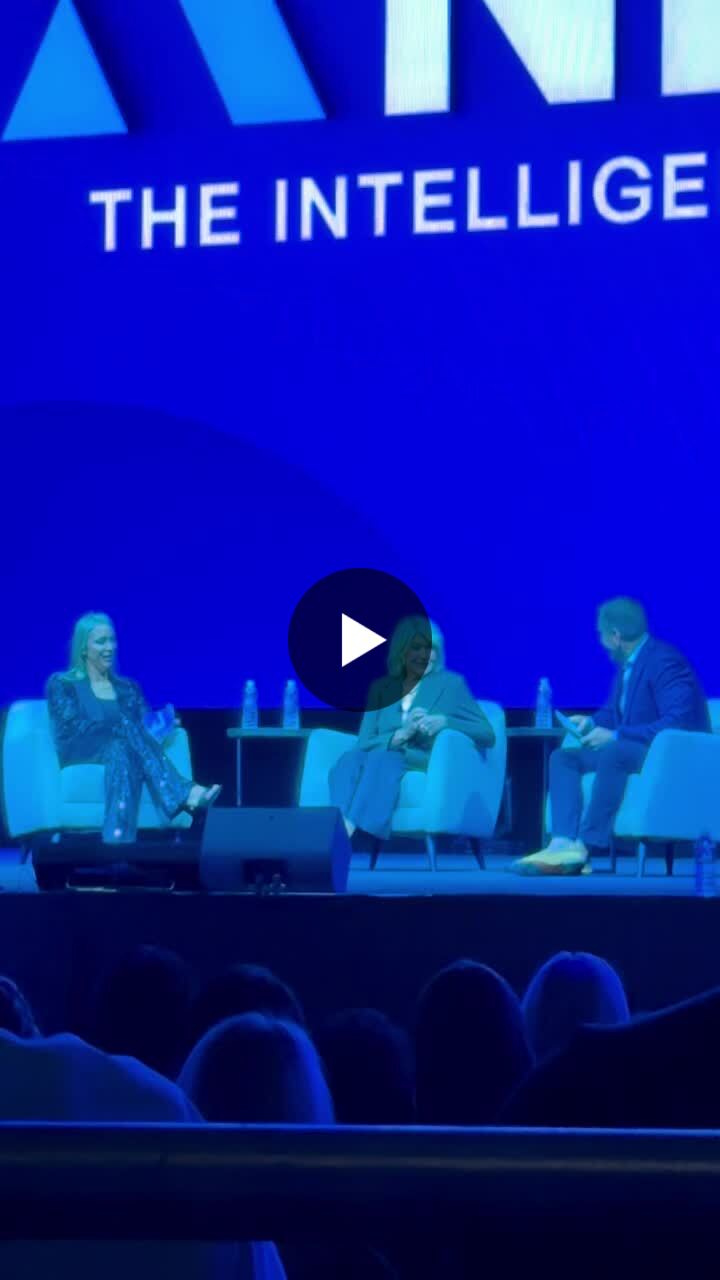
By 2025 the event theme was the “Intelligent Insurance Era,” with AI, data and connectivity at the center. Onstage, Rains joined then-CEO Taylor Rhodes and Martha Stewart for a fireside conversation. Reports from the room emphasized authenticity, product knowledge and the instruction to learn something new every day. It was an entertaining pairing, but also a neat expression of Rains’s job: place a familiar cultural figure beside a technical company and find the shared language without making either one sound borrowed.
The human voice in the technical room
Rains’s public work is often about creating rooms, literal or otherwise. In December 2021, she joined Applied Client Network chief executive Brian Langerman on the Re:Applied podcast to discuss industry trends and what agencies and brokerages could expect in the coming year. Three years later, she announced that the Insurance Technology Podcast was adding video. Her rationale was almost comically human: host Reid Holzworth was engaging and unpredictable, so audiences ought to be able to watch him as well as listen.
The post highlighted conversations with founders, executives and industry commentators, including a founder who had recently taken up tap dancing. That detail is not incidental. Technical marketing often flattens people into titles and companies into capabilities. Rains’s editorial instinct runs the other way. The leadership story gets a cattle ranch. The founder gets tap shoes. The technology remains present, but it is no longer asked to carry the whole conversation.
Her role also extends beyond launch copy and event stages. Rains serves with the Georgia Chapter of the Insurance Industry Charitable Foundation, whose local grantmaking supports organizations working with homelessness, children at risk and veteran causes in the Atlanta community. She has also represented Applied on the Big “I” Diversity Council, a group focused on building a more sustainable and diverse independent-agency network.
These affiliations sit naturally beside the public language of her corporate work. Insurance is an industry organized around networks: agents, brokers, carriers, clients, vendors and associations. Rains does not describe innovation as a lone inventor’s thunderbolt. She describes people getting connected and then getting useful things done.
The advantage of staying for the next chapter
Applied’s business has changed around her. The portfolio grew, the company’s leadership evolved, and artificial intelligence moved from a specialist topic to the front of conference programs. Yet Rains remains on the global leadership team in 2026. Longevity does not guarantee judgment, but it gives judgment more material. She has seen the company before and after its brand transformation, through remote and in-person events, and across successive versions of the digital-insurance promise.
Her most durable contribution may be a kind of narrative continuity. Insurance technology will always produce new nouns. The customer’s questions change more slowly: Will this save time? Will it connect to the systems already in use? Will the company behind it understand the work? A CMO can chase each new term or keep translating it back to those questions.
Rains appears to prefer the second approach. Even her most future-facing material keeps returning to the same social verbs: learn, connect, collaborate, grow. There is no mystery in them. That is precisely their value. The software may be elaborate; the point of it should not be.
“Forty years in, our belief that we are on the cusp of the next great leap has never been truer.”- Courtney Rains
Marketing can make the future sound inevitable. Rains’s work is more interesting when it makes the future sound collective. Her version has customers in the sentence, partners in the room and colleagues behind the firsts. For a company selling the connective tissue of insurance, that is not merely a pleasant tone. It is the product argument, made human.