Enterprise software has a storytelling problem. Its most consequential virtues are usually invisible: the database that reconciles cleanly, the integration that survives a change upstream, the policy rule that fires before a small error becomes an expensive one. Buyers are asked to admire architecture while imagining the Tuesday afternoon it is meant to improve. Amede Hungerford has made a career in that gap, translating systems into decisions.
His path to the chief marketing officer's chair began with a B.S.E. in electrical engineering at Duke University. The degree is more than an unexpected line in a marketing biography. It is a useful way to read the work that followed. Hungerford's career moves through Hewlett Packard, Sybase, Intuit, FICO, NetSuite, Boomi, K2, Reflektion, Redwood Software and BriteCore. The categories vary, but each company sold a complicated change to people who could not afford for it to fail.
The marketer in that setting is part translator, part systems designer. Product, sales, partners and customers each hold a different piece of the circuit. If the handoffs are poor, the market hears static. Hungerford's public record is unusually consistent on this point: understand the buyer journey with customer-facing teams, give partners a practical role, build demand as an operating capability, and make the product's value legible in the work customers already do.
“B2B marketers should wish for a data-centric approach to delivering a differentiated customer experience.”Amede Hungerford, 2016
01 · The early cloud yearsWhen partners became part of the product story
By 2013, Hungerford was NetSuite's vice president of partner marketing. Cloud business software was maturing, but reaching buyers still required accountants, resellers, consultants and specialists who could connect a general platform to a particular company. That year, NetSuite's channel sales grew 50 percent in the first quarter. An industry profile attributed much of the momentum to Hungerford and his team, who oversaw partner recruitment, enablement and management.
The detail matters because partner marketing is easy to misread as promotion by proxy. In enterprise software, a partner is often the person who makes an abstract platform local. They know the vertical, the workflow and the suspicious question a buyer asks after the polished demo. Managing that network is less like buying reach and more like designing an interface.
Hungerford left NetSuite in October 2015. In 2016, Dell Boomi named him chief marketing officer. Boomi sold integration: the connective tissue between applications and data. Its product sat behind the scenes, making an increasingly cloud-heavy business behave as one business. The marketing assignment was wonderfully circular. He had to connect the company that sold connection.
At Boomi, Hungerford built a global marketing organization and digital demand-generation capability. He also wrote about integration and API management, spoke about customer journeys, and convened a global ecosystem at Boomi World. In one discussion of digital experience, he described marketing leaders working directly with customer-facing sales leaders to understand the buyer journey. It is the sort of sentence that lacks fireworks and contains an operating manual.
02 · Faster rebuildsA brand refresh on an operator's clock
In 2018, Hungerford joined K2, the low-code process-automation company, as CMO. The announcement credited his Boomi team with dramatically scaling the integration-platform business and said he had experience helping SaaS companies grow through the range from $100 million to more than $750 million. His stated ambition at K2 was concrete: scale the marketing team and build campaigns that could land the company's story around the world.
A year later, he moved to Reflektion, an AI-powered retail-personalization company. Here the language changed from connecting applications to recognizing shoppers. The commercial problem remained familiar. Retailers had data and recommendation engines; the prize was a coherent experience for an individual moving through search, product pages and email.
A public recommendation from a Reflektion colleague supplies a rare glimpse of Hungerford's first weeks on the job. The company had a sparse marketing team and no sturdy demand program. Within 60 to 90 days, he hired four team members, organized a sales kickoff, refreshed the brand and laid the foundation for its first account-based marketing program. The sequence is revealing. People, sales alignment, identity, demand. Strategy arrived with a calendar attached.
One career, four versions of the same knot
Make partners effective; make scattered data behave as one system.
Turn process design into a platform story the market can repeat.
Translate AI and automation into individual experiences and dependable operations.
Give regional carriers a credible path beyond legacy core systems.
Redwood Software came next. As CMO, Hungerford worked on a broader automation proposition spanning IT, finance and business processes. In 2021, Redwood announced a €315 million strategic investment from Turn/River Capital. Hungerford described himself as proud of the team's platform and its impact on thousands of customers around the world. Another company, another invisible machine, another effort to make operational plumbing worthy of attention.
03 · Insurance's expensive pauseThe case for changing the machine underneath
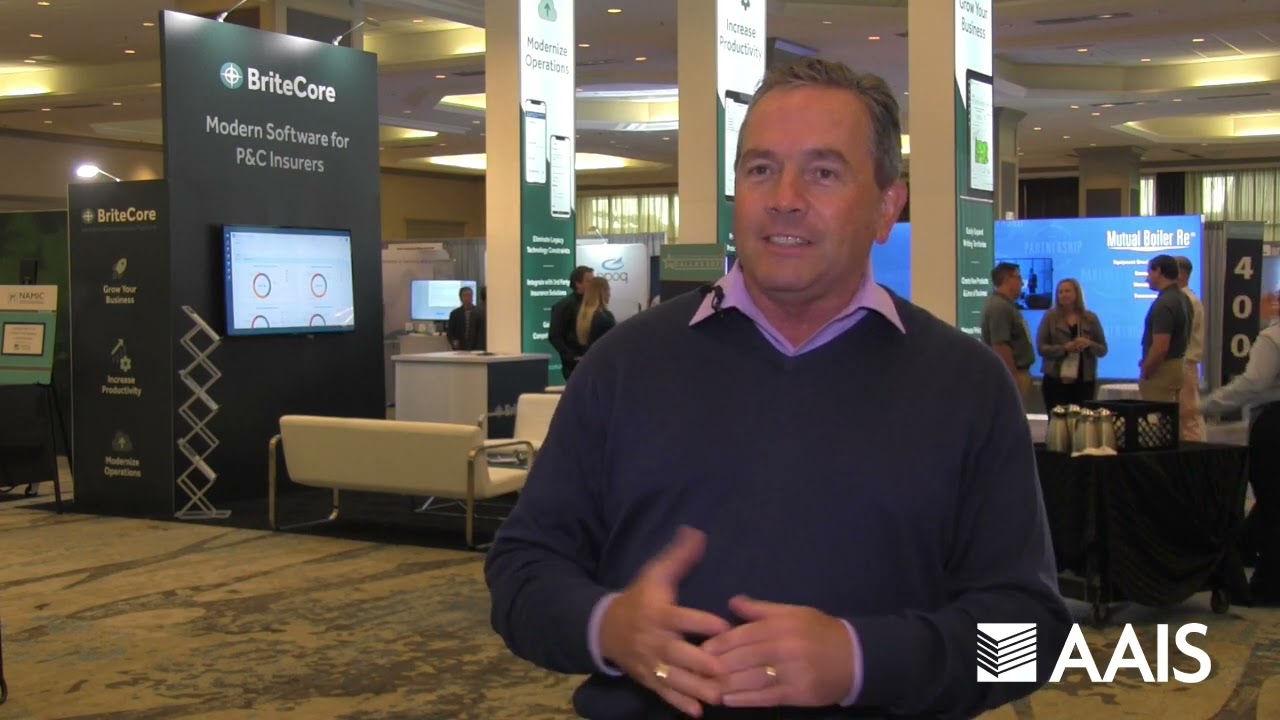
BriteCore appointed Hungerford CMO in January 2022. His remit covered demand, market awareness, product marketing, strategic events and communications. It now includes alliances. The company provides a cloud-native core platform for property and casualty insurers and managing general agents, spanning policy administration, rating, billing, claims, documents, analytics, and portals for agents and policyholders.
Core insurance software is a particularly unforgiving place to practice translation. A carrier can dislike a legacy system for years and still fear replacing it more. Policies renew. Claims arrive. Regulators expect records. Agents need answers while the grand transformation is still on slide 43. Hungerford has framed the obstacle plainly: long implementations and high-priced technology choices can make doing nothing appear reasonable.
“For too long, insurers have faced long implementations and high-priced technology options to accomplish their modernization goals.”Amede Hungerford, joining BriteCore
His response is to move the conversation closer to operations. In a 2023 session with mutual-insurance executives, reports were described as the record of what happened, dashboards as a view of what is happening, and analytics as a tool for understanding why. Hungerford added a modest but important use: dashboards can help with auditing. The observation puts the glamour of visualization back in its proper place. A graph earns its keep when it improves a decision or a control.
The same practicality shaped his later public sessions on automation, AI and analytics. The themes are familiar to any insurer: reduce manual tasks, improve communication with agents and policyholders, start with useful measures, and apply new technology where it changes the work. In December 2025, he was listed for a BriteCore session on valuation at scale, joining an insurer and a valuation-data partner to discuss underwriting speed, accuracy, governance and future predictive use.
04 · The durable ideaCustomer experience happens in small moments
At ITC Vegas in October 2025, Hungerford joined a Stripe-presented fireside chat called “Winning the Moments That Matter.” The premise was almost domestic in its scale: loyalty can turn on a payment that works, a renewal that arrives without friction, or another routine interaction that does not make a policyholder reconsider the relationship. Infrastructure becomes experience one small moment at a time.
That thought links the chapters of his career. Integration matters when a person does not have to repeat information. Automation matters when a team can spend less time moving a task and more time resolving it. Personalization matters when relevance survives scale. A modern insurance core matters when agents and policyholders can complete ordinary work without learning the eccentricities of old software.
There is an appealing lack of romance in the assignment. Hungerford's public remarks favor journeys, operating teams, ecosystems, dashboards and implementation constraints. Colleagues describe a strategic thinker who executes quickly, collaborates across departments and mentors generously. Those traits fit the résumé. He repeatedly enters categories where the product is complex, the buyer group is broad and the cost of confusion is high.
His professional community extends beyond the companies on that résumé. Hungerford has served on the board of the Software & Information Industry Association's Software & Services Division since 2016. His appearances range from SIIA's TechChat to insurer webinars where the guests, rather than the host, carry most of the expertise. Moderating well is its own form of product thinking. The useful question opens a path; the host keeps the path clear; the audience leaves with language it can use. It is also a neat summary of the alliances role now attached to his BriteCore title.
The engineer became a marketer, but the engineer's question appears to have stayed: where does the signal break? At BriteCore, the answer may sit between a carrier's appetite for modernization and its memory of every technology project that ran long. Hungerford's job is to make the route across that gap credible. Not by making the software sound simple, but by making the choice easier to understand. In consequential software, clarity is an operating feature.