The most revealing object in BriteCore's history may be a multipart carbonless insurance form. At Bremen Farmers Mutual in Kansas, employees once printed those forms, tore off the perforated edges, separated the copies, organized the stacks, filed one set and mailed the rest. A web quoting tool was supposed to help. Instead, because it did not talk to the old policy system, staff maintained two rating engines, rekeyed data and waited for an overnight exchange. The agents' screen was always one day behind.
This is the unphotogenic problem BriteCore sells against. The San Mateo company provides the operating system behind a property and casualty insurer: define a product, calculate a rate, issue and change a policy, send a bill, record a payment, process a claim, generate documents and show the useful parts to agents and policyholders. Reporting, portals, mobile access and integrations sit on the same cloud platform. In 2026, eight AI copilots joined the machinery.
The buyers are not consumers shopping for coverage. They are the carriers and managing general agents that manufacture it - especially mid-sized North American firms wedged between local knowledge and aging software. BriteCore says more than 100 insurers use its platform. That is modest beside the giants of enterprise software, but meaningful in a market where switching the core resembles replacing a building's plumbing while the tenants keep showering.
The product started as a customer meeting
In 2009, six P&C insurers partnered with Intuitive Web Solutions, the software company run by brothers Phil and Chris Reynolds, to build a web-based insurance processing system. An archived customer newsletter supplies the useful grit: after another vendor failed to connect an existing rating engine to new quoting software, the IWS team built a rating engine from scratch. BriteCore launched in 2010.
That founding arrangement mattered. Instead of guessing what an insurer needed, the developers had six design partners with live policies, awkward exceptions and regulatory obligations. The result grew from policy administration into billing, claims, documents, reporting, analytics, agent and policyholder portals, and a marketplace of third-party connections.

“Our agents went from paper to online in a single day.”Jason Buchek, Alamance Farmers' Mutual
The company is now led by CEO Ray Villeneuve; both founders remain board members. BriteCore raised $47.5 million in 2019 from Warburg Pincus, Radian Capital and WCF Mutual Insurance Company, then added a $20 million Series C in 2021 led by Warburg Pincus. BriteCore said at the time that total capital raised had reached roughly $83 million. It does not publish pricing or a valuation. The supplied company data estimates annual revenue at $12.3 million and headcount near 90, neither publicly confirmed.
What the software actually replaces
A policy administration system is not simply a database of customers. It contains the rules that turn a filing into a quote and a quote into a contract. BriteCore's low-code tools let trained carrier teams define coverages, rates, fees, underwriting rules and forms. Policy management handles the lifecycle from quote and bind through endorsement, renewal and cancellation. Billing supports direct, agency, mortgagee and split-payer arrangements. Claims keeps notices, reserves, payments, documents and activity together.
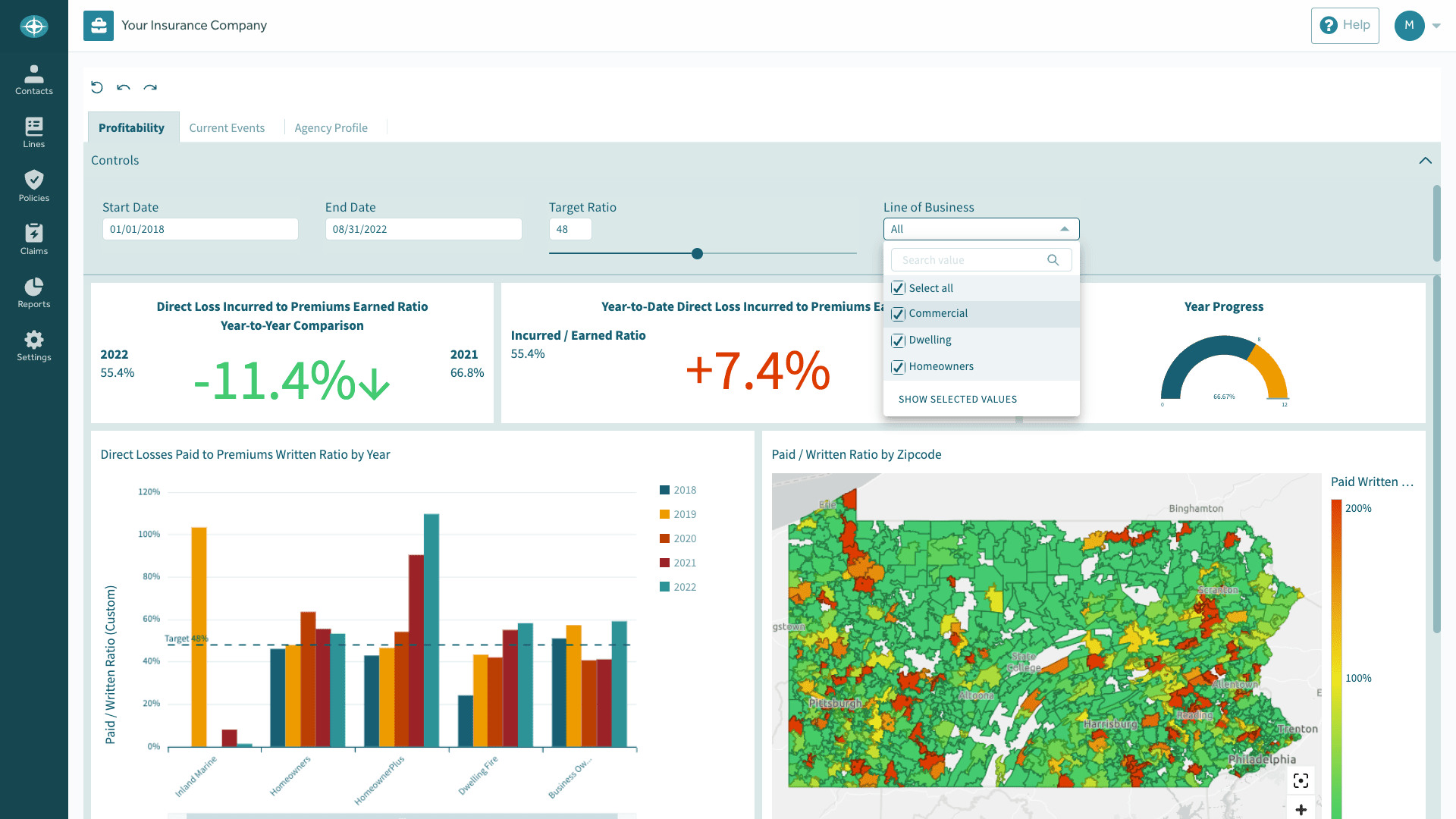
Agents get web access to quotes, policies, billing, claims and documents. Policyholders can pay, enroll in autopay, go paperless, upload property photos, file a first notice of loss and retrieve documents through branded web or mobile portals. Larger or more digital carriers can build their own experiences against published APIs while leaving the transaction engine underneath.
From handoff pile to one shared record
The business model is subscription software plus the practical work around it: implementation, data conversion, configuration, integration, training and support. BriteCore delivers managed releases rather than selling periodic upgrades. In 2026 it described a biweekly release cadence. That keeps customers on a current platform and reduces version fragmentation, although carriers still need testing, governance and change management. “No upgrade project” is not the same thing as “no work.”
A buyer is therefore pricing two things at once: the contract and the operating model it replaces. The contract is negotiated and varies with modules, conversion and services. The incumbent cost hides in duplicate entry, paper, postage, hardware, one-off interfaces, outside report requests and the people needed to nurse a batch process through renewal season. Bremen's 15-fold reduction in printing and postage is useful because it names one line item. The larger calculation is whether staff can spend less time moving data and more time underwriting, serving agents and handling claims.
Scope matters. A carrier can use BriteCore as an all-in-one suite, but “all in one” does not mean every specialist disappears. Property valuations from e2Value, loss history from LexisNexis, payments, accounting, inspections and flood tools still enter through integrations. BriteCore is trying to own the coherent transaction record while partners supply narrower intelligence and services. That division is sensible when the interfaces are maintained. It becomes another patchwork when integration ownership is vague.
The receipts - and the fine print
BriteCore's strongest evidence is not a feature matrix. It is the before-and-after detail in customer stories. Bremen Mutual says one system eliminated duplicate rating, reduced printing and postage costs by a factor of 15, and let a team two-thirds its former size support the same premium volume. After a derecho produced more than 1,200 claims in days, its two-person claims team handled the surge without reinforcements.
East Tennessee Mutual had a different breaking point. Its renewals started a month early, agents had no system access, claims lived partly in spreadsheets, and management reports hid the detail. A heavy catastrophe overwhelmed the old core and changed the board's mind. The carrier implemented BriteCore before that year ended. It later expanded its agent network, completed two mergers and reported nearly tripling direct written premium. Technology did not cause every dollar of growth, but it removed a visible constraint.
Alamance Farmers' Mutual offers the implementation lesson. It wanted by-peril rating and access for independent agents. The carrier worked with BriteCore and rating organization AAIS, dedicated internal resources, divided the project into phases and set intermediate milestones. It reported 20 percent policy growth in an expanded territory. The software mattered; so did the unglamorous choice to give the project owners and calendar space.
The AI move is unusually specific
In May 2026, BriteCore launched copilots for submission intake, policy summaries, claim summaries, invoice explanations, documents and forms, rate changes, rules, and reports. The narrowness is a virtue. “Explain this invoice” and “turn this submission into structured fields” are measurable jobs. BriteCore says its intake copilot can reduce manual intake work by 80 to 90 percent, a vendor claim that buyers should test with their own messy documents.
The architectural pitch is that AI sits inside governed workflows rather than floating above them in a chat window. Native and third-party agents connect through managed Model Context Protocol services, with authentication, access controls, rate limits, audit trails and human review. Sensitive workflows remain in the carrier's environment while outside models are used selectively. BriteCore currently cites Anthropic's Claude Sonnet and says the model layer is designed to change.
The best AI feature may be the least cinematic one: making an insurance invoice understandable.
Where BriteCore fits - and where it does not
Guidewire, Duck Creek, Majesco, Insurity, OneShield, Sapiens, Socotra and EIS all compete somewhere in the core-platform market. BriteCore's wedge is a unified, configurable system for the middle: more insurance depth than a generic workflow tool, less organizational theater than a sprawling enterprise replacement. It adds reach through integrations for payments, accounting, property valuation, loss history, inspections, flood risk and claims intelligence.
The company backs that position with operating markers rather than consumer-style scale. Its site reports 99.99 percent uptime over the latest rolling year, 520 enhancements in 12 months and 291 core modules deployed in the cloud. It says 40 percent of the organization works on research and innovation. In July 2026, the platform won the SIIA CODiE Award for Best FinTech Solution. Awards are not a migration plan, but the release volume explains BriteCore's cultural promise: customers are buying a moving service, not a version number preserved in amber.
| Good conditions | Bad conditions |
|---|---|
| North American P&C carrier or MGA | Business outside property and casualty insurance |
| Leaders willing to simplify workflows | Every legacy exception is treated as sacred |
| Named experts for data, rules and testing | Modernization is delegated entirely to the vendor |
| Preference for managed cloud releases | Hard requirement for on-premise deployment |
The approach will not work by procurement alone. A carrier has to clean data, resolve contradictory rules, map integrations, train users and decide which old habits deserve to survive. Low-code configuration helps only when someone owns the product decisions. Continuous releases help only when the organization can absorb change. And an all-in-one platform can reduce vendor sprawl without eliminating the need for specialist data and service partners.
The five-part BriteCore playbook
- Recruit design partners who share one expensive, recurring workflow.
- Build the system of record before decorating the customer experience.
- Make common changes configurable and reserve code for genuine differentiation.
- Break migration into owned phases with measurable operating outcomes.
- Use APIs and partners at the edges, while keeping the core data coherent.
BriteCore's mission is to help P&C insurers grow, raise productivity, build strategic value and improve customer experience. The more interesting observation is smaller: old insurance software fails in queues. A rate change waits for a programmer. A quote waits for an overnight job. An underwriter waits for loss data. A policyholder waits for a bill explanation. BriteCore's product strategy is to shorten those queues without forcing a mid-sized carrier to become a software company.
That is not a glamorous category. It is, however, a durable one. Weather keeps happening. Policies keep renewing. Checks still have to balance. The winner is rarely the platform with the loudest launch. It is the one that lets a two-person claims team face 1,200 files on Monday morning and get to work.