Ten days is a peculiar unit of ambition in insurance technology. It is long enough to fill a calendar with meetings. At Hayes Parsons and its sister business Admiral Marine, Genasys says it was enough to get a yacht insurance product ready for sale. The assignment included rating, referrals and policy documents. A working insurance product has considerably more underneath it than a cheerful button marked “buy”.
That example captures the appeal of Genasys, a software company selling to an industry where a new commercial idea can become an administrative burden before anyone collects a premium. Its proposition is practical: give insurers, managing general agents and brokers a configurable system for the work behind the policy. Then let them change their products without commissioning a fresh software project every time.
First, put the boat in the water
The yacht project started with preparation. Admiral Marine supplied specifications, existing customer journeys and research. Genasys sent pre-sales manager Herman Nel to work alongside the team for five days, followed by remote refinement. Templates supplied a starting point; people in the room supplied decisions. The published case study describes a ten-day result, including legal expenses cover, onboarding and automated rating.
“I’ll admit we were a little sceptical.”James Woollam · Managing Director, Hayes Parsons
Woollam’s admission gives the story its tension. Delivery changed the customer’s view. The useful lesson is specific: prepare the brief, bring decision-makers close to the build and teach the customer while configuring. A shorter queue for decisions can matter as much as a shorter queue for developers.
One product. Defined scope. Customer and vendor working together.
A garage with a very particular customer
Genasys began in Cape Town in 1997, when Steve Symes was engaged by a European insurer to build a customer-centric administration system for distributed agents. He worked from his garage. The company says its name grew from “Generating a System”, a piece of naming logic with the literal-minded charm of a software engineer.
Its anniversary history dates its first product, Customer of One, to 2001 and the opening of its UK office to 2019. That chronology matters. Genasys had spent years dealing with insurance administration before no-code became a fashionable way to describe software. Today’s offer rests on accumulated knowledge of what insurance businesses need to record, calculate, collect and explain.
The company now operates across the UK and South Africa. Its origin also explains an enduring emphasis: the customer should be visible across the system, with insurance records serving that relationship. It is a more demanding ambition than putting an old form on a new screen.

The policy has a life after checkout
The main Genasys platform combines policy administration, claims and billing. Its customers buy operating software. Policyholders encounter the consequences through buying journeys, documents, payments and claims. Named users include Simplyhealth, King Price, Hamilton, GuardRisk, Arma Karma and Hayes Parsons, a spread that makes more sense once Genasys is understood as infrastructure for insurance businesses.
Its policy tools cover new business, adjustments, cancellation and renewal. The no-code builder provides configurable quote-and-bind journeys, and the company advertises more than 350 preconfigured products. Those templates give teams something to adapt rather than an empty screen. Specialist insurance knowledge still determines whether the resulting product makes commercial sense.
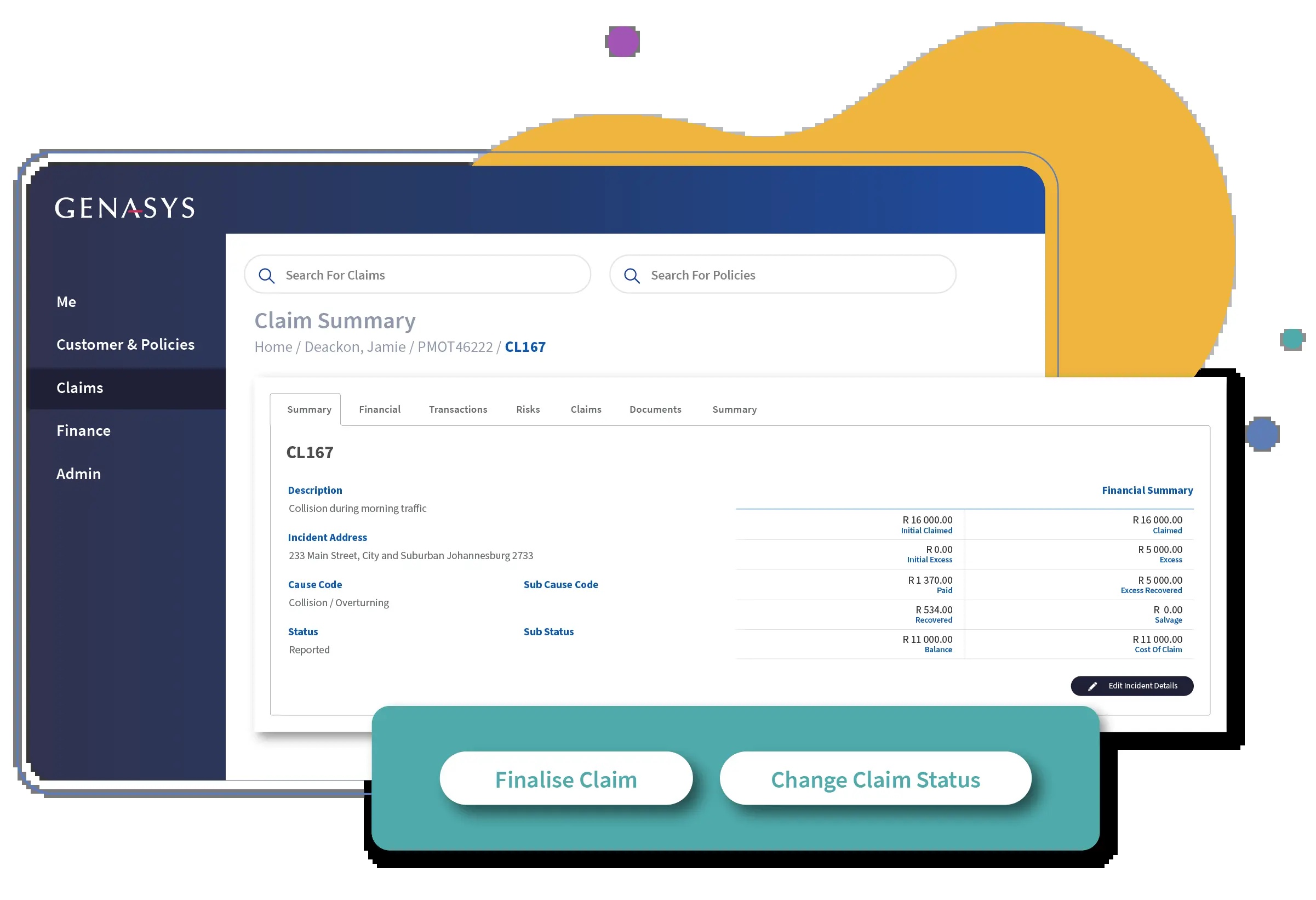
The mundane details are the point. A customer changes cover halfway through the year. A renewal needs new documents. An application needs referral rather than an automatic acceptance. Genasys gives those events a place in the system. The value becomes clearer when considering a policy’s full working life, rather than its first successful sale.
Billing is part of the product
Genasys’s billing and finance tools handle premium collections, commissions, taxes and claims payments, with information mapped into a general ledger. It is a reminder that insurance software must follow the money as carefully as it follows the customer. A policy can be beautifully presented and still create an awkward afternoon for the finance team.
This is where a combined system earns attention. The same business event can affect cover, documents and accounting. Making those records agree reduces the need for staff to reconstruct the story across separate applications. For brokers and MGAs, whose operations involve other parties and their reporting requirements, that consistency is a commercial consideration.
The purchasing question is therefore broader than whether a product can be launched quickly. Can the team administer it comfortably after launch? How will commissions reconcile? Where will the transaction history live? Those are sensible demonstration questions, grounded in the functions Genasys sells.
Six weeks bought King Price some confidence
King Price’s experience offers another version of the speed story. In Genasys’s account of the project, the insurer’s older AS/400 system had become restrictive: newer functionality, integrations and rule-based automation were difficult to achieve. What failed first was its ability to keep pace with the business.
In 2019, King Price began testing Genasys with an engineering insurance product. That initial deployment took six weeks, according to the case study. The distinction matters: six weeks refers to a first product, not proof that every insurer can move an entire business in that period.
The broader migration used staged work, mapping heavily used parts of the old system and testing before live transfer. The practical sequence is worth copying: choose a bounded test, check the result, then expand. A launch proves that something can run; migration testing helps establish whether existing records and everyday operations will survive the move.
A million plans need a different clock
Simplyhealth supplies the counterweight to any impression that all insurance change should fit into a fortnight. Its April 2022 announcement described a multi-year programme to migrate more than a million health plans to Genasys’s platform, then called SKi. The brief included a central policy system that could connect with other partners and improve interactions for corporate customers, employees and consumers.
By July 2025, Genasys was reporting that more than 80% of Simplyhealth claims were processed without human intervention. It also reported a 28.6% year-on-year reduction in claims-related operating expenditure. These are company-reported project results, rather than a forecast for the next buyer.
28.6% lower claims-related operating expenditure, year on year. Results reported by Genasys.
The underlying problem had been a manual, resource-intensive claims process. Automating routine work offers a straightforward benefit: fewer ordinary cases waiting for someone to move them along. More complex cases still require attention. For a prospective customer, the relevant comparison is its own claims mix and process, not the most attractive number in another company’s success story.
Leave room for the tools people already use
Genasys advertises more than 450 documented API endpoints. In ordinary language, these are ways for other software to exchange information with the core platform. Its integration material describes real-time and batch connections, alongside examples involving Flowgear, Experian and Microsoft Power BI.
A July 2024 partnership with Web Connectivity Limited adds a more specialised example: messaging and integration expertise for the London insurance market, including ACORD messaging. The logic is to connect with the wider industry’s working arrangements.
This helps define Genasys’s competitive position. It combines a core system with the ability to connect outside services. Buyers considering alternatives such as Guidewire, Duck Creek, Sapiens or Majesco need to compare the actual product line, geography and operating requirements. Genasys describes its target as the mid-market. That positioning is a statement of intended fit, not evidence that one platform wins every comparison.
The invoice includes the work around the software
Genasys’s MGA product page describes an initial setup charge and monthly licence fee, typically based on gross written premium processed. Its current FAQs also identify users, transaction volumes, integrations and migration scope as pricing factors. The business model is recurring software revenue attached to a scoped customer engagement.
Those variables explain why the practical cost question begins with the business being moved. A new product and an existing book bring different work. Buyers should distinguish setup, recurring charges and continuing integration requirements when assessing a proposal. A faster configuration exercise does not make data preparation or staff time disappear.
The company’s service offer includes enhancements, incident handling under service-level agreements, training and software upgrades. That ongoing relationship is part of what customers are buying. The no-code promise shifts some work towards configuration, while support and insurance expertise remain part of the delivery.
Growth needs people who can deliver
In December 2021, Genasys announced R260 million from Frog Capital. Management retained operational control under the announced arrangement. Expansion of its South African technology capability was part of the plan. The investment was a bet on taking an established insurance software business into a larger market.
The operating demands are visible in its recent appointments. In May 2026, former By Miles COO and buzzvault founder Becky Downing joined as COO, responsible for delivery, customer success and operational scaling. Hugh Hessing and Gavin Routledge had joined the board as non-executive directors the previous month.
Public recruitment material emphasises accountability and honesty, with hybrid roles in London and South Africa. Such statements describe the intended culture. The harder test is whether a growing business can keep providing the close working relationships its customer stories celebrate. Hiring operational leadership makes that an explicit responsibility.
Even the joke acquired a delivery date
Genasys has found an unusually literal way to make insurance approachable. In 2024, it promoted a fictional insurance management game for April Fools’ Day. In July 2026, Insurance Simulator 2026 became real, available to play in a browser for free. Marketing executive Ed Halsey later described the late-night work behind it, drawing inspiration from games about management, paperwork and deduction.
The joke fits the business. Insurance becomes more interesting when the machinery is visible: what gets accepted, what gets paid, which decisions create trouble later. Genasys’s commercial challenge is to make that machinery easier to operate at a scale customers can afford. Its most useful demonstrations begin with a particular problem and end with people doing the work differently.