Most people encounter an insurance company at two emotionally inconvenient moments: when a bill arrives or when something has gone wrong. Majesco works several floors beneath those moments. Its software creates the policy, calculates the premium, sends the bill, routes the claim, pays the distributor and tells the underwriter what deserves another look. It is the kind of machinery nobody posts about when it works and everybody notices when it does not.
That makes Majesco an unusually useful company to study. Its product is not a shiny app laid over a simple database. It is a replacement nervous system for businesses built from decades of rules, state filings, actuarial tables, broker relationships and old code. The company sells policy, billing and claims systems for property and casualty insurers; another core for life, annuity and health; digital portals; underwriting and distribution tools; loss-control surveys; analytics; and, since buying Vitech in January 2026, pension and retirement administration.
The corporate lineage begins with Mastek, founded in India in 1982 by Ashank Desai, Ketan Mehta and R. Sundar, with Sudhakar Ram joining the early team. The U.S. subsidiary Majesco Mastek arrived in 1992. Insurance software was later separated under the Majesco name, merged with Cover-All in 2015 and became a U.S.-listed company. That history matters because Majesco did not wander into insurance after building a generic workflow tool. It accumulated the industry's exceptions first.
The $729 million permission slip
The plot changed in 2018, when software executive Adam Elster became chief executive and pushed the company toward cloud delivery. It changed faster in the strange summer of 2020. Thoma Bravo agreed to buy Majesco without its deal team meeting management in person. The first signed price was $13.10 a share, valuing the company at $594 million. Then another bidder appeared. Thoma Bravo raised its offer to $16. The final consideration was approximately $729 million.
The cost is the cleanest answer to what Majesco's transformation required. It was not $729 million spent on a cloud migration; it was the price of taking the whole company private and giving the new owner control over capital allocation. The useful part came after. Majesco says cloud sales represented all new sales activity during its first year under Thoma Bravo. It completed more than 33 cloud implementations and trained over 1,400 partner resources. The company also adopted a remote-first operating model and installed Salesforce, NetSuite and ServiceNow in its own house.
“If I'm putting a dollar in here, we need to get four dollars back.”A.J. Rohde, Thoma Bravo, describing the investment discipline
That line explains the relationship better than a cloud diagram. Management got speed and capital, but investments needed a measurable return in customer growth, product value or recurring cloud revenue. By 2023, Majesco said more than 70 percent of customers were on its cloud. For fiscal 2025, it reported 95 percent, along with more than $300 million in revenue, more than $100 million in EBITDA, 176 customer go-lives and net retention above 107 percent.
What the software actually does
Imagine a small commercial insurer launching coverage for solar installers. Policy software defines who is eligible, what is covered and which forms appear in each state. Rating turns the risk into a price. Billing manages installments, commissions and late payments. Claims begins with the first notice of loss and follows the file through assignment, fraud checks, reserves and settlement. Distribution software onboards agents and calculates compensation. Loss Control sends inspectors into the field and turns their photos, notes and audio into structured risk data.
Majesco offers those pieces independently, but its strategic pitch is the connection between them. A premium audit can flow into rating and billing. Inspection data can influence underwriting. Policy, billing and claims staff can work from a common task view. Digital portals sit in front of the same records rather than becoming another isolated skin. The company calls this an intelligent core. Less poetically, it is an attempt to stop an insurer's departments from arguing through nightly batch files.
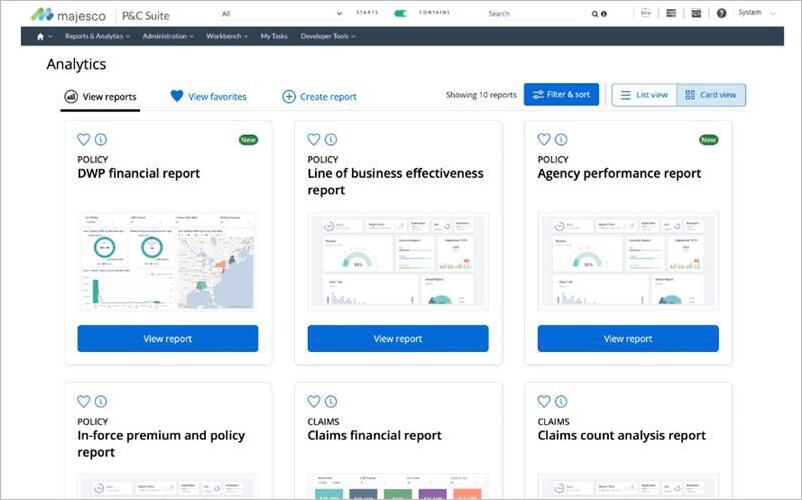
The Spring 2026 release added 13 AI agents across this portfolio. They assist with multi-step quoting, service, billing and claims work; validate bills and reconcile payments; support claim reopening; extract information from documents; and help with compliance tasks. Majesco also advertises a guided policy write-off that takes under 30 seconds, compared with three to five minutes in a traditional interface. The distinction is important: the AI is embedded beside a defined transaction. It is not a general chatbot asked to invent insurance procedure.
An acquisition map disguised as an org chart
Majesco's post-buyout deals make more sense when arranged by the insurance work they added. Utilant brought loss-control surveys, premium audit, property data and more than 87 customers in 2021. Global IQX added sales, enrollment and an underwriting workbench for life and health in 2022. Decision Research Corporation brought enterprise rating, reinsurance and an MGA-oriented core in 2024. Vitech added V3locity for pensions, retirement and group benefits in 2026.
Loss control, premium audit and property intelligence.
Sales, enrollment and underwriting workflows.
Enterprise rating, reinsurance and MGA core.
Pensions, retirement and group benefits.
This is the company's clearest difference from a narrow point solution. Following Vitech, Majesco says it is the only core provider spanning property and casualty, life and health, and pension and retirement on its cloud-native, AI-native architecture. The deal lifted the reported customer count above 375 and the combined company's annual revenue to roughly $500 million. It also made CVC Funds, Vitech's former owner, a minority investor.
Breadth does not remove competition. Guidewire is the enterprise benchmark in many P&C searches. Duck Creek, Sapiens, Insurity, OneShield, Origami Risk, EIS, Socotra, Salesforce and internal systems all appear in buyer comparisons. Majesco's case rests on insurance-specific content, configurable cloud deployment and the ability to start with a module or connect more of the operation. The tradeoff is familiar: a broad platform can reduce integration seams, but it also increases the importance of implementation governance.
What failed first
The failure Majesco is selling against is not one famous outage. It is the old modernization program: years of customization, an on-premises installation, an upgrade treated like another transformation and a bill that can reach tens or hundreds of millions of dollars. Insurers tolerated that model because their products were complicated and their tolerance for operational risk was low. Eventually the system meant to reduce risk became a strategic risk itself. Launching a product took too long. Customer data sat in silos. Experienced employees retired with process knowledge still trapped in screens and workarounds.
What changed minds was not cloud fashion alone. It was the operating pain of keeping old cores relevant while digital expectations, climate risks, regulation and new distribution models moved faster. Majesco's answer is preconfigured insurance content, APIs, microservices, regular SaaS releases and low-code tools that put more configuration in the hands of business and IT teams. Its fiscal 2025 report says 80 percent of customers were on current generally available versions and describes upgrades in ten days or less for its intelligent cores. Those are vendor-reported figures, but they point at the correct bottleneck: adoption, not invention.
When the playbook will not work
Do not buy a platform to avoid making operating decisions. If every historical exception must survive, configuration becomes custom code wearing a name tag.
Do not automate dirty handoffs. AI agents need reliable data, explicit permissions, auditable decisions and owners who understand the workflow.
Do not confuse modular with small. Even a phased core replacement needs integration capacity, testing, regulatory review, change management and executive attention.
The part readers can copy
Few companies can copy Majesco's capital, customer base or four decades of insurance detail. The sequence is more portable. First, pick a recurring workflow where the system of record already holds permissioned data. Second, standardize enough of that workflow to release updates without reopening every implementation decision. Third, place assistance inside the transaction rather than in a separate AI destination. Fourth, measure adoption in completed work: faster quotes, fewer billing touches, cleaner claims, shorter upgrades and more products launched.
Own the record
Automation is strongest when it can see the governed policy, bill or claim.
Constrain the task
Give an agent a bounded transaction, rules and an auditable exit.
Ship the upgrade path
A feature trapped behind a multi-year upgrade has no practical adoption.
Count business motion
Track go-lives, retention, cross-sells and cycle time, not demo applause.
Majesco's 2026 form is a product of that sequence. It has the core records, expanded the adjacent workflows, moved nearly all customers to cloud delivery and now inserts agents into repeatable work. The company still has to prove that its latest agents create durable savings outside product demonstrations. It must also integrate Vitech while keeping P&C customers convinced that expansion has not diluted investment in their market. Majesco answered that concern with a fresh P&C investment push and another release, which is the enterprise-software equivalent of showing your work.
The result is not a consumer story pretending to be simple. It is a systems story that becomes interesting precisely because the system is difficult. When an insurer can launch a product sooner, settle a claim with fewer handoffs or update software without a new archaeology project, the customer rarely knows Majesco was involved. For back-office infrastructure, invisibility is often the compliment.